Answering the Bog: An Experimental Ethnography of Imšara
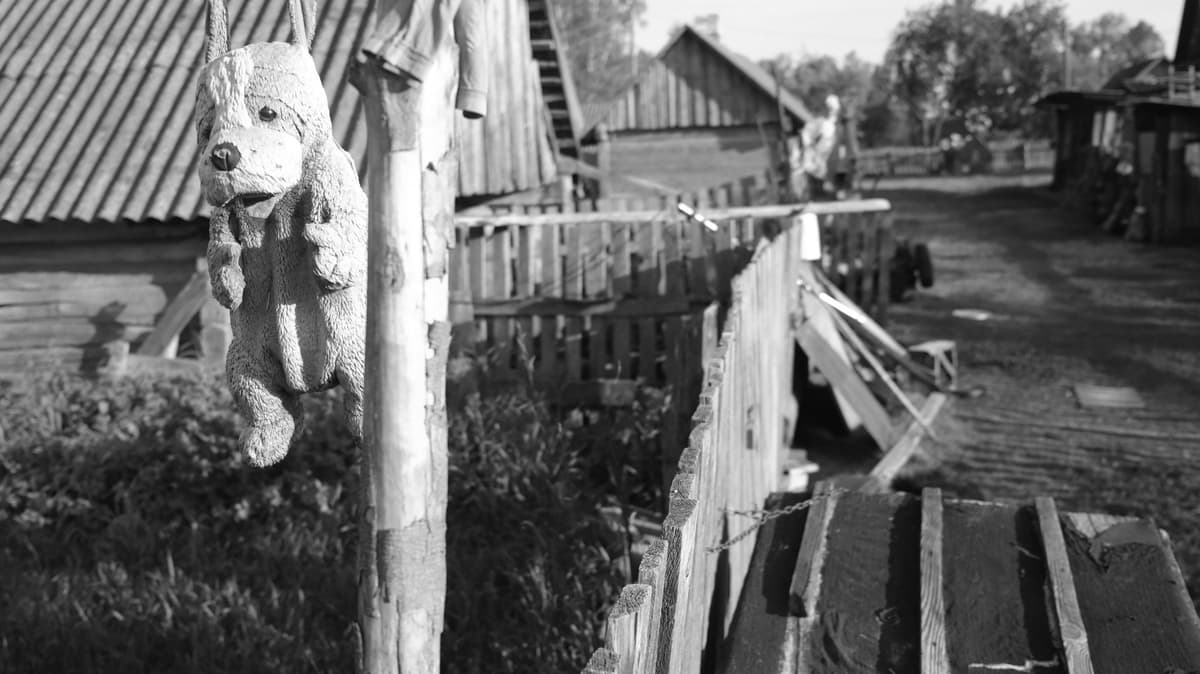
For a year, Anton Anishchanka recorded four Belarusian bogs, one per season, with a visual artist, a folklorist, a biologist, and a filmmaker. On his album Imšara, musicians answer a woodpecker and a chorus of toads instead of accompanying them. He describes where documenting ended and composing began.
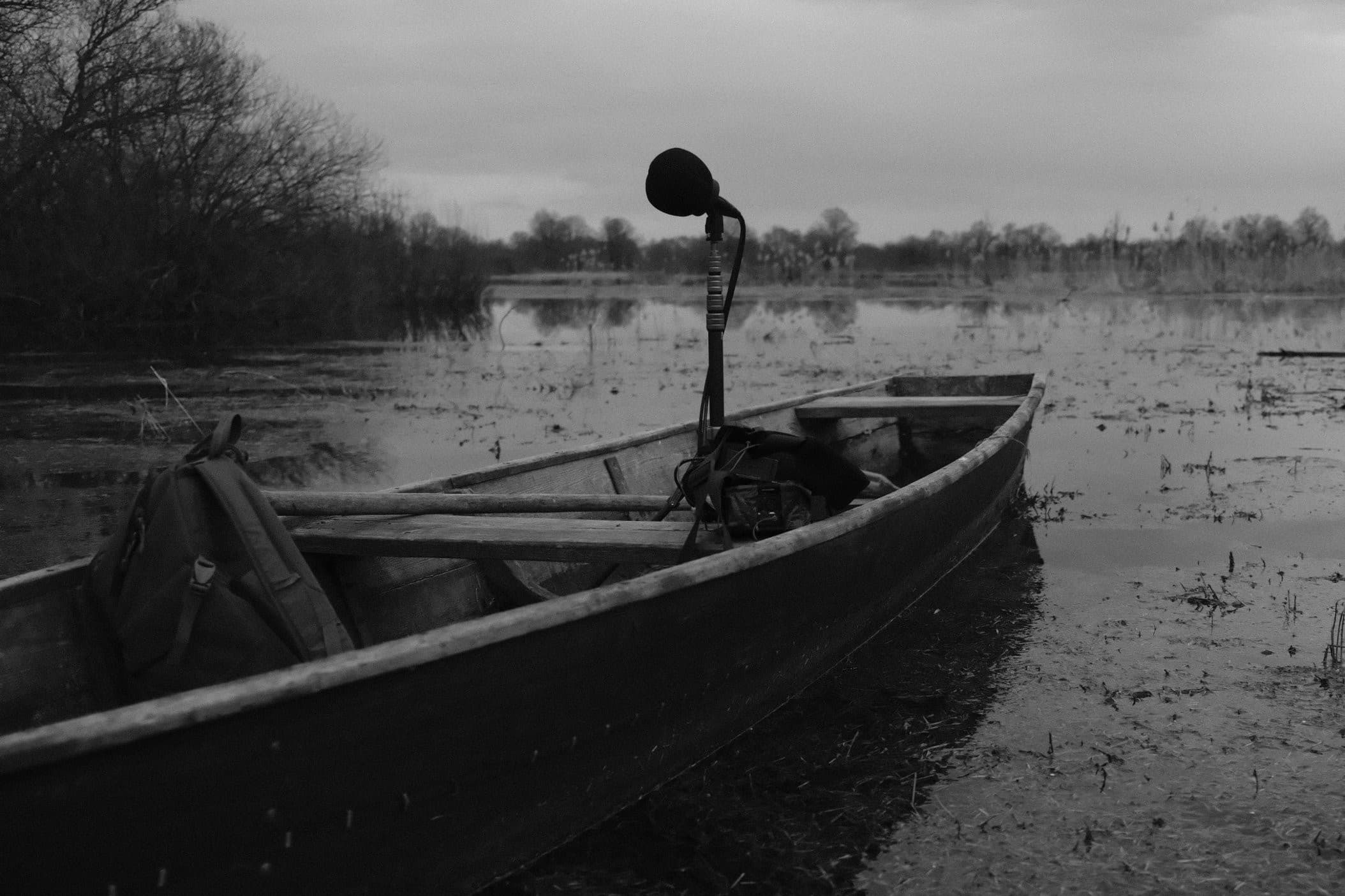
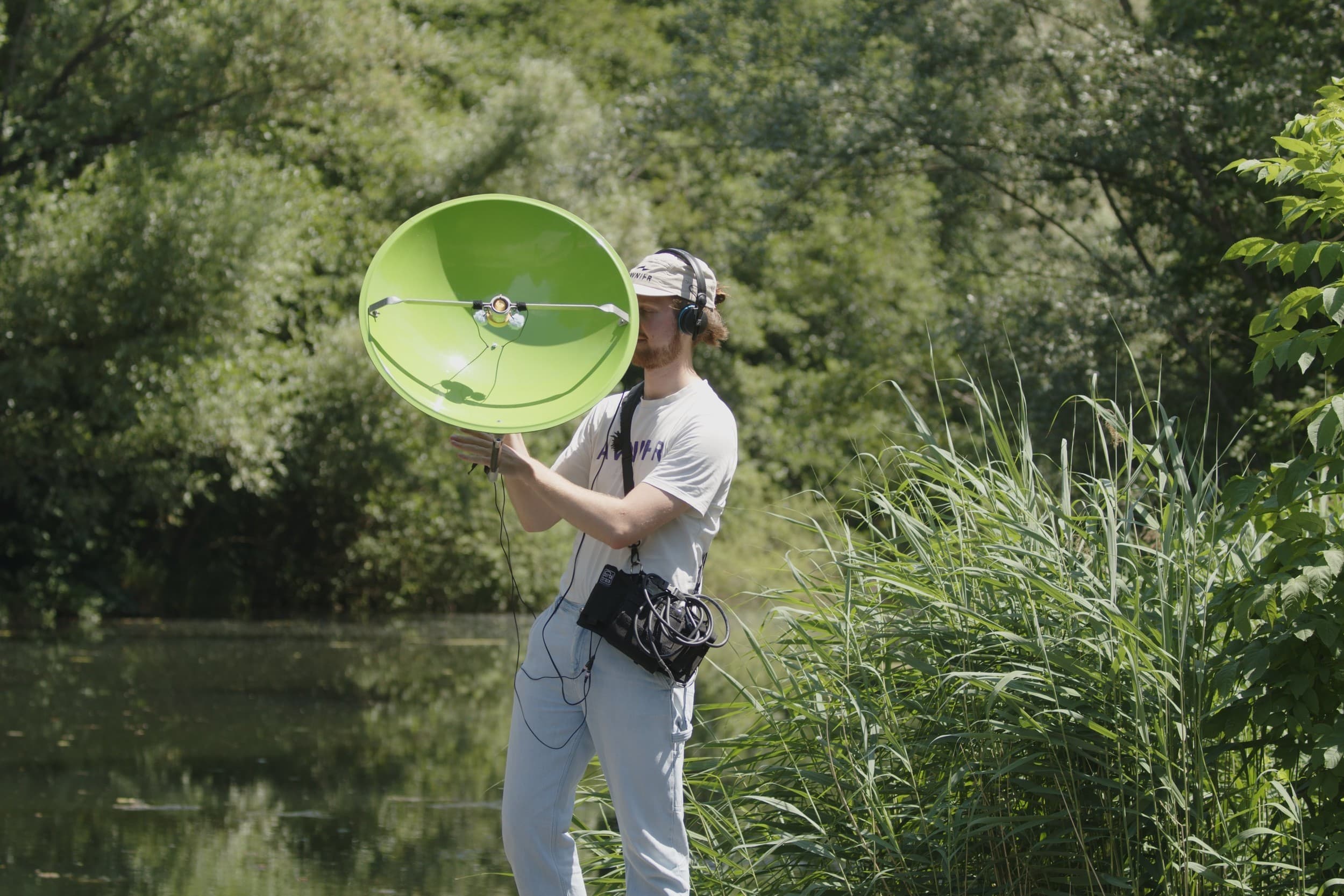
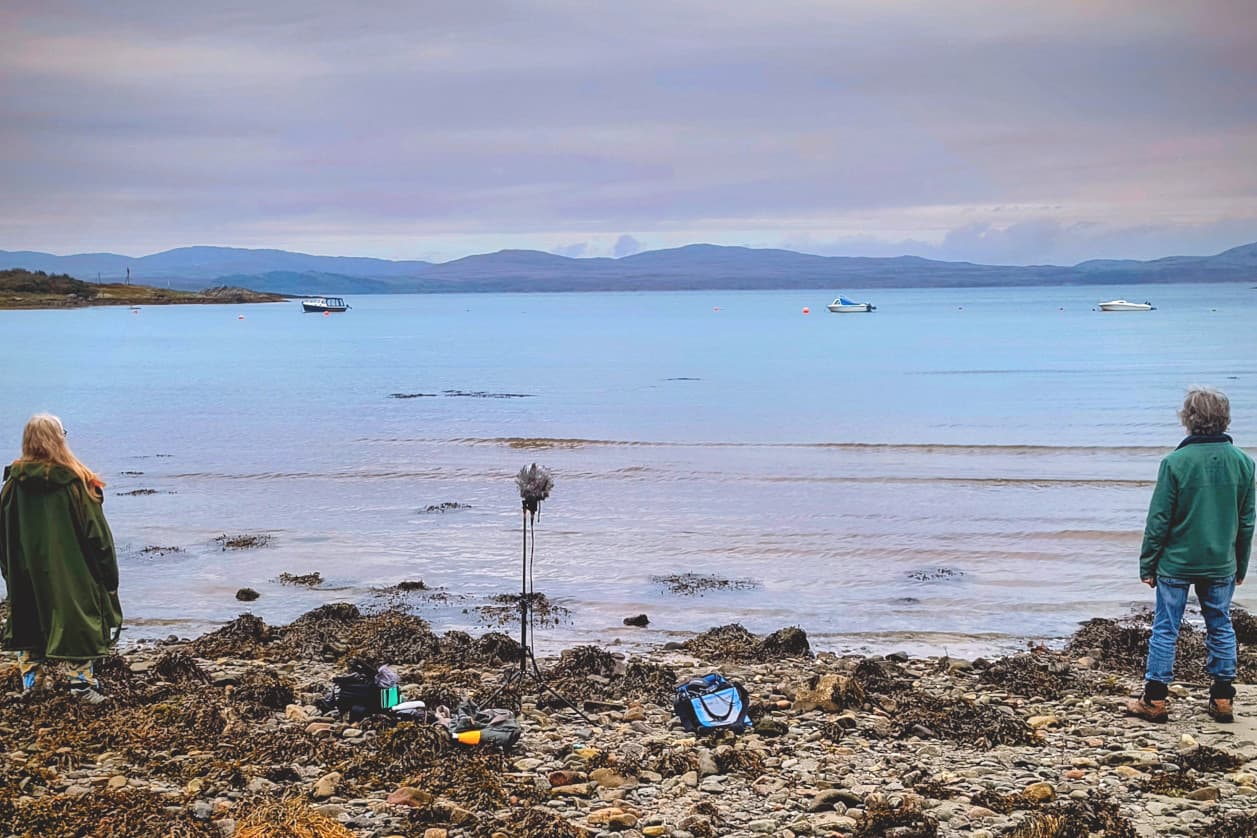
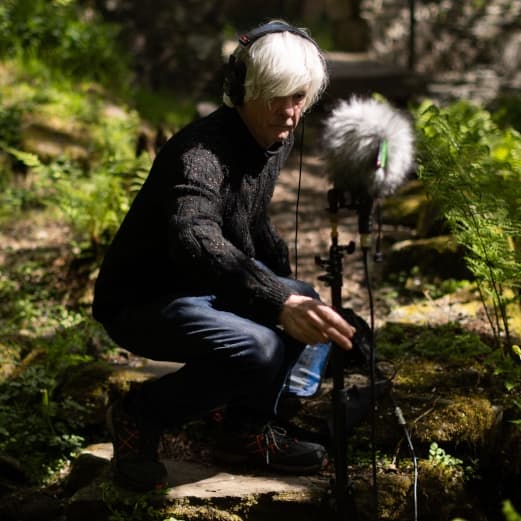
Field recording from a boat, Imšara expedition, Belarus, 2025–2026
In the Palessie village of Mardvin, Nadzeya Hota told us about a voice that calls from the bog at noon. You never see who is calling. “When the sun is already at midday,” she said, “there’s something that calls out, like someone shouting. You mustn’t call back. Only at noon.” Once, picking berries with a friend, she forgot the rule. Oŭ! — and from the bog came back Oŭ! She called again, and it answered once more, closer each time, “closer, closer, good people—and then it started rocking the tops of the forest.” Her hair stood on end. “I’ll never forget that oŭ.”
I’ve thought about her story a lot since spring, because the album I spent the last year making is built on the opposite instruction. Imšara is a record of musicians answering the bog and the territories that surround it: improvising with a woodpecker, a pond of fire-bellied toads, and geese leaving in November. The village tradition knows very well that the bog speaks. It also knows that answering is not innocent. There are rules for when you may answer, how, and what you must leave alone. This text is about the album and about the method behind it. But the method only makes sense next to the knowledge of the people who live beside these bogs, so I’ll keep letting their voices interrupt mine, the way they interrupted the plan.
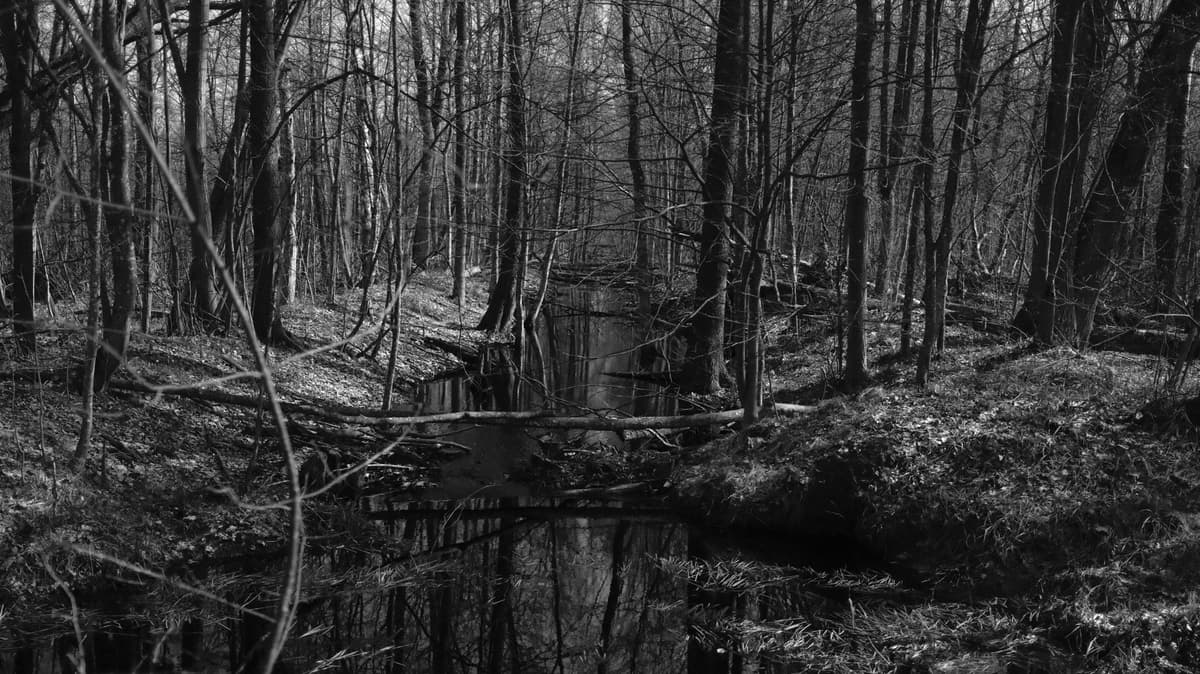
Stream in a bog forest, Imšara expedition, Belarus, 2025–2026
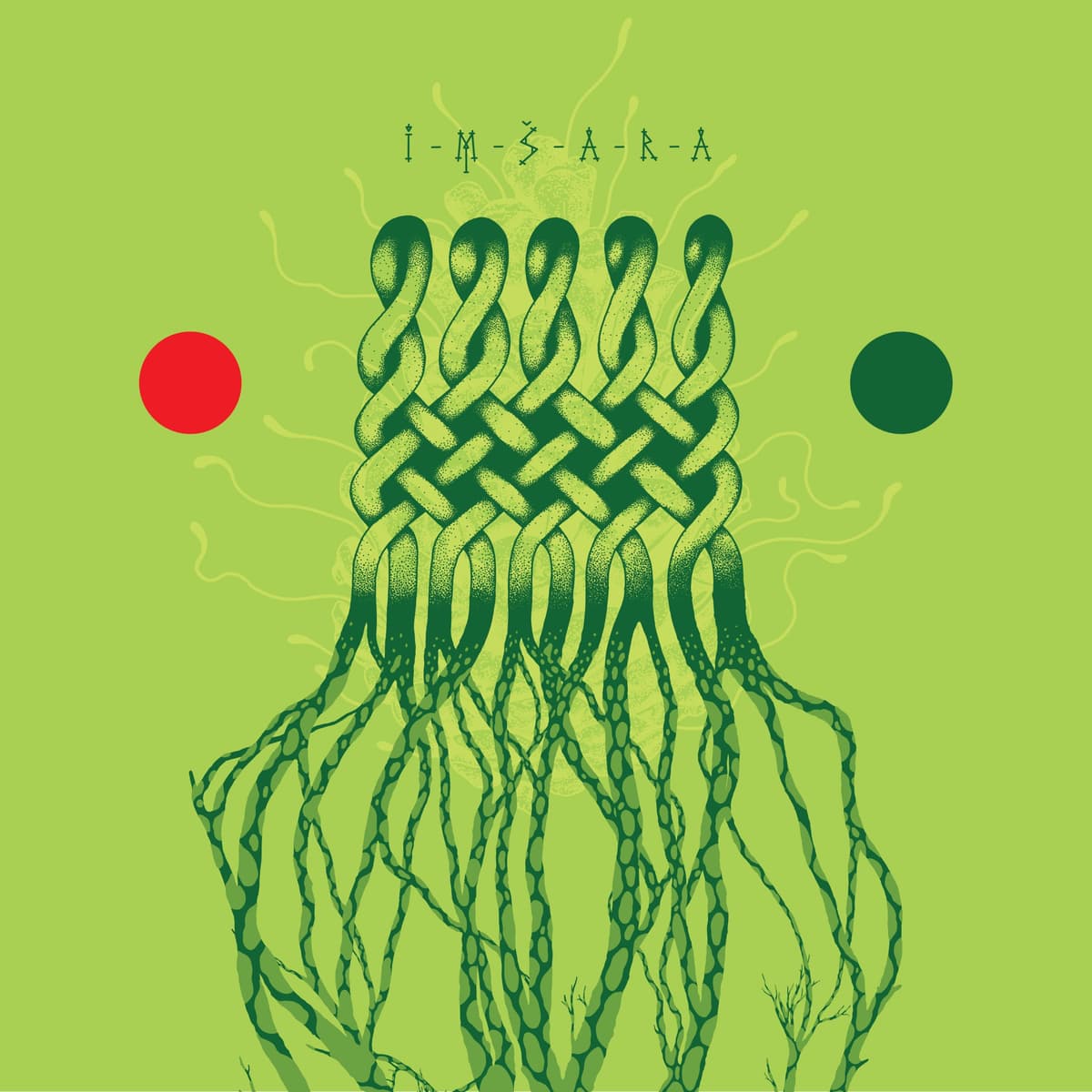
Imšara is the sound part of a multidisciplinary project: four expeditions to four Belarusian bogs, one per season, from November 2025 to June 2026. It came out on vinyl on the Shatkavalka label.
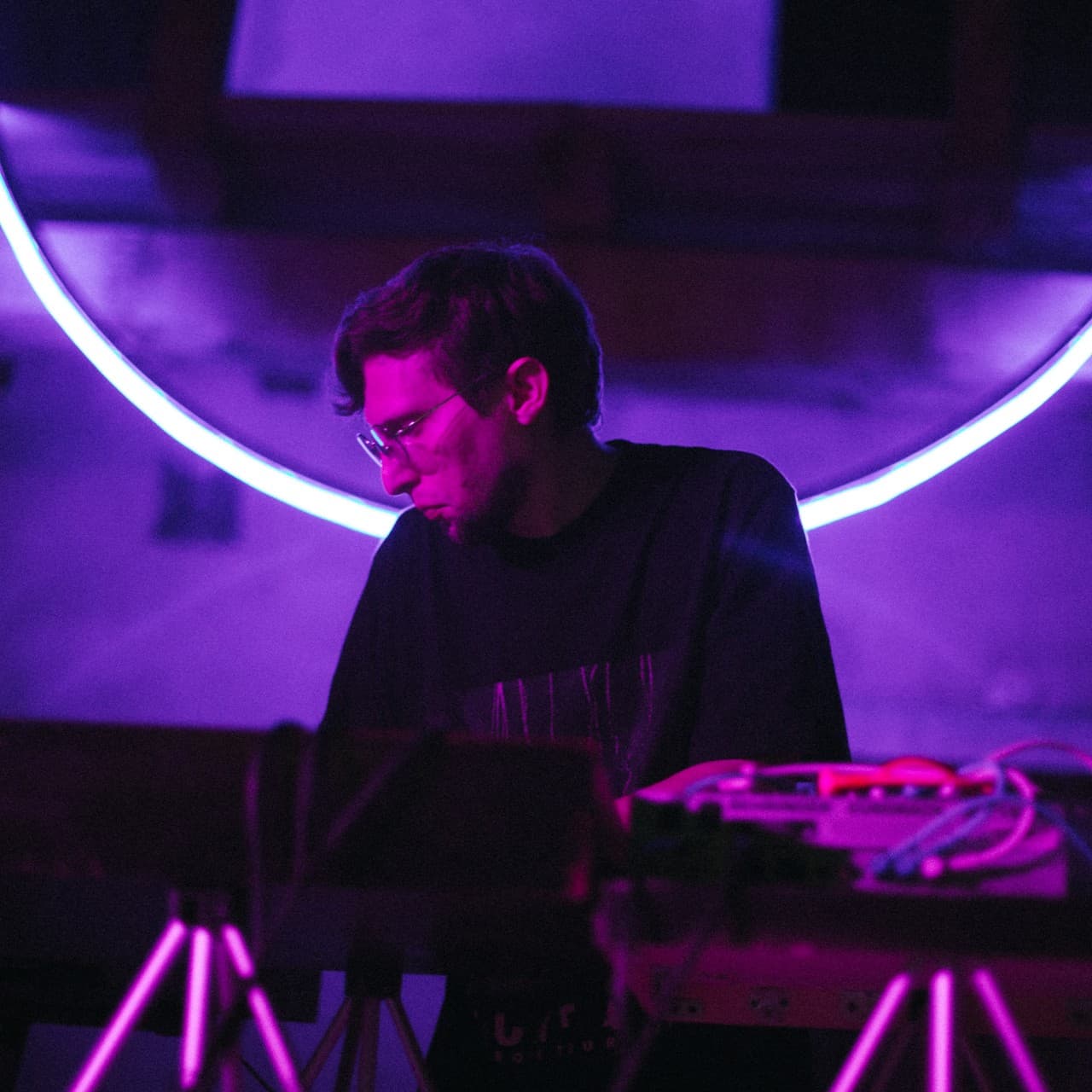
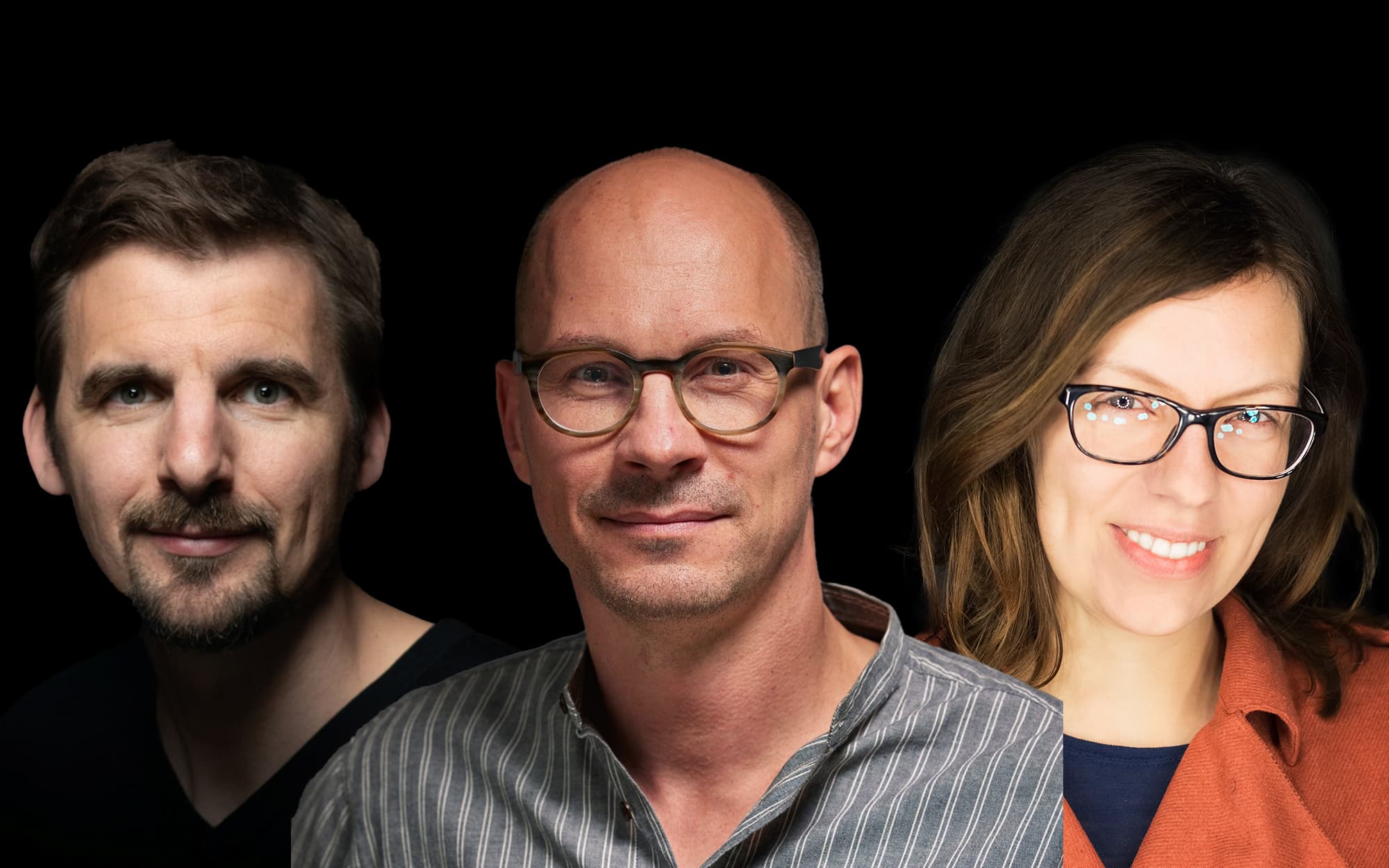
The team was a small group with very different ways of paying attention. Bazinato is a visual artist and researcher.
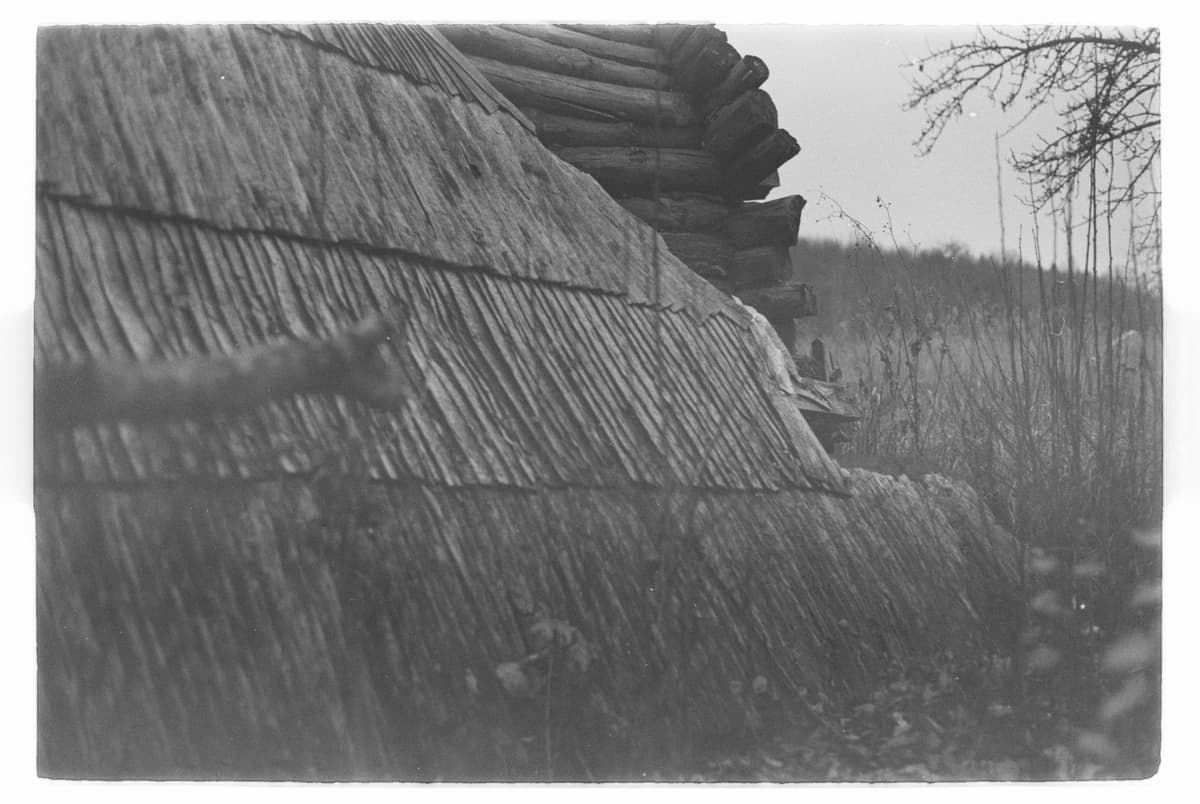
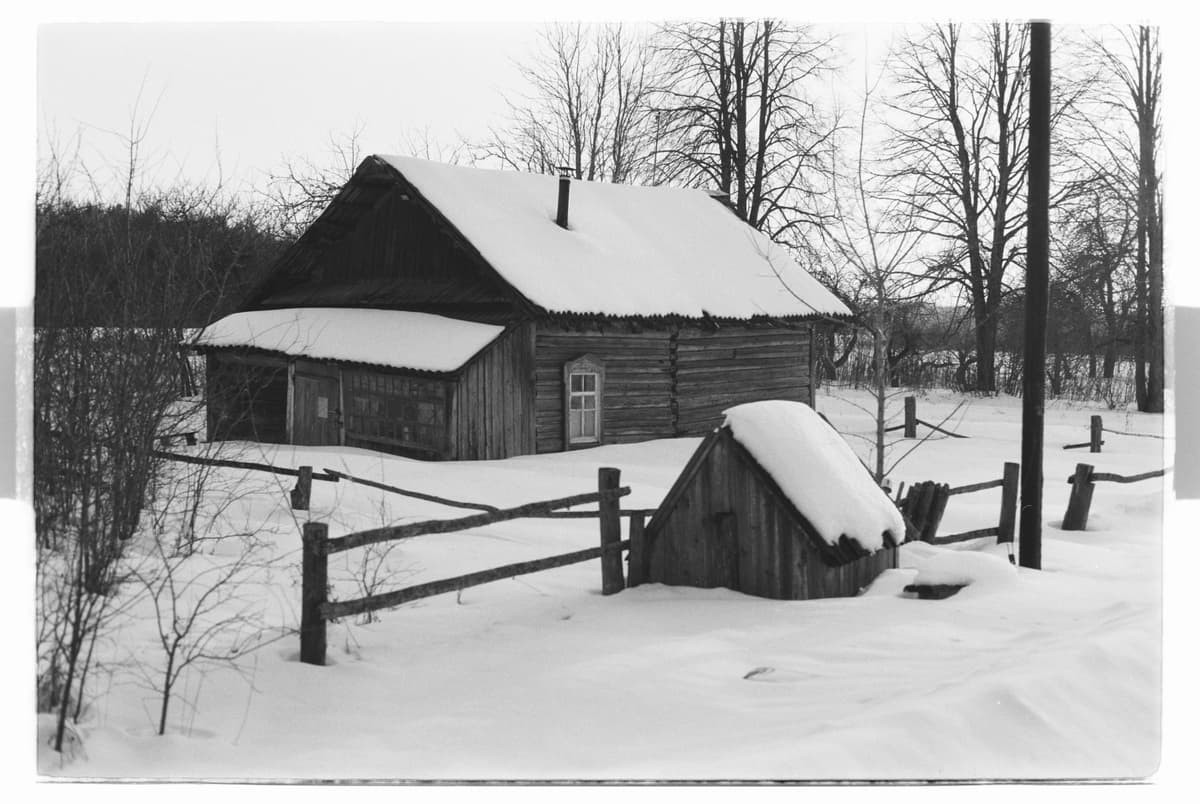
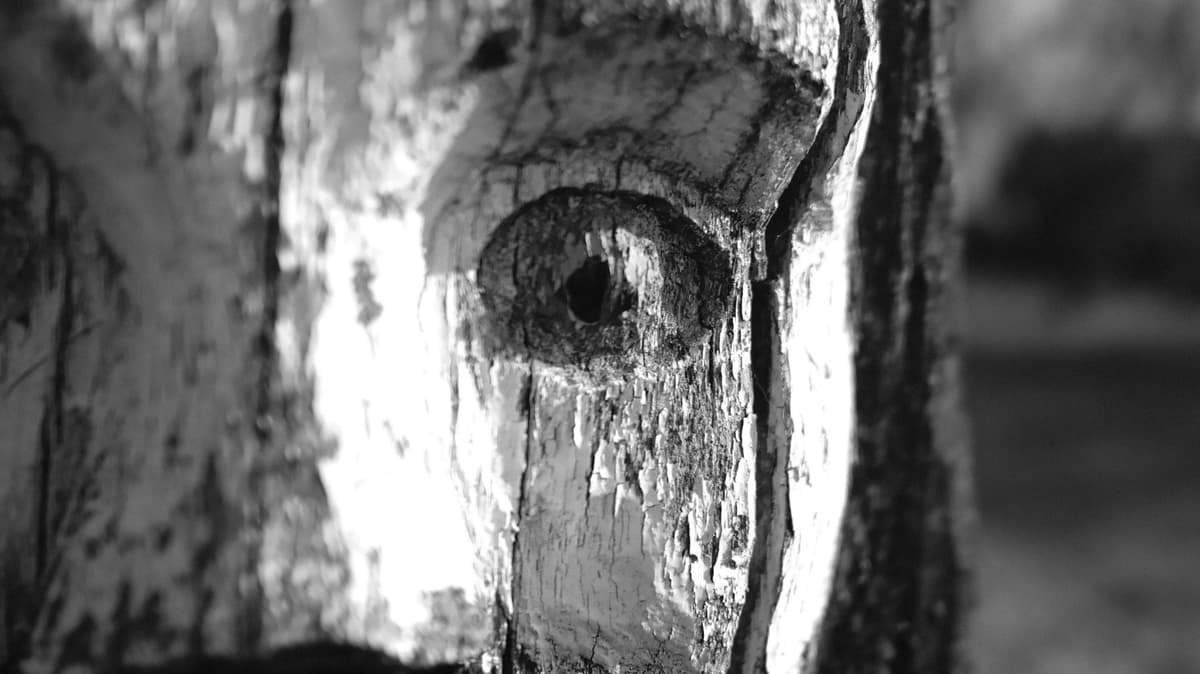
Shingle roof of a log house, Imšara expedition, Belarus, 2025–2026
Tatsiana Valodzina is a folklorist and anthropologist. Alesia Kruchonak is a biologist. Alaksiej Piskun is a videographer and amateur ethnographer. I’m the electroacoustic musician and field recordist. A lot of what follows comes from Tatsiana’s chapter in the book, “From Swamps to The Swamp.” It’s an ethnography of the bog built on the recordings we made together, and reading it back, I kept finding my own process in it.
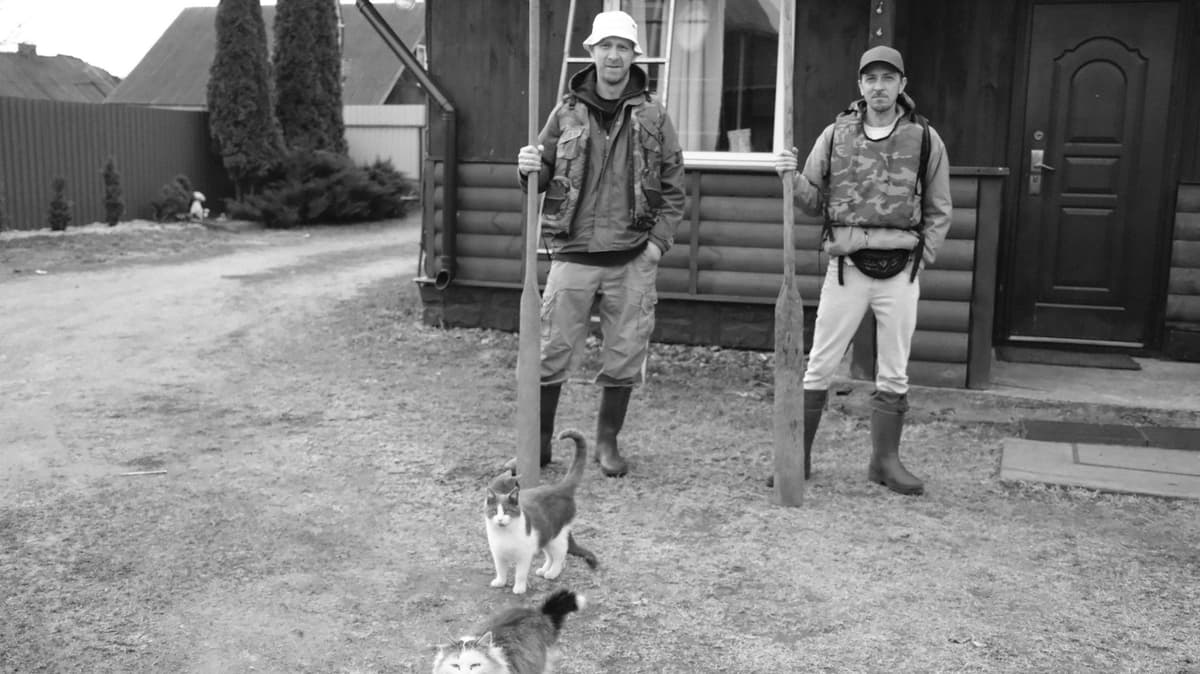
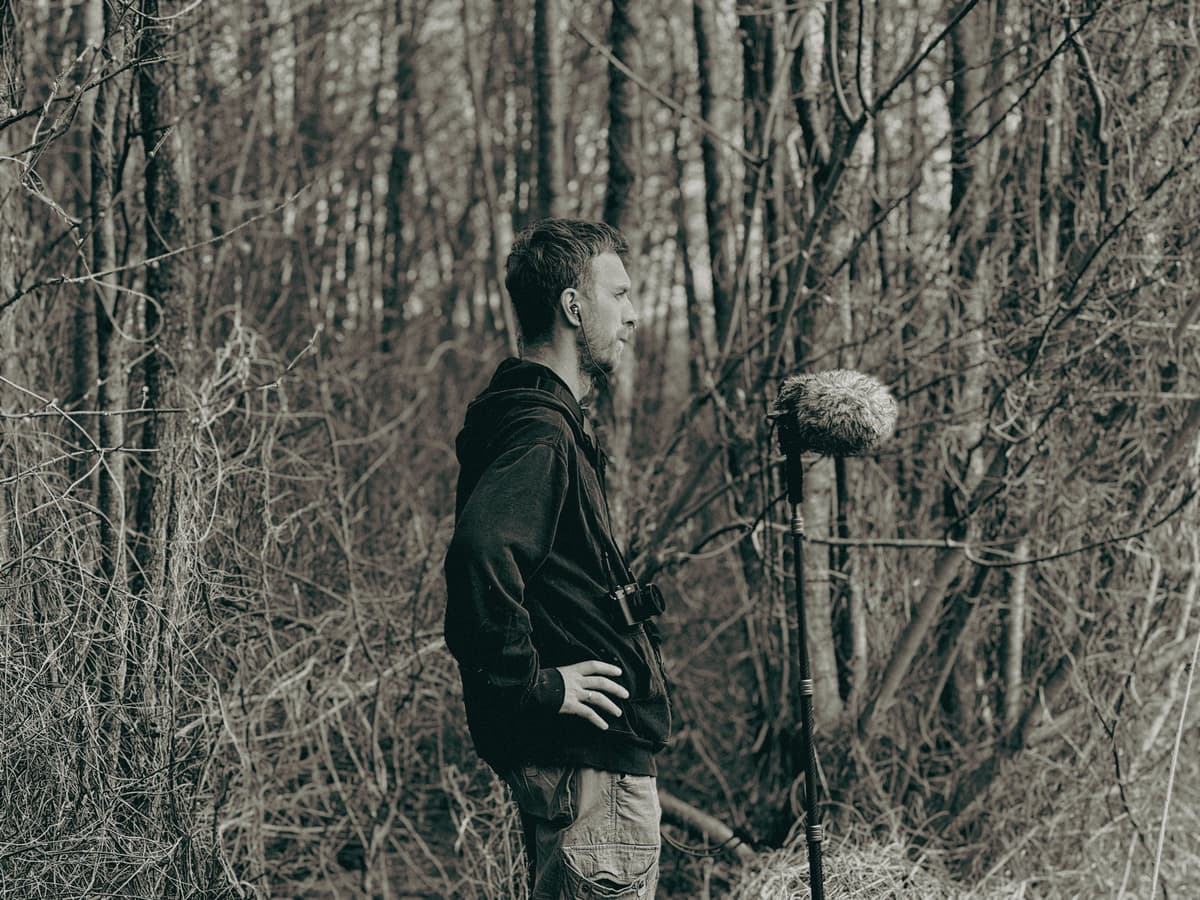
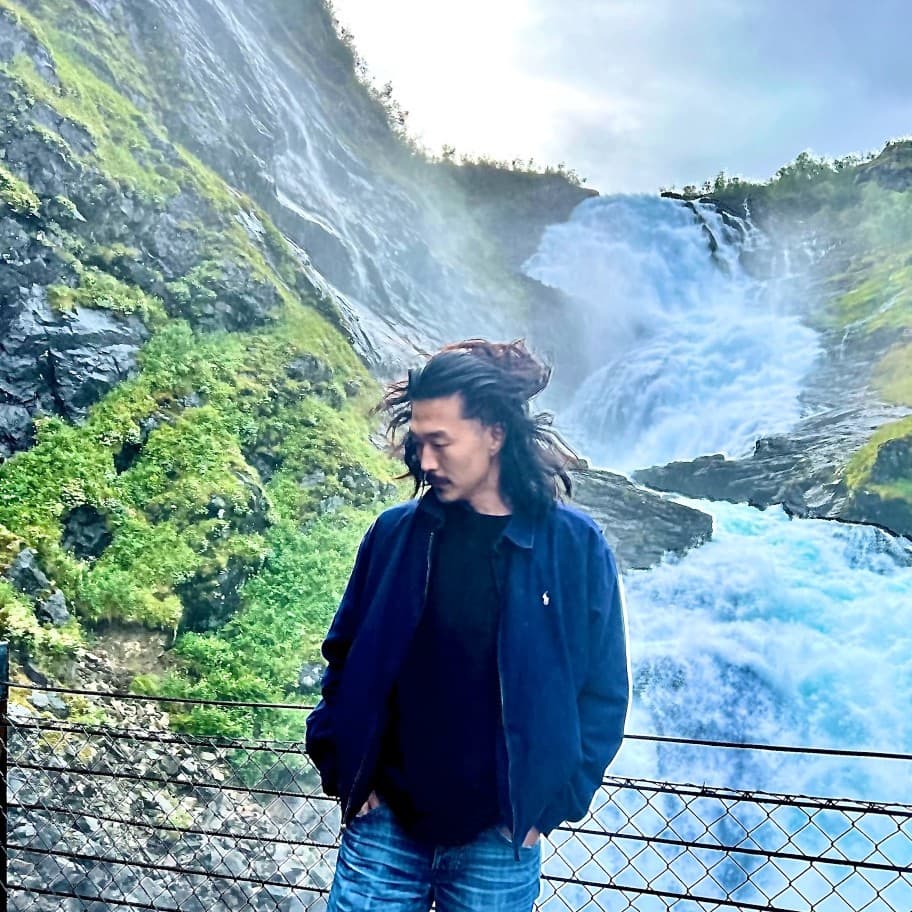
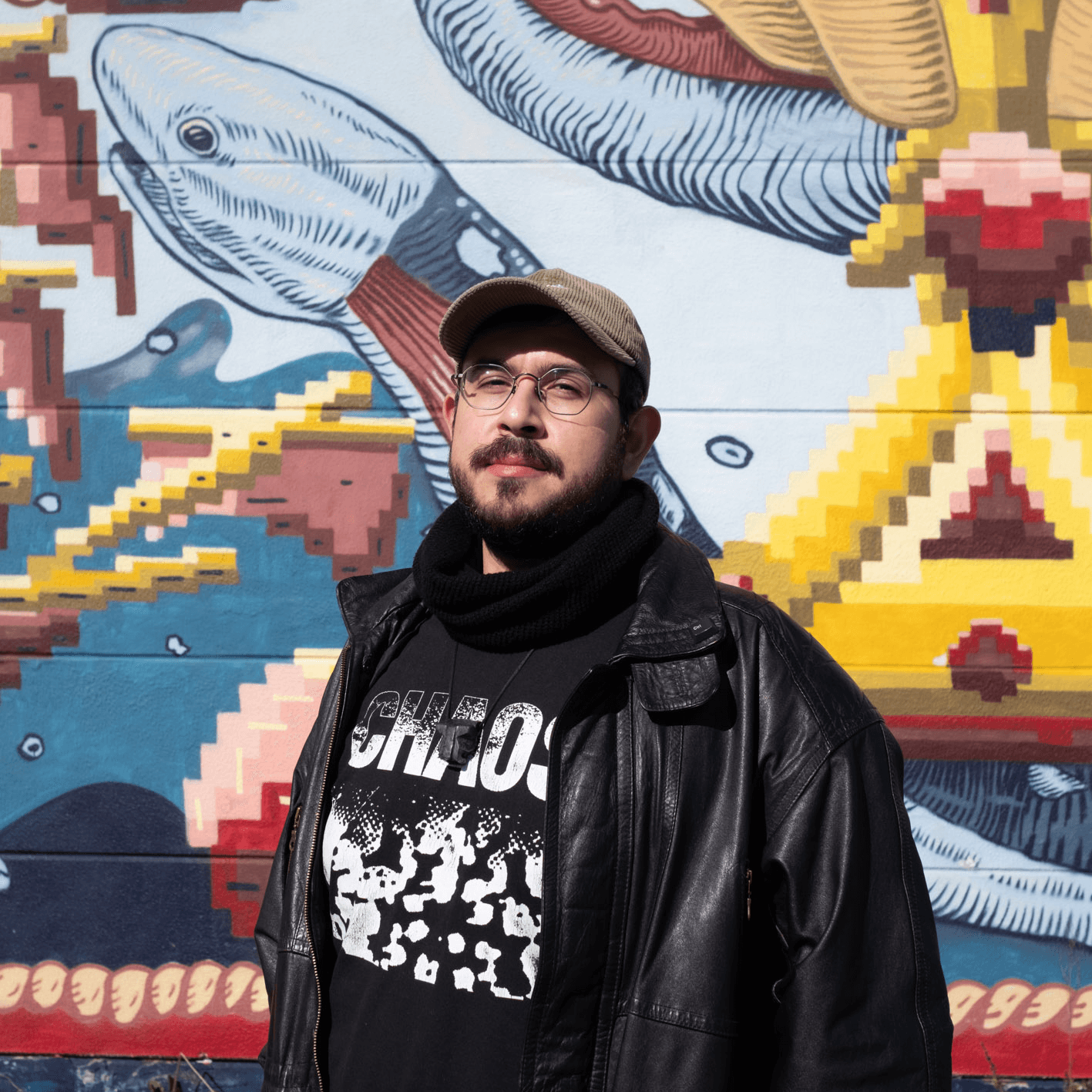
A. Anishchanka left and Bazinato right, Palessie expedition
What were we looking for?
Tatsiana’s chapter starts with a question I didn’t dare to ask myself so directly. What were we trying to find? What ideas did we want to confirm in the musings of the “people of the marshes”? Was it romantic longing for a golden past and its folk wisdom? Was it a sober concern for nature? Or an eco-nationalism we hadn’t yet reflected on?
Further on, she turns on the whole enterprise. The educated city people of the 19th century discovered the peasant and saw great wisdom in his poetry. We, she writes, intellectuals worn out by quarrels with artificial intelligence, run off to nature and find the same eternal harmony: neruš, untouched land, and Atlantis. The forest spirits and house spirits of the old mythologists are replaced by fashionable “more-than-human agents.” The romance stays the same.
I want to keep that warning in front of everything else here. An album “in co-authorship with nature and local people who live around” could easily be exactly that: a new costume on an old romance. The only protection I found was to stay close to the material and to the people and to let them contradict me.
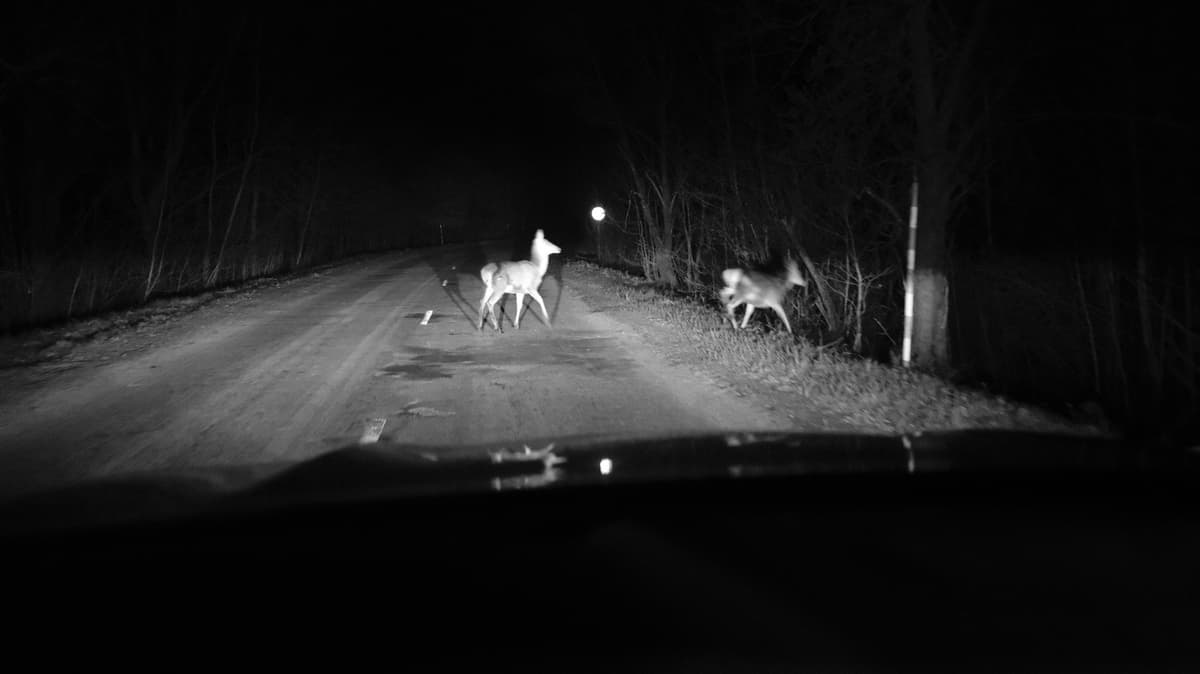
Deer on a road at night, Imšara expedition, Belarus, 2025–2026
Before the plan
The project’s short version is four seasons, four bogs. The real start was earlier. From 2023 I went on solo trips across Belarus to nature reserves, making field recordings and photographs. Each time someone local came with me: an ornithologist, a gamekeeper, or simply a person who knew the ground. I noticed that with a gamekeeper or a villager, I started watching the person as part of the environment. These people don’t have the gap with nature that city people have. In the Vyhanaščanskaje marshes, the gamekeeper Aliaksandr told me about wild rosemary, Ledum, which many consider poisonous. He chews it instead of gum. Great for your breath, he said.
Later, in Tatsiana’s material, I found the same plant from many sides. Locally it’s called bahun or bahno. It’s the most-mentioned bog herb in the whole country. People brew it for bad coughs carefully, because “you can get dizzy from it.” They lay it against moths and mice. One plant can hold medicine, danger, household practice, and a gamekeeper’s joke at once. A microphone hears a man chewing. It doesn’t hear any of that.
So field sound alone started to feel too thin. A trip with the filmmaker Kirill Loukii and Bazinato to the Moch bog became the starting point for a proper art and research project, and a few months later we had the plan.
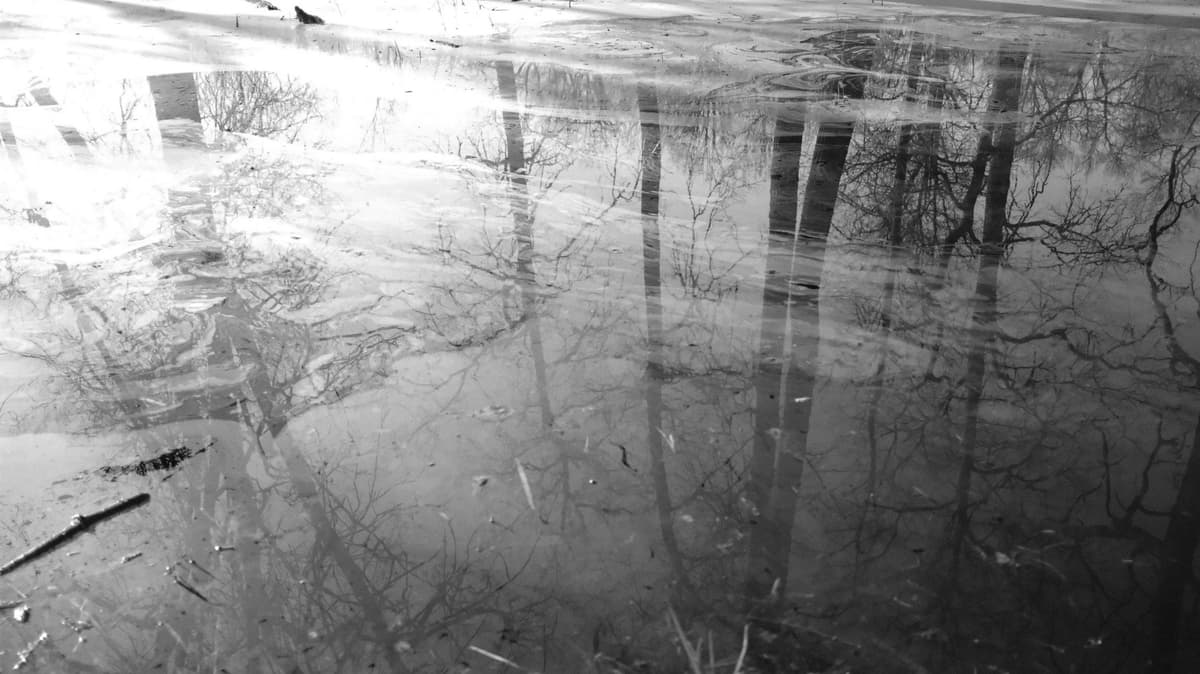
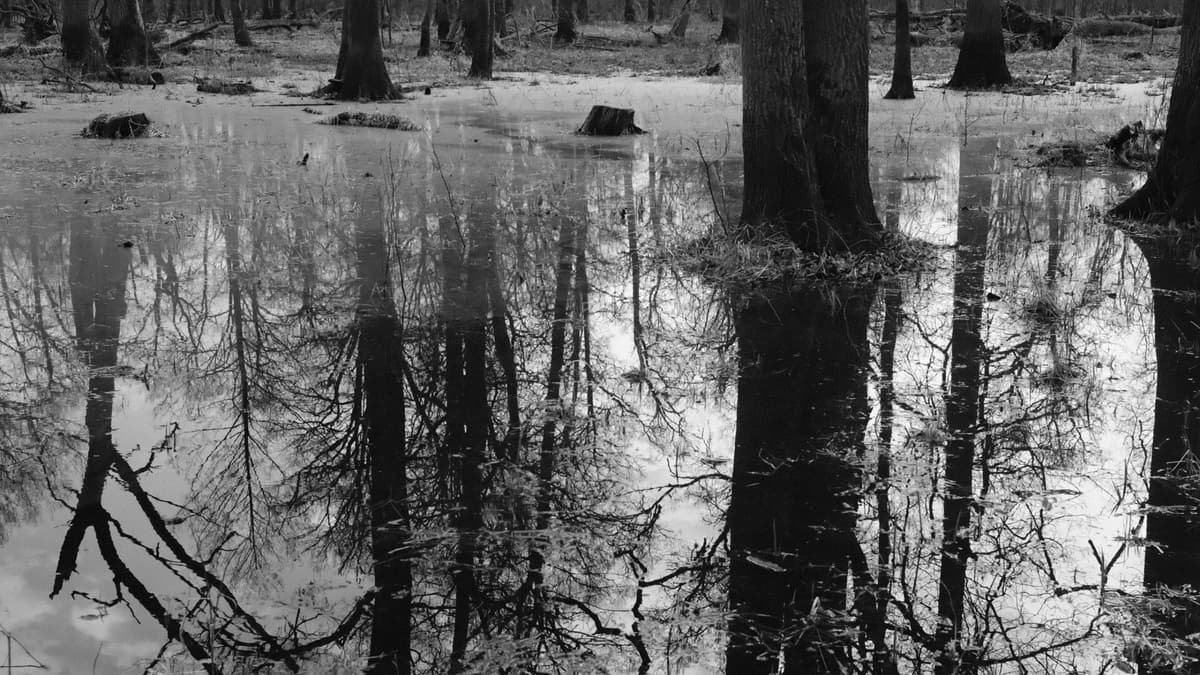
Trees reflected in bog water, Imšara expedition, Belarus, 2025–2026
Four seasons, four bogs
We didn’t record the same wetland four times. Each season took us to a different mire, and the route followed the year:
Autumn: the Yelnya mire complex, 6–9 and 18 November 2025.
Winter: the Duleby Islands, 27 February to 1 March 2026.
Spring: the Prypiać marshes, 1–5 April 2026.
Summer: the Vyhanaščanskaje mire complex, 4–7 June 2026.
So the method was two cycles laid over each other: the turning of the year and a walk across the country, north to east to south to west. Different dialects, histories, and kinds of bog. That matters more than it sounds, because “bog” is not one thing in the local languages. Tatsiana lists some of the names people use. Amšara: a mossy place, sometimes with bushes, trees, and a little lake. Adchlań: the black abyss of very deep springs in the mire. Žyravo: a quagmire where the spring sways. And my favorite, bubien. It means "drum" and it names a bog you can cross: soft, swaying, and bending as you walk. The ground itself has a word that is also an instrument. When I later asked drummers to play with these places, I took it as a kind of permission.
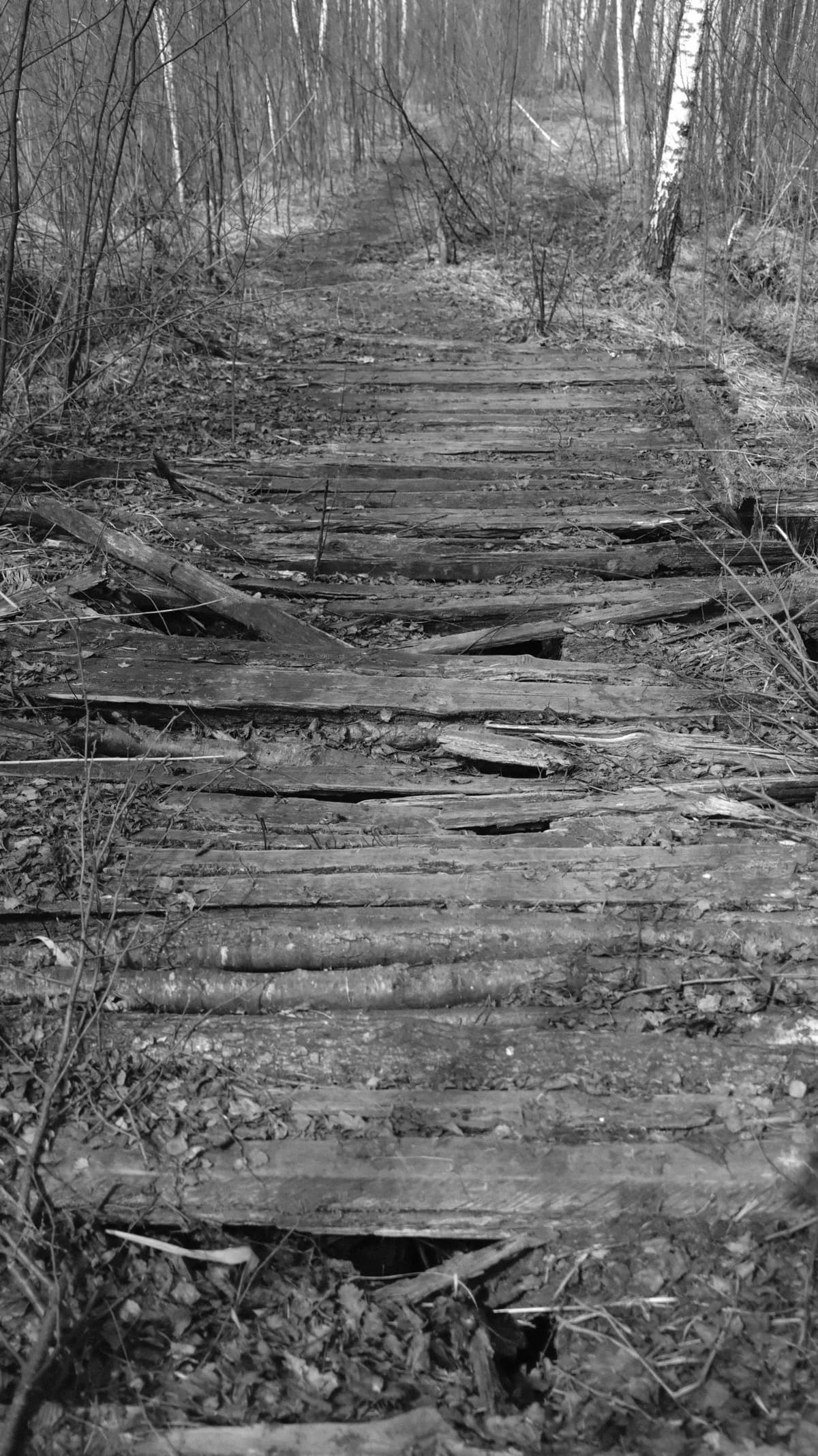
Old wooden boardwalk, Imšara expedition, Belarus, 2025–2026
The acoustics of the bad place
Silence turned out to be ethnographic material as much as acoustic material. In Tatsiana’s chapter there is a traditional zamova, a spell to send away the evil eye. It sends it “to the mosses, to the bogs, to the rusty quagmires, to the rotten logs”. And then it defines the place by what can’t be heard there: “where the sun doesn’t warm, where the winds don’t blow, where the roosters don’t crow and the geese don’t cry and the dogs don’t bark, and the birds don’t sing, and the beasts don’t run, and people don’t walk.” The bad bog of the spell is a place without a soundscape. Evil goes where nothing sounds.
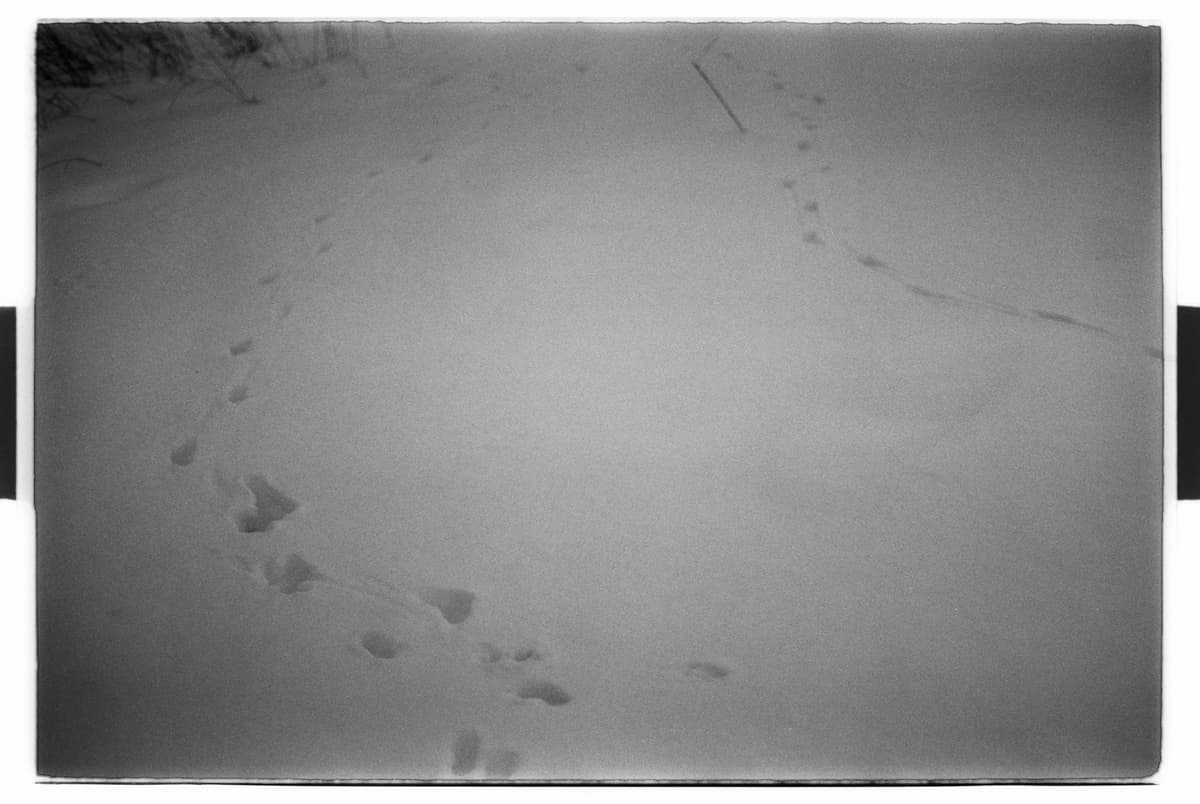
At Yelnya in November and at Duleby in late winter, I was recording something close to that place. In winter the snow was so deep we went out on skis. Alesia Kruchonak, our biologist, wrote that winter turns the bog into a manuscript on a white page. Tracks everywhere; animals are seldom seen. Sound worked the same way. A great spotted woodpecker at its winter “forge” in a dead pine, splitting cones, was one of the few clear rhythms in that muffled world. There’s a second story in Tatsiana’s material about getting lost, and it’s acoustic too. Kanstancin Uscinčyk grew up near Duleby. He went into the bog after mushrooms, turned for home, and couldn’t get out. “The roosters are crowing, the dogs are barking, and I can’t get out.” Three times he turned back toward the village and ended up in the bog again. Then he sat on a stone, swapped his footwraps from one foot to the other, as the old people told you to, and walked straight out into the field. The village was audible the whole time. Hearing it didn’t help.
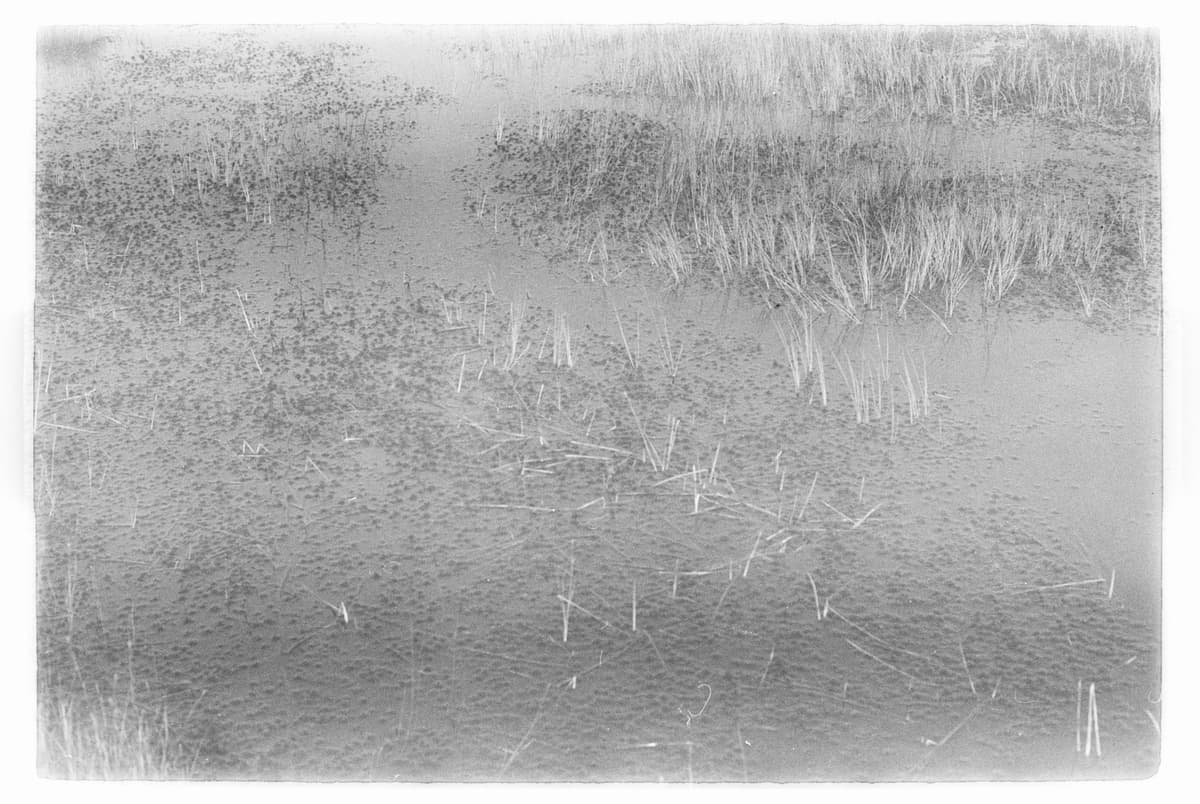
Reeds in icy water, Imšara expedition, Belarus, 2025–2026
That’s a precise description of the problem I had with my winter recordings. Everything I needed was audible, but I still had no way out of the material.
A year without a form
While we travelled, I couldn’t answer even simple questions about the album’s shape. Should it be seasonal at all? Was music even needed, or should the marshes speak for themselves?
On the autumn trip I recorded the electrical impulses of plants, thinking I’d make melodies from them. That never happened. I did know that I wanted nature to be not a setting but a full co-author, and I invited my friend, the composer Maksim Kruhly, to think about what that could mean. Mostly we talked and listened. The archive grew, and I still didn’t know what we’d do with it.
The bog nightingale
Spring in Palessie turned everything over. In a few days I saw more wild animals than in my whole life: wolves, moose, deer. But the place that took me completely wasn’t wilderness. It was a small pond in a gas pipeline clearing on the road between Chlupinskaja Buda and Sniadzin.
On 3 April, at 14:41, a chorus of fire-bellied toads was building one of the most complex acoustic structures I’ve ever heard. Each animal repeats a soft, bell-like call at its own interval. The calls slide in and out of phase, line up for a moment, and fall apart again. I heard it as minimalism, Terry Riley, or Steve Reich, except nobody wrote it, and it never repeats exactly.
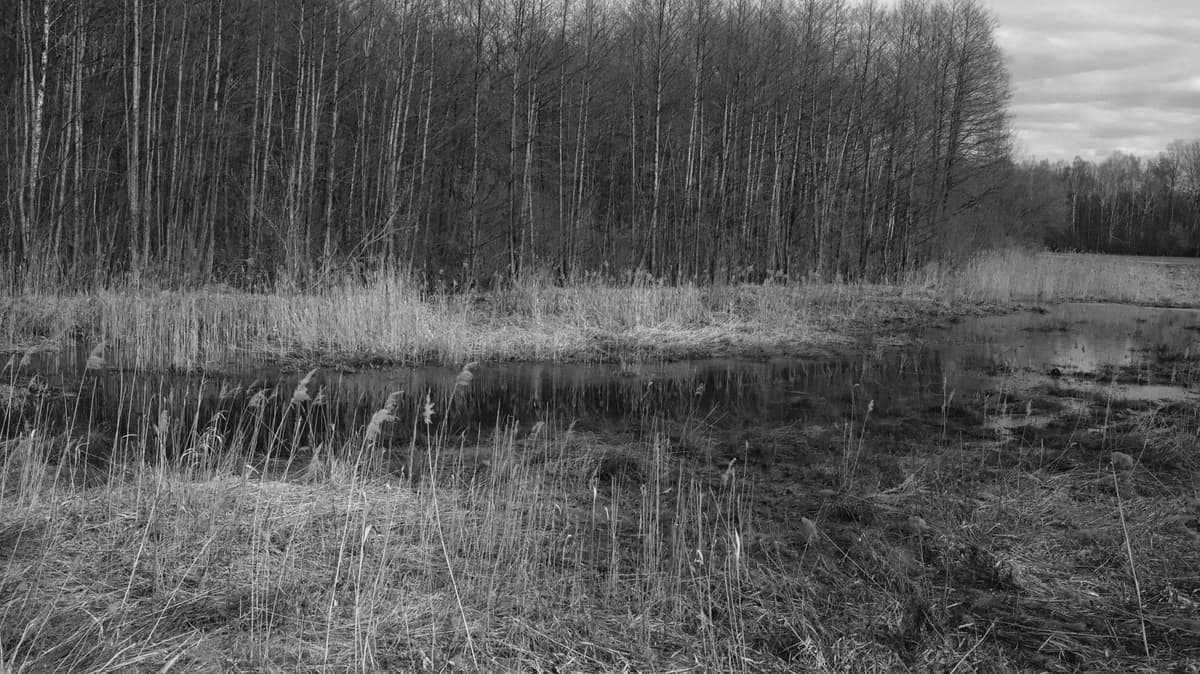
Reeds and water at the edge of a birch forest, Imšara expedition, Belarus, 2025–2026
Later I found out how the people around there hear frogs. They call them the bolotni solovej, the bog nightingale: “The nightingale starts, and they start too.” Maryja Strunieckaja told us frogs show you whether water is clean: “Frog goes into the water, drink the water; frog leaves the water, don’t drink it.” Tatsiana notes that, unlike almost every other bog creature, frogs were hardly mythologized. They live mostly in children’s rhymes. Mariya Damasevich from Sniadzin recited one for us: "A stork walks over the bog, calling the frog to work." The frog says, "I won’t go!" The stork says, "I'll drag you!" The frog says, "I'll smack your face!" The stork says, "I'll take you to court!
The chorus I heard as minimalism is, locally, a nightingale, a water test, and a joke about a lawsuit. None of these hearings cancels the others.
Answering, not accompanying
At some point I decided we simply had to start. I invited the drummer Ian Sapega and asked him to improvise with three recordings: the woodpecker from winter, the fire-bellied toads from Palessie, and geese leaving autumn Yelnya. After the session, Ian said he was completely drained.
That was the first real result, and his exhaustion explains the method better than I can.
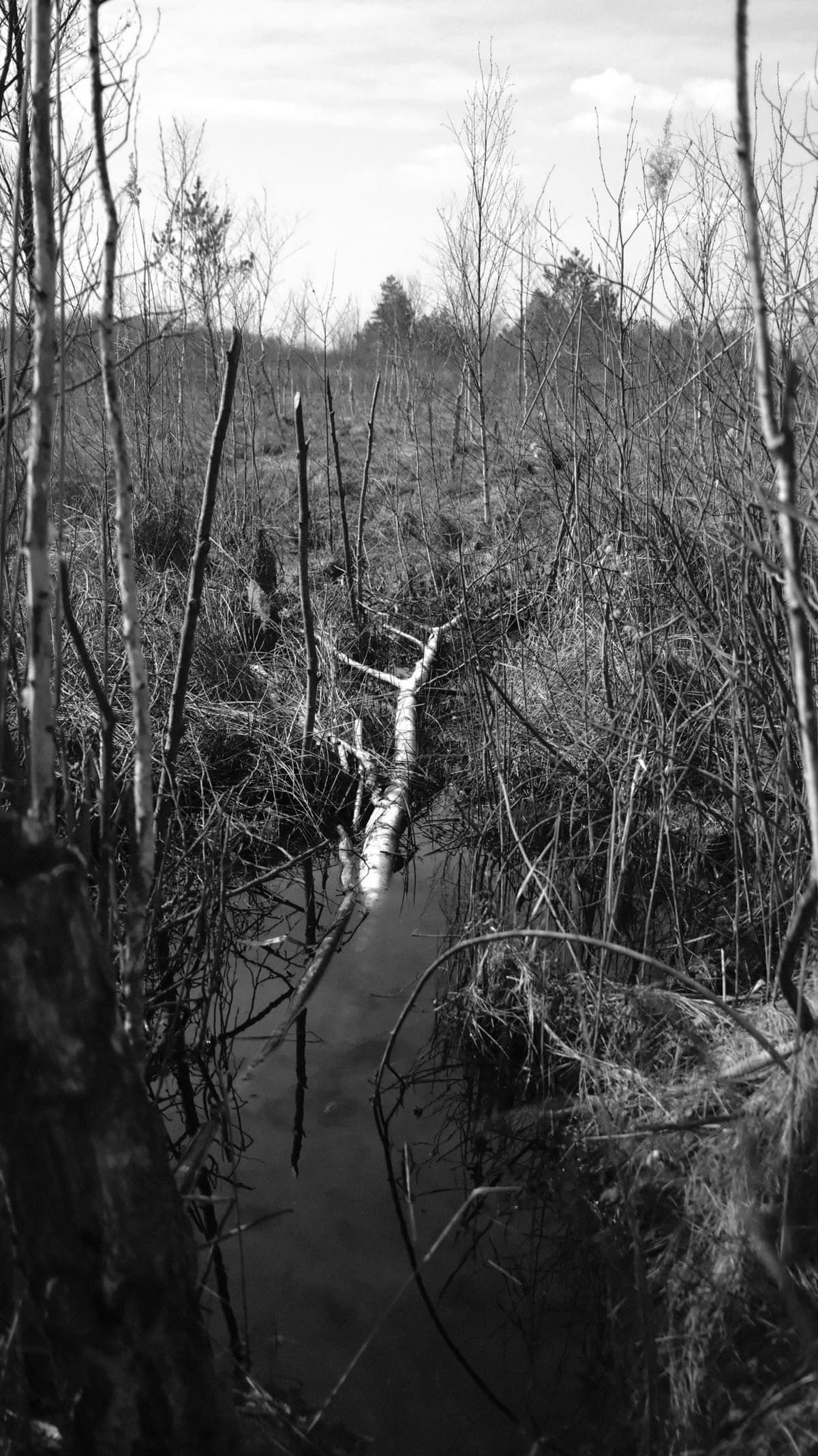
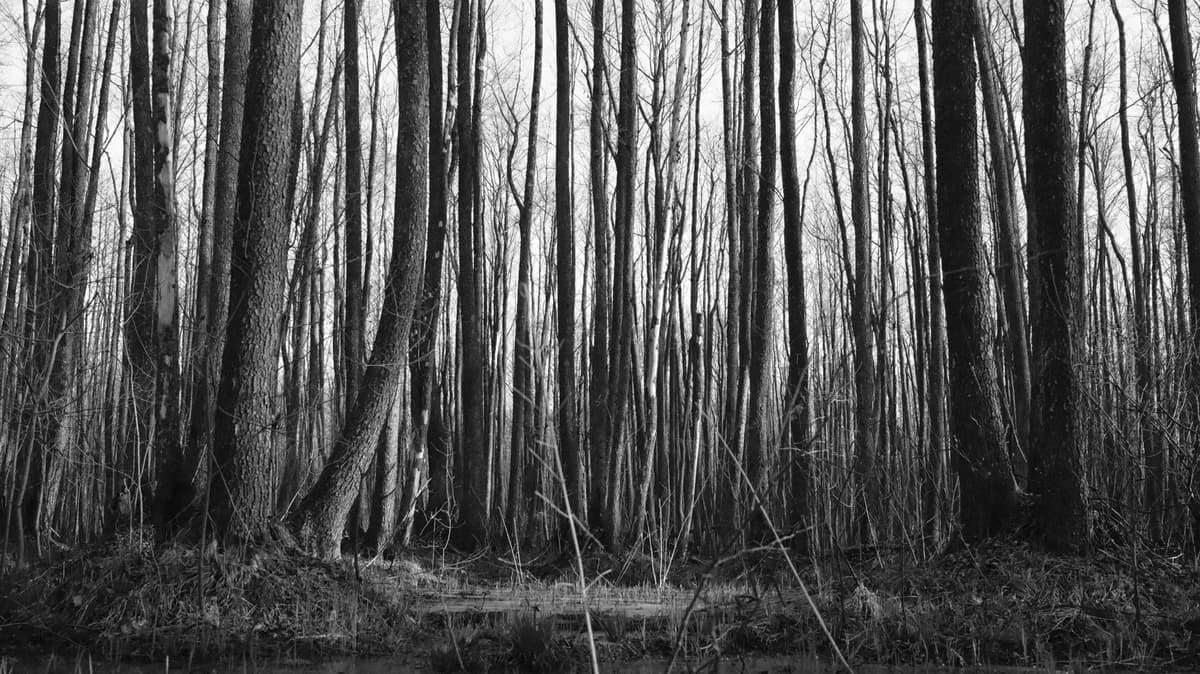
Fallen birch in a bog ditch, Imšara expedition, Belarus, 2025–2026
To accompany a field recording is to treat it as a bed. It sets the mood, you play over it, and it asks nothing of you. You could swap one pond for another, and the music would barely change. Bernie Krause, who has spent more than half a century recording wild soundscapes, describes something like this as the oldest musical relationship we have. Early humans, he says, used the sounds of the forest or the desert “as a natural karaoke orchestra with which we performed. In other words we used it as a backup band.” He also says the debt runs the other way from the myth: “It wasn’t Orpheus who taught music to the animals, but the reverse.” I wanted to keep the second idea and leave the first behind. If the animals were our first teachers, it seemed wrong to turn them into a backing track.
To answer is to treat every event in the recording as something said to you, without knowing what comes next. A woodpecker doesn’t keep time; it knocks in bursts, and the pitch changes with the wood. The toads don’t share a pulse. Departing geese come as a wave that rises, crowds and thins into distance. Krause found this kind of order in the spectrograms of healthy habitats: insects in one niche, birds in another, frogs in another, “each staying out of each other’s way so their voices could be heard unimpeded.” The voices, he says, “coalesce in a way that’s not planned but cooperative or competitive, one creature in relation to another.” It’s a structure, but nobody wrote it down. There is no score by a human composer, no bar lines, and no cue for your entry. Everything a musician is trained to rely on—the written part, the count, the agreed form—simply isn’t there. What’s left is listening, with a level of attention you rarely need on stage, and a willingness to step out of your comfort zone and keep stepping out, because the partner never plays the same thing twice and never waits for you. You leave space because a reply that drowns out the other voice isn’t a reply. That’s why Ian was drained.
Here Tatsiana’s material changed how I understood my own instruction. “Answering” wasn’t something we invented for the album. In the villages it’s an ordinary ethic, and it has strict rules. “Everything is built as a dialogue,” she writes, “understandable to both the human and the animal. And always according to the rules; otherwise, expect punishment.” If you meet a wolf and say, “Look, a wolf!” Taccjana Lipskaja told her, the wolf answered, “May you fall silent!” and your throat goes hoarse and you can’t speak. A woman from Zapolle told how her mother met a wolf on a winter road. She read the Lord’s Prayer and asked it: "Let us go home; our children are small and waiting, and the house is cold. The wolf stepped aside. Kanstancin Uscinčyk says swallows circle over his doorstep to ask whether they may nest. He puts out an old boot for them. “I speak with everyone.” Iryna Simčanka from Zapolle hugs a birch or an oak, “closes her eyes and stands and listens, as if some city lives in the tree. And the sap there.”
So the bog is full of partners, and the tradition knows the etiquette. Answer the wolf the right way. Ask the tree for strength, and ask the aspen to take the pain away. And don’t answer the voice that calls at noon. Our improvisations were a modern, studio version of that etiquette. The instruction to every musician was the same and very short: no rigid frames, just listen to the environment and respond to it.
On the finished record, that circle grew to Ian Sapega and Raman Tsiabut on drums, Dzianis Parechyn on bass clarinet, Maksim Kruhly and Vlad Kozyrev on piano, and me on piano, adungu, duduk, and bamboo flute.
"Pond" (B3) is the toad chorus with Ian’s drums, Dzianis’s bass clarinet, my adungu, and duduk: the toads are the clock, a clock with no center. “My words, Your help” (A2) answers the Duleby woodpecker, where it’s as much about color as rhythm. “Where did you fly?” (D1) and “Transparency” (D2) go back to Yelnya in November, near the village of Budy, at 03:48 at night and 10:20 in the morning. There the hardest thing was not to fill the space the bog left open. I should be honest about the limits. The toads weren’t answering Ian. They were recorded weeks earlier, at a pond that doesn’t know we exist. What “answering” changes is not the animals’ role but ours. It’s a discipline of attention for the human player. “We’re not listeners; we are lookers,” Krause says of Western culture, and his advice is blunt: “Natural sounds are the voices we need to heed closely. But we have to shut up.” Answering starts there, with knowing when to be silent. The bog doesn’t need our music. The question was whether our music could be made in a way that doesn’t need to dominate the bog.
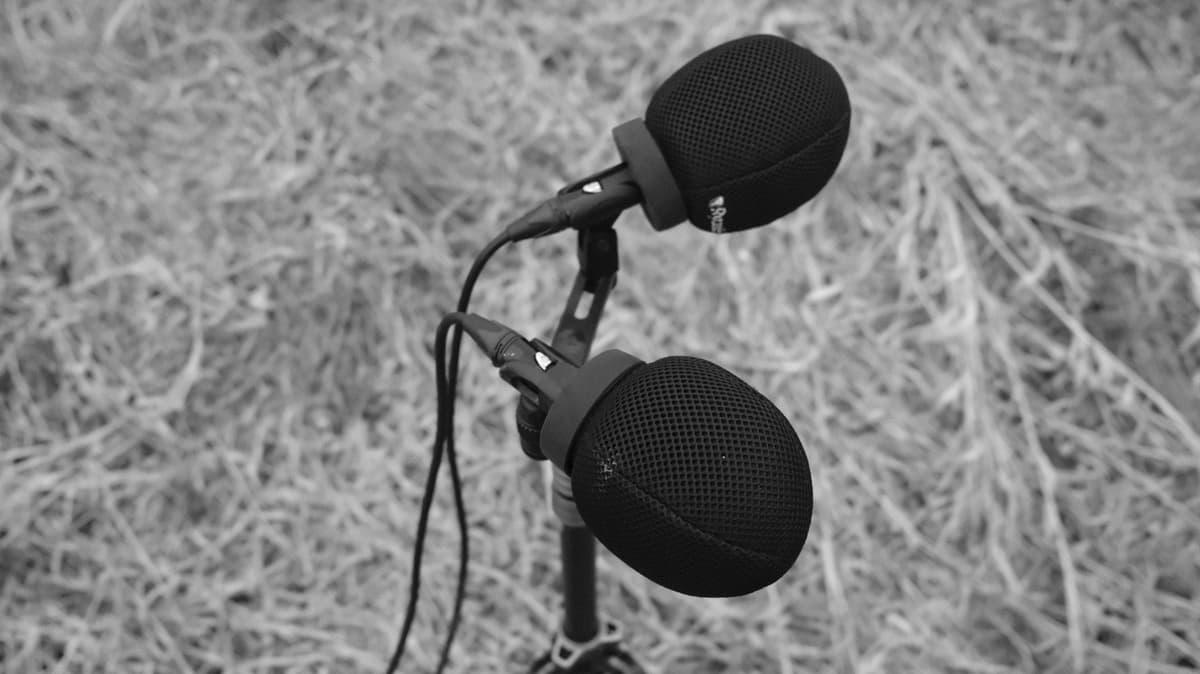
Field recording microphones, Imšara expedition, Belarus, 2025–2026
Measuring the bottom
Even before Ian’s session, I had settled on a form: four tracks of eleven minutes each. One track, one bog, one season. A greeting to Vivaldi from the post-post-post-modern world we live in now. It lasted about three months. In autumn and winter there were conversations and whole lives, but I didn’t hear them as musical material. Palessie corrected that. In Sniadzin we asked the first man we met where the old women lived, and he sent us straight to Baba Marusia: Mariya Danilauna Damasevich, born in 1937, eighty-nine years old and full of energy. She’s a healer who knows zamovy. She sang to us very quietly, because singing is forbidden during Great Lent. She told Tatsiana that Sniadzin is the oldest place of all, that there used to be a sea beyond the bog, that a ship sank in it, and that women picking cranberries were shown its bow. Herodotus’s sea, which scholars have argued about for centuries, is for her as concrete as the well in her yard. She also said the evil one lives only in the bog, “not to be said in our presence,” and that wherever you go, you cross yourself. Palessie brought another layer: souls leaving a house through a dismantled roof, beings met at night. Hanna Alyakseeyna Rapcevich from Razdzialavičy told Tatsiana and Alesia about a woman who went berry picking on St. Yan’s Day and met a man in black with a book. He opened the book and walked on. She felt hot and unwell, the forest began to roar, and she called to the other women: “Let’s go home now.” They had seen nobody. When I came home from that trip, I had a strong feeling that I’d brought something, or someone, back with me. It’s difficult to rationalize, but I’m sure it got into the music, into "Pond" and “Liquid and Solid.”
By summer the material was enormous: nature sounds, songs, stories, and rites. How could all of it fit into four tracks of eleven minutes?
Tatsiana’s chapter has a story about this kind of greed for depth. Near the village of Basin there is a bog called the Bottomless. People tried to reach its bottom with a stone on a rope. They kept tying more rope on, and when they let it down a little further, a voice came from the depths: “Don’t measure with a rope, or you’ll measure with your head.” I think every field recordist and every ethnographer needs that sentence. Throwing out most of what we’d gathered would have devalued the process and the people who sang for us and walked us to the right spot. But keeping everything and pretending to have reached the bottom would be its own lie.
So I broke the form and included everything that had become important, but I tried to keep each kind of material honest about what it was. The four eleven-minute tracks became fourteen across four sides. The line between documenting and composing stopped being one line. It runs differently through each kind of material.
Field recordings as interludes. "Alder forest" (B1), "Stream" (C2), and “Woods” (C5) are left alone. My authorship here is choice: where to stand, when to press record, and how long to stay.
Incantations as thresholds. The record opens with “Incantation” (A1): Baba Marusia’s prayer for entering the woods, recorded by Tatsiana, set against the Duleby winter night. “As I go into the woods, Jesus Christ goes ahead of me, the Lady Blessed Virgin is in the middle, and we, sinners, are behind.” Cover us from the creeping serpent, the jumping beast, the wicked man. “And then do not be afraid; you won’t get lost that much.” These are literally the words you say before entering, so they’re how you enter the album.
Lives as told. “My words, Your help” takes its title from Ekaterina Aleksandrovna Klepcha, born in 1935, recorded by Tatsiana in Zapolle. Her words against the evil eye (“Brown eyes, God, my words, your help”) sit inside a story that moves unexpectedly from war and hunger to the towels she wove herself to a daughter who died. Then a wolf comes for her goats when she’s a little girl, stands and watches her, and goes back into the woods. “A true God!” A story like that can be framed with music, but the music mustn’t take over the telling. A toad chorus can be looped without lying about toads. A woman’s memory of hunger can’t be looped without turning her grief into a hook.
Songs. The traditional songs are mostly lyrical, about love and loss. "Arkadz" (C1) is Arkadz Mironavich Il’enya, born in 1936, recorded in Chvojensk: a green oak in the fog, a spring beneath it, and a maiden who drops her ring. "Za hajem" (C3) is Hanna Rapcevich: flax, a darling far away, blackberry thorns to bind it with. At the end, she and Alaksiej argue gently about dinner: “Right, go eat; it’s getting cold.” “But you’re coming with us.” “Oh, you’re not going without me? Right then, let’s go.” It’s the same “let’s go home” as in her story about the man in black, only this time the danger is cold soup. “Bahun” (A3) carries a spring song sung by H. S. Tsetserukova and recorded by T. B. Varfalameyeva, first released in 2006 on a collection of music from the Bialyničy and Kličaŭ districts. Its title is the local name for wild rosemary.
A text from elsewhere. “Liquid and solid” (B2) is Bazinato’s manifesto (“The carbon in my body was once part of a star. And now it listens to the swamp”), recorded in Garikula, Georgia, over crickets from Vyhanaščanskaje.
And the answers, the improvisations, sit in the middle, where document and composition really overlap. The recording is a document, the playing is composition in real time, and the result is neither.
If I had to name one rule, it would be this: I could compose around a voice, but not on top of it. Choose, cut, place, frame, answer, but never change what a voice was saying.
Birds that leave
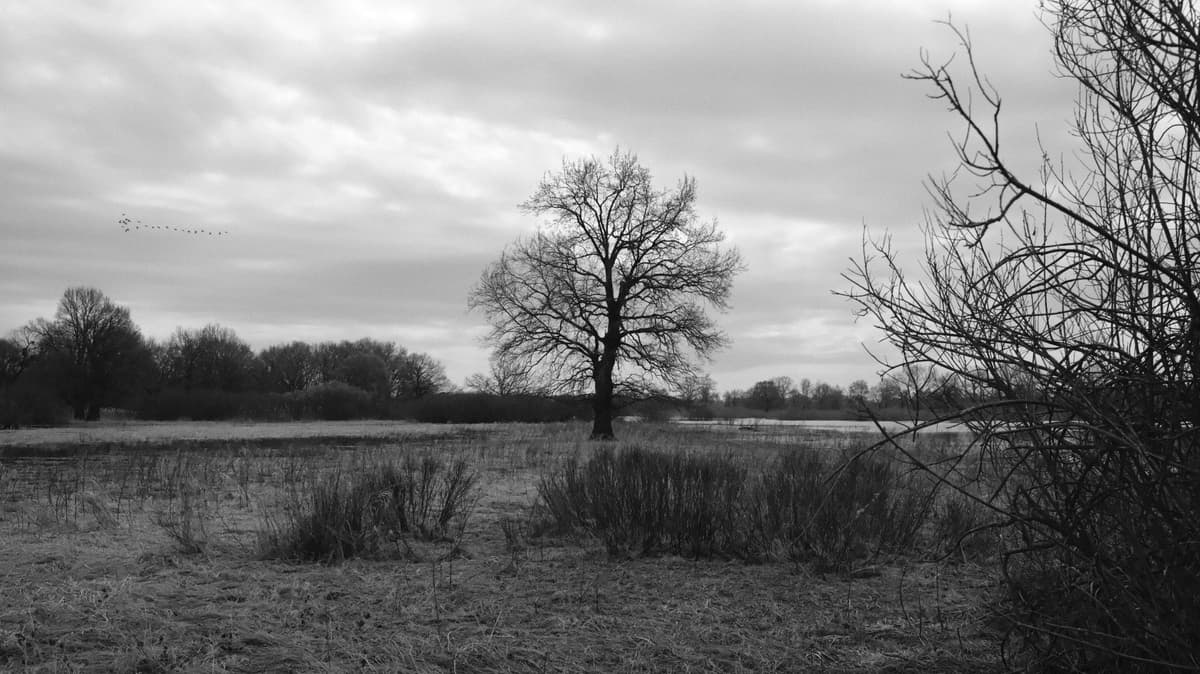
Side D of the record goes back to where the year started, autumn at Yelnya, and to birds that leave. Here Tatsiana’s material and mine meet most closely. In Babrovičy, near Vyhanaščanskaje, Nina Horbač told Tatsiana and Alesia, “When the cranes fly off to the south, it’s such sadness for me, to tears. I wave to them and say, "Have a good journey, come back home alive, and an easy road to you.” In Simanickaja Rudnia on the Prypiać, people have a rule for spring. When the cranes return, you mustn’t call them žuraŭli, because the word sounds like žurycca, to grieve, and if you hear them say it, you’ll grieve all year. In spring they’re called viasiolki, the cheerful ones. In autumn they’re cranes again. Even the name of a bird has seasons.
“Where did you fly?” is built around another departing bird. Yadzviga Yanauna tells how she and her family caught a stork out on the ice in early spring. “Their feet were cold,” she says. She raised it in the barn, walked with it, and talked to it, “and it answered me.” She let it go to bathe in the ditch. Twice it came back to its place. The third time it cried out loud, flapped its wings and flew. “I’m shouting after it: come back, you’ve lost your way. Where have you gone, where have you flown to?” It flew to the lake and fell into the wrong hands. “That’s how I mourned it.”
In that one story there’s everything this text is about. A human talks to an animal, and the animal answers. There’s a rule about letting go. And at the end there’s a call that no longer gets an answer. In autumn at Yelnya, the geese and cranes I recorded were leaving too. I didn’t plan the rhyme. It came out of the archive.
Zinaida
During the last expedition to Vyhanaščanskaje, friends sent us an old video from a folk festival. Three women were singing, and our friends asked us to find out who they were. All anyone knew was that they came from Vyhanaščy. On the last day of the expedition, just before driving home, we stopped at the house of Zinaida Mikalaeuna Myalik, one of the three, and showed her the video.
She had been singing with her mother and her sister. Neither is alive. She told Tatsiana about their choir: how they toured, won first prizes, were invited to Minsk and were given the title of the Makarskija People’s Choir, around 1991. “Our choir had a long history,” she said. “And then my mom died, my sister died, and when somebody needed somebody to perform, they’d call me, and I’d sort of…” She didn’t finish.
She’s left alone with these songs. There’s nowhere to sing them, and no one to sing them with.
On the way home I listened to the song from the video again and again, thinking about Zinaida losing her family, and the songs going with them. A passing era, a passing culture. An hour earlier it had been an anonymous festival clip, three voices, someone wanted to name. Now I knew who stood next to whom, and the recording sounded entirely different. Nothing in the sound had changed. Only the names had come back.
That song became “Strata” (C4). It holds the trio from 2000 (Lyudmila Mikalaeuna Lanets, Natallya Yemelyyanauna Makarskaya, and Zinaida), recorded by M. Kozenka, and Zinaida singing alone, which I recorded on 12 June 2026. Between them is a fragment of her talk with Tatsiana. I’ll go up that mountain and look upon that valley… I planted it myself, I watered it myself; the one that I loved is gone. I didn’t try to rebuild the trio or fill the place where two voices used to be. The gap is what the piece is about. Strata is “loss” in Belarusian and “layers” in English. Peat is both: a layer on a layer of what was alive, preserved by water. Zinaida’s voice in 2000 and in 2026 is like that: two layers of one song with a lifetime pressed between them.
If I had to say what Imšara is, I’d point to that kitchen. It’s an attempt to make out what can still be heard, even if it can still be heard. Not to save it. A record can’t save a living tradition; a song needs people with a reason to get together and sing. But a record can stand next to it, listen properly, and put the names of the people who sang where others can find them.
Alaksiej, and singing back
Kirill was supposed to film the expeditions but fell ill a couple of days before the first one, and I asked Alaksiej Piskun. A day’s notice, three days on a bog: “Let’s go, great!” He stayed to the end. Besides filming, he sings traditional songs and organizes folk gatherings in remote villages, bringing grandmothers and grandfathers together with young people who care about all this. He doesn’t archive the tradition; he carries it on. And he sings beautifully. Listen to the last track, “Divine gift” (D3). It’s a song first recorded by Iryna Maziuk in the Vetka district in 2008. Alaksiej learned it and sang it, and Siarhei Cviki recorded him. The Lord walked upon the damp grounds… Look, those gardens flourish without water… And there is a kingdom waiting for you. Alleluia.
In Tatsiana’s chapter, the bog is a border between this world and the other. In one cosmogony she quotes, the devil spat out the earth he’d hidden in his cheek, and wherever he spat, bogs appeared. Yet people pray in those bogs and meet a wandering God there. After "Strata," it would be easy to close on grief. Alaksiej is a different kind of answer, the same way Ian answered the woodpecker. Not a copy, not an archive, but a reply from someone alive now, in the language the song was made in.
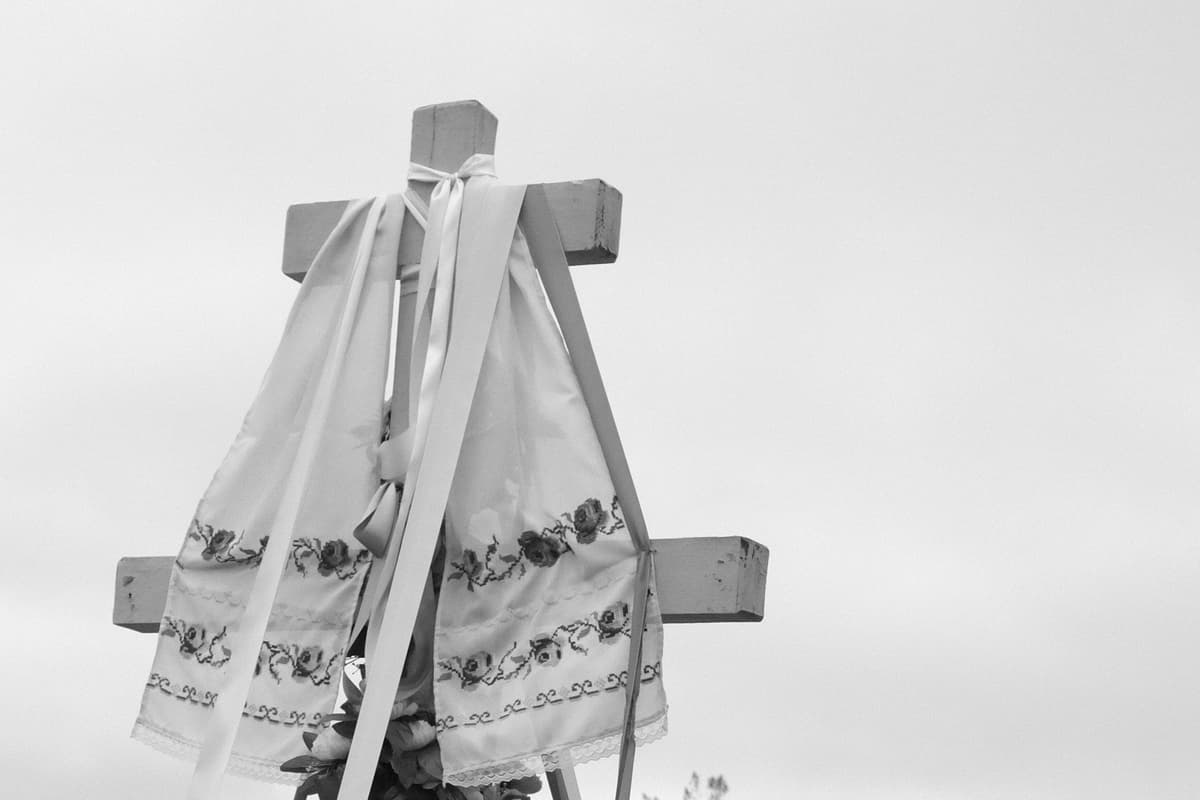
Cross with embroidered towels, Imšara expedition, Belarus, 2025–2026
Ten days in the mountains
When the expeditions were over, I went to Georgia to build the album. It’s my favorite way to work: somewhere far from three and a half jobs and daily routine. Ten days, fourteen to seventeen hours a day in one room, an hour or so off to eat, and twice a walk in the mountains.
I had no heavy synthesizers or tape machines with me, just the recordings, Ian’s drum parts, a duduk, an adungu, and objects around the house. Later, Anton Shnip recorded drums for "Bahun," "Liquid and Solid," "Pond," "Arkadz," and "Strata" at LÖS Studio in Warsaw, and Siarhei Cviki mastered the record. It was a strange state: Georgian sunsets and my head deep in Belarusian bogs. A shift in the perception of present reality, the one we all have to find some harmony in now, when the rules keep changing and you still have to keep your balance. Vyhanaščy means “the driven out.” I don’t want to push that too far, but part of the record’s geography is displacement too.
In that room the year became an order, and not the order of travel: winter opens the record, Side C is mostly people, Side D returns to autumn and ends with the alleluia. The year was a way of gathering, not a script for listening.
What it is
I don’t know what to call the music. Post-folk, ambient-field-recording-jazz, whatever. What’s on the album is us, diving into the Belarusian bogs and into what and who surrounds them, through the lens of now. The languages on it are as mixed as the bog itself: Belarusian and Russian, Palessian and other local dialects, and Trasianka. So are the voices: toads, a woodpecker, geese, crickets, grandmothers, drums, a bass clarinet, a manifesto recorded in Georgia. Tatsiana ends her chapter with a grammatical observation. In Belarusian, "balota," the bog, is neuter. Jano majo, it’s mine. It has no clear gender, like a lake, joining masculine force and activity with feminine receptiveness and changeability. Then she gives her main conclusion plainly: by destroying nature, we destroy ourselves.
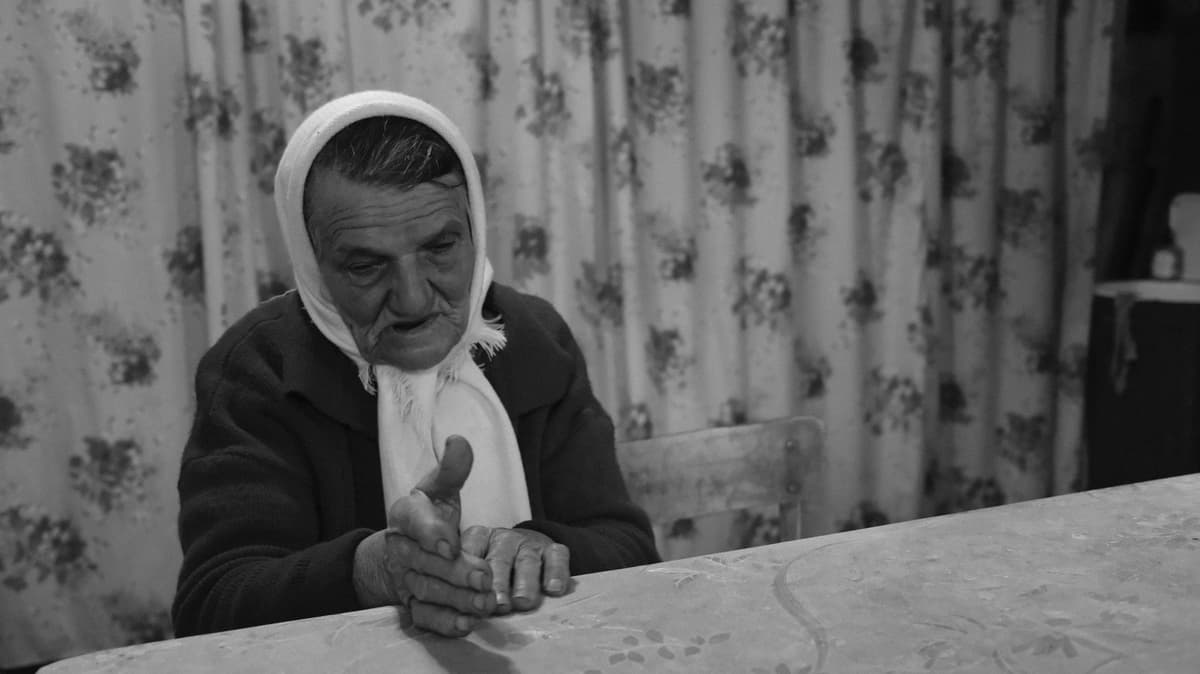
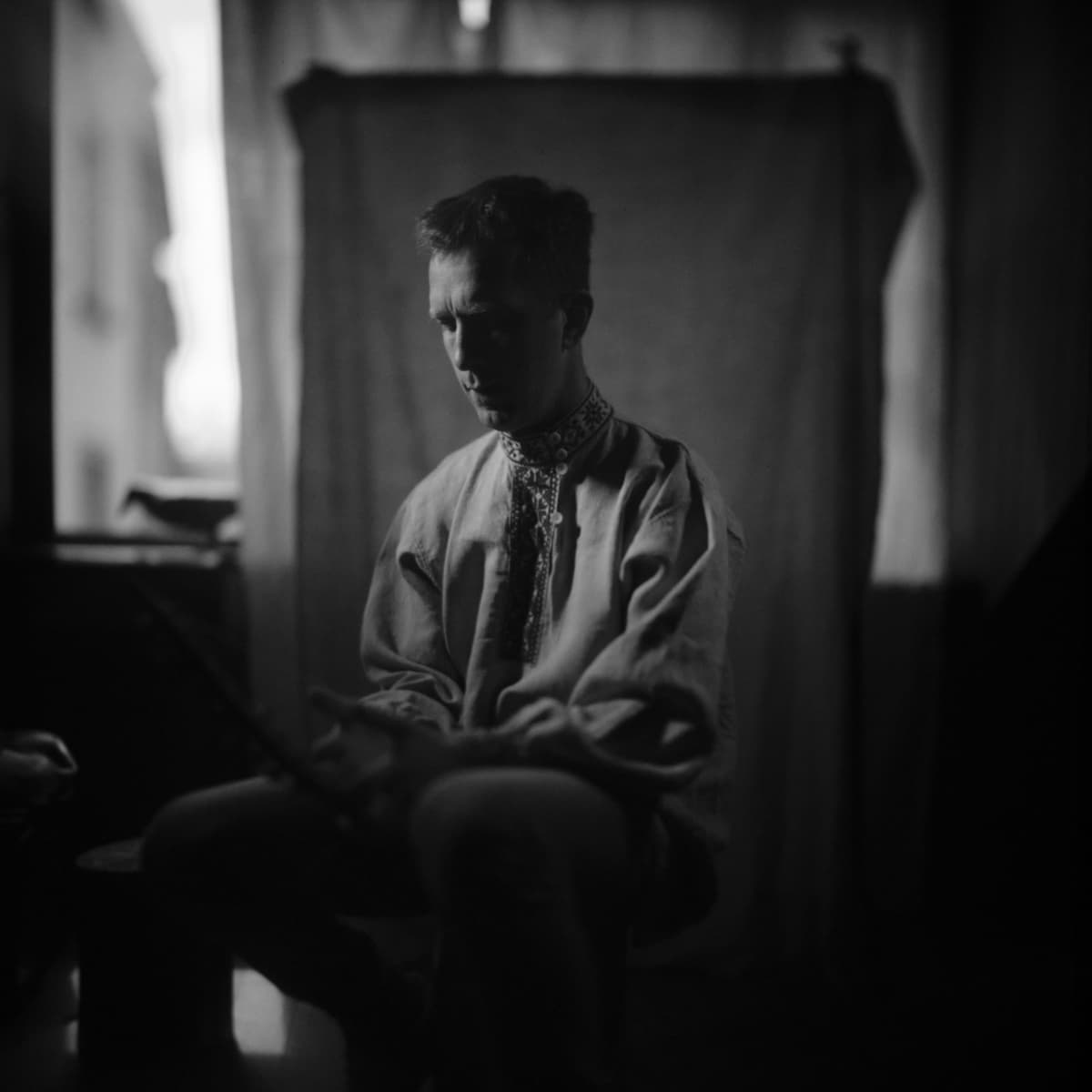
Portrait in an embroidered shirt, Imšara expedition, Belarus, 2025–2026
The people beside the bogs say the same thing, in other words. Taccjana Lipskaja from Simanickaja Rudnia: “I’ve carried out more berries than I’ve had braids in my hair. When they drained it, the bahun came, and everything grew over with bahun.” Kanstancin Uscinčyk: “You wouldn’t believe it—when I think about the drainage, my heart hurts.” That summer the Vyhanaščanskaje bog was dry, the sphagnum crunched like paper, and in places there were no mosquitoes at all. Alesia explained what that means: no insects, no frogs; no frogs, no food for the black stork’s chicks. The bog nightingale goes quiet, and the place starts to sound like the place in the old spell, where the roosters don’t crow and the geese don’t cry.
One of the locals told us that when you walk on a bog, you have to keep asking: can you stand here? I think that’s the best description I have of working with field recordings, people’s voices, and musicians together. At every step you ask whether the ground will hold, whether this sound can carry a composition or needs to be left alone, and whether this voice is one to answer or one you must let call out unanswered at noon.
The grandmothers and grandfathers are dying. Nature is getting more polluted. Imšara doesn’t fix that. But I think we’ll still make a few interesting things here, and this is one of them.
Side A: A1 Incantation · A2 My words, Your help · A3 Bahun
Side B: B1 Alder forest · B2 Liquid and solid · B3 Pond
Side C: C1 Arkadz · C2 Stream · C3 Za hajem · C4 Strata · C5 Woods
Side D: D1 Where did you fly · D2 Transparency · D3 Divine gift
Musicians: Anton Anishchanka – piano (A1, D2, D3), adungu (A2, A3, B3, C1, C4, D3), duduk (A3, B3, C1, C4), bamboo flute (D1); Maksim Kruhly – piano (A2); Vlad Kozyrev – piano (A3); Dzianis Parechyn – bass clarinet (A3, B3, C1, C4, D2); Raman Tsiabut – drums (A3, B2, C1, C4); Ian Sapega – drums (A2, B3, D1, D2).
Field recordings by Anton Anishchanka: A1, A2 – Duleby Islands Swamp Reserve; B1, B3 – swamp forest beside the pipeline road Chlupinskaja Buda–Sniadzin, fire-bellied toads in the pond; B2, C5 – Vyhanoshchanskoe Nature Reserve, crickets / forest near the road Vyhanaščy–Razdzialavičy; C2 – oxbow of the Prypiać, Pripyatsky National Park; D1, D2 – Yelnya Landscape Reserve, near Budy village.
Voices: A1 M. D. Damasevich; A2 E. A. Klepcha; A3 H. S. Tsetserukova; B2 Bazinato; C1 A. M. Il’enya; C3 H. A. Rapcevich; C4 L. M. Lanets, N. Y. Makarskaya, Z. M. Myalik (group singing, rec. M. Kozenka, 2000) and Z. M. Myalik (solo, rec. A. Anishchanka, 12.06.2026); D1 Y. Y. Yurshevich; D3 A. Piskun.
Production: produced and mixed by Anton Anishchanka; mastered by Siarhei Cviki; artwork and layout by Bazinato; photos by Anton Anishchanka; annotation, essay, photo and quote selection by Nadzeya Burmistrava; drums on A3, B2, B3, C1, C4 recorded by Anton Shnip at LÖS Studio, Warsaw. Ethnographic quotations are from Tatsiana Valodzina’s chapter in the forthcoming book Imšara, based on recordings made by the Imšara expedition and by Tatsiana Valodzina and Alesia Kruchonak in 2025–2026; the zamova against the evil eye is quoted there from the published collection Zamovy (1992).
All photos by Anton Anishchanka
Bernie Krause quotations:
“as a natural karaoke orchestra with which we performed. In other words we used it as a backup band.” / “We’re not listeners, we are lookers.” – An all-natural animal orchestra, BBC News Magazine.
“They all coalesce in a way that’s not planned but cooperative or competitive, one creature in relation to another.” – The Noises of Nature, press dossier “Paisatges Sonors”, Observatori del Paisatge de Catalunya.
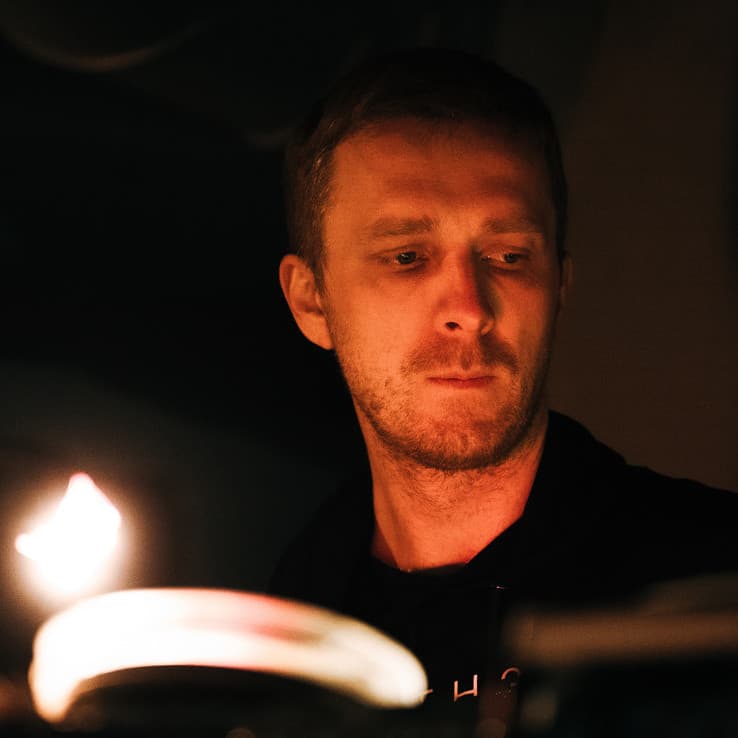
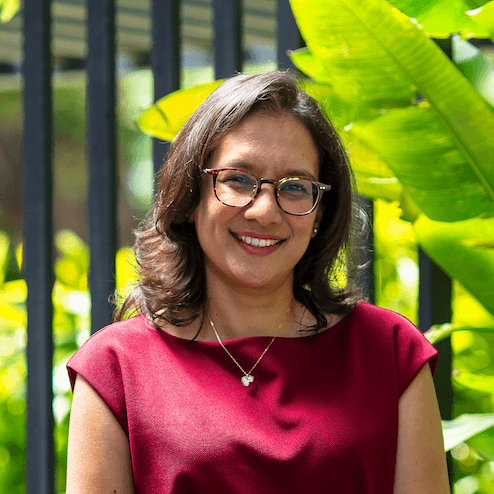
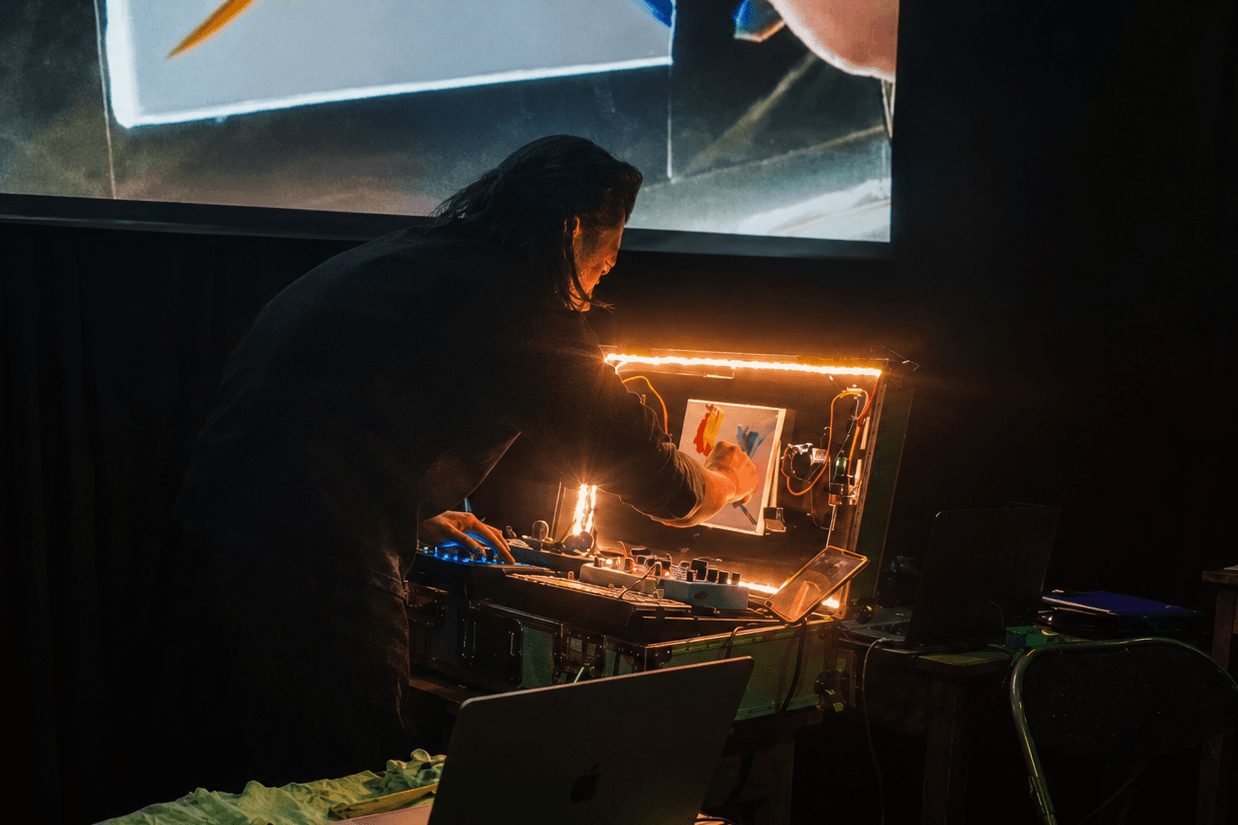
Anton Anishchanka is a sound artist, composer, field recordist and ethnographic researcher from Minsk, Belarus. His work combines archival recordings, field recordings, analog synthesis and live processing. His 2025 album Krope was named one of The Quietus Albums of the Year. He founded the label Shatkavalka and the space for experimental and improvised music Accidental Point in Minsk, and has conducted field research in Belarus, Armenia, Romania and Uganda.