

How do you capture a walk-through sound installation? You don't record it — you rebuild it.
In a physical sound installation there is no fixed listening position and no fixed duration. Visitors move freely — their path is the work. A recording from one spot loses exactly that freedom. Worlds builds it in from the start: a virtual space you can actually walk through, where sound behaves the way space does. Part of the Sounding Future platform.
Every world is built from four elements.
Frame
Space
The global acoustic frame of a world: reverberation, room character, externalization. Tight and dry, or wide and resonant.
Point
Sources
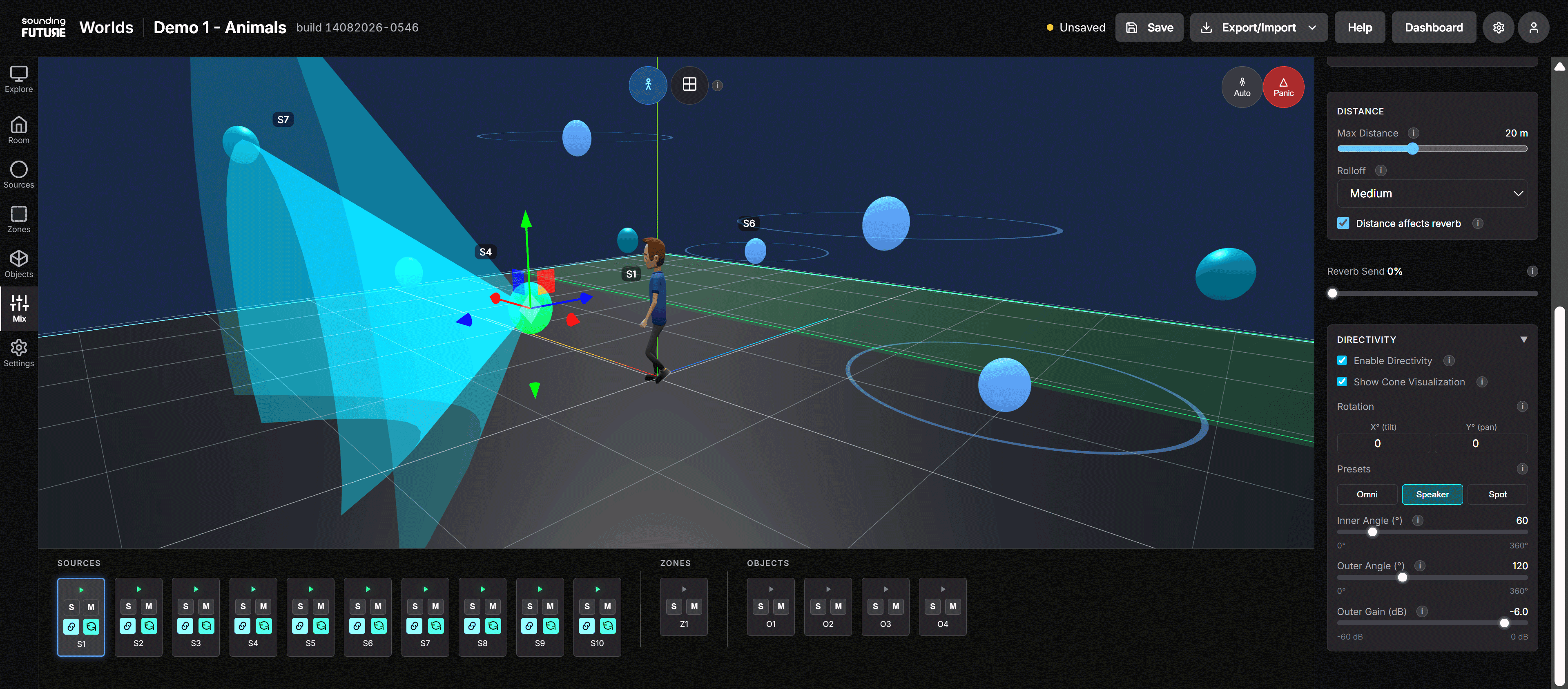
Point-like sound sources with physically plausible distance and directivity — radiating a full 360° or in a focused cone, like a loudspeaker.
Area
Zones
Area-based sound beds that fill a region with ambience. Enter, and the sound fades in; leave, and it fades out. Zones can overlap with clear priorities.
Trigger
World Objects
Interactive triggers, visible or invisible: approach one and a sound starts, a text appears, a change unfolds. The tool for narrative moments.
Open the link and start building. Nothing to install.
From a simple box to a 360° photo of a real courtyard.
Start with a neutral geometric space to test an idea, upload your own 3D model, or use a 360° photo as a photorealistic backdrop. Recreate a real place where an installation will later stand — or build spaces that would be impossible in physical reality.
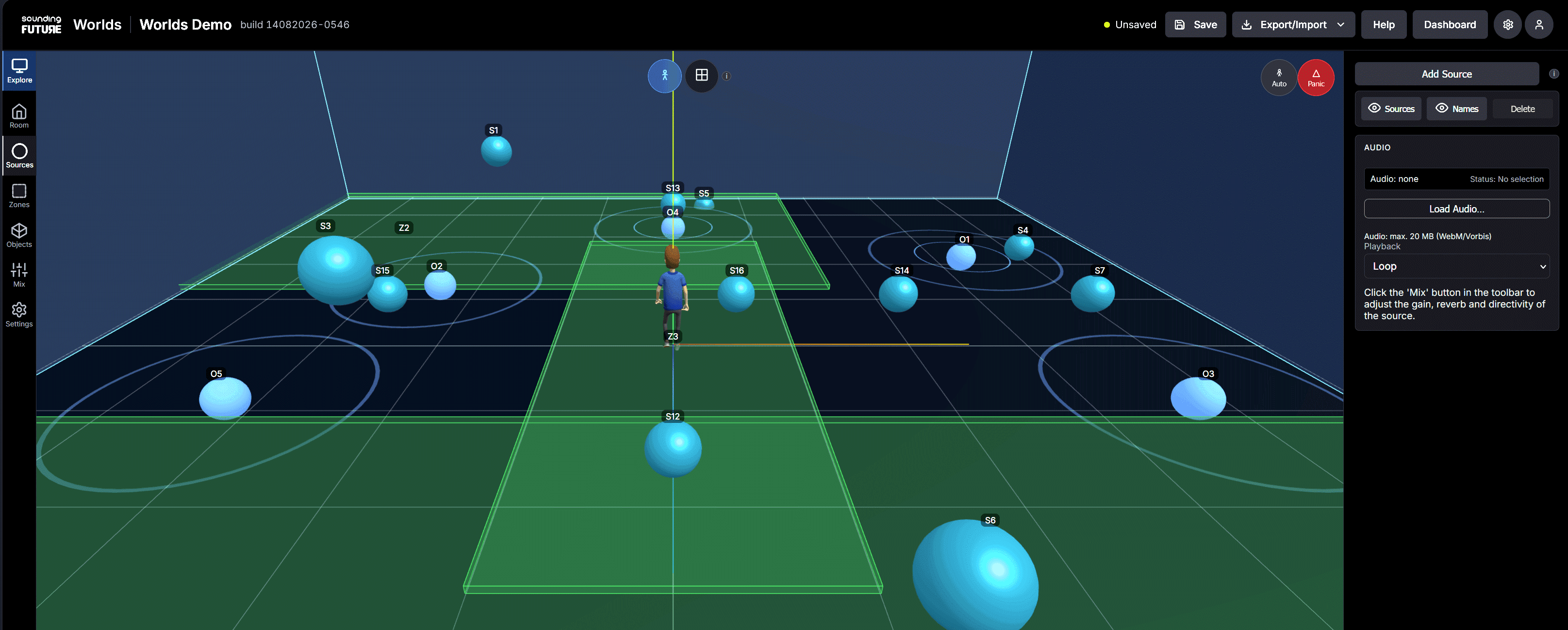
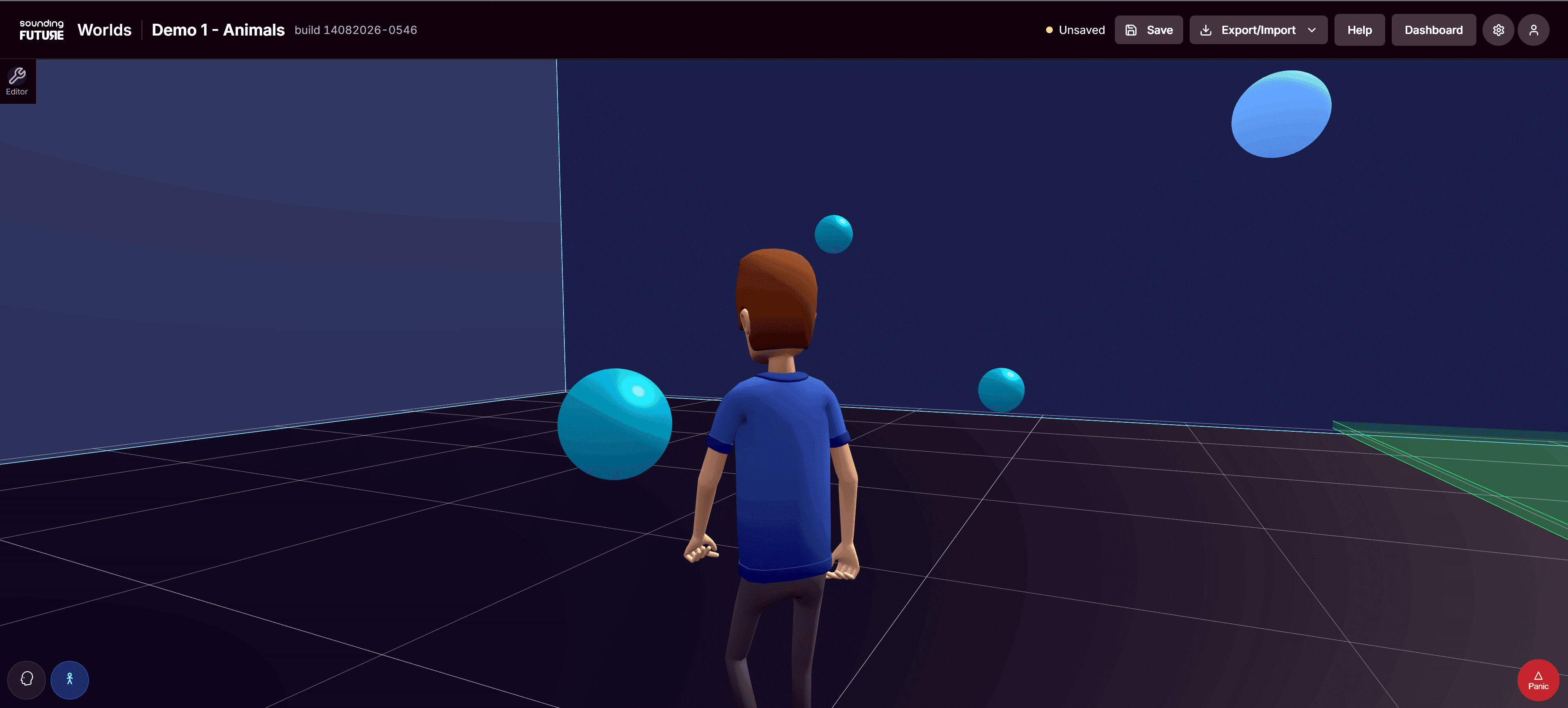
Step inside your own composition — at any moment.
Three views: bird's-eye for precise placement, third-person for overview, and first-person to walk through the world exactly as visitors will later. You are not mixing on a timeline — you are shaping a space you can enter immediately. In explore mode, the tools disappear and only the world remains.
A mixing desk for space instead of a timeline.
Every Source, Zone and sounding Object gets its own channel with mute, solo, level and reverb send — a workflow familiar from any DAW, transferred to the spatial context. Sources can be grouped for sample-accurate sync, so an eight-channel composition plays as one coherent work, each channel anchored at its place in space.
A tool and a stage.
Document
Preserve walk-through installations.
Rebuild an existing installation virtually — with free position and duration intact. Not a recording of one state, but the work itself, walkable online long after the physical exhibition closes.
Compose
Build what physical space can't hold.
Vast rooms, dozens of simultaneous sources, impossible architectures. Worlds is a compositional space in its own right — a venue that exists only online, taking the medium seriously as a stage.
Prepare
Plan installations before they exist.
Recreate the actual courtyard, gallery, or hall where a work will stand — and experience on screen how a composition feels on site, before a single loudspeaker is placed.
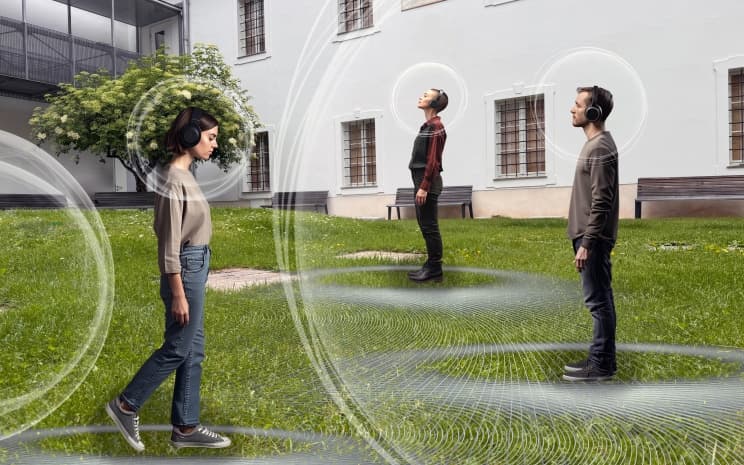
Three worlds leave the screen and become a walkable installation.
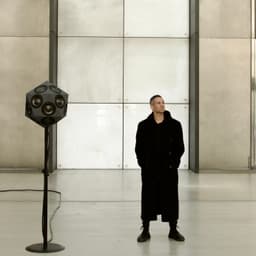
Visitors move through the museum courtyard with headphones, located in space via tracking — hearing live how the sound changes with every step and every turn of the head. Three composers have each built their own world with Worlds, now travelling the opposite way: from the virtual world into real space.


A production of Sounding Future — Platform for Innovative Music and Audio Technology.





Early access
Build one of the first worlds.
Worlds is opening in stages, developed hands-on with composers and curators. Join the waitlist for updates and early access — we're onboarding artists and institutions step by step. If you're a festival, museum, university or gallery interested in working with Worlds, tell us and we'll be in touch directly.
Who we're onboarding
- Composers & sound artists
- Curators
- Institutions — festivals, museums, universities
- Researchers & educators
One or two emails at most — updates on the beta and early-access invitations. No spam, unsubscribe anytime.