
How Do You Document a Sound Installation?
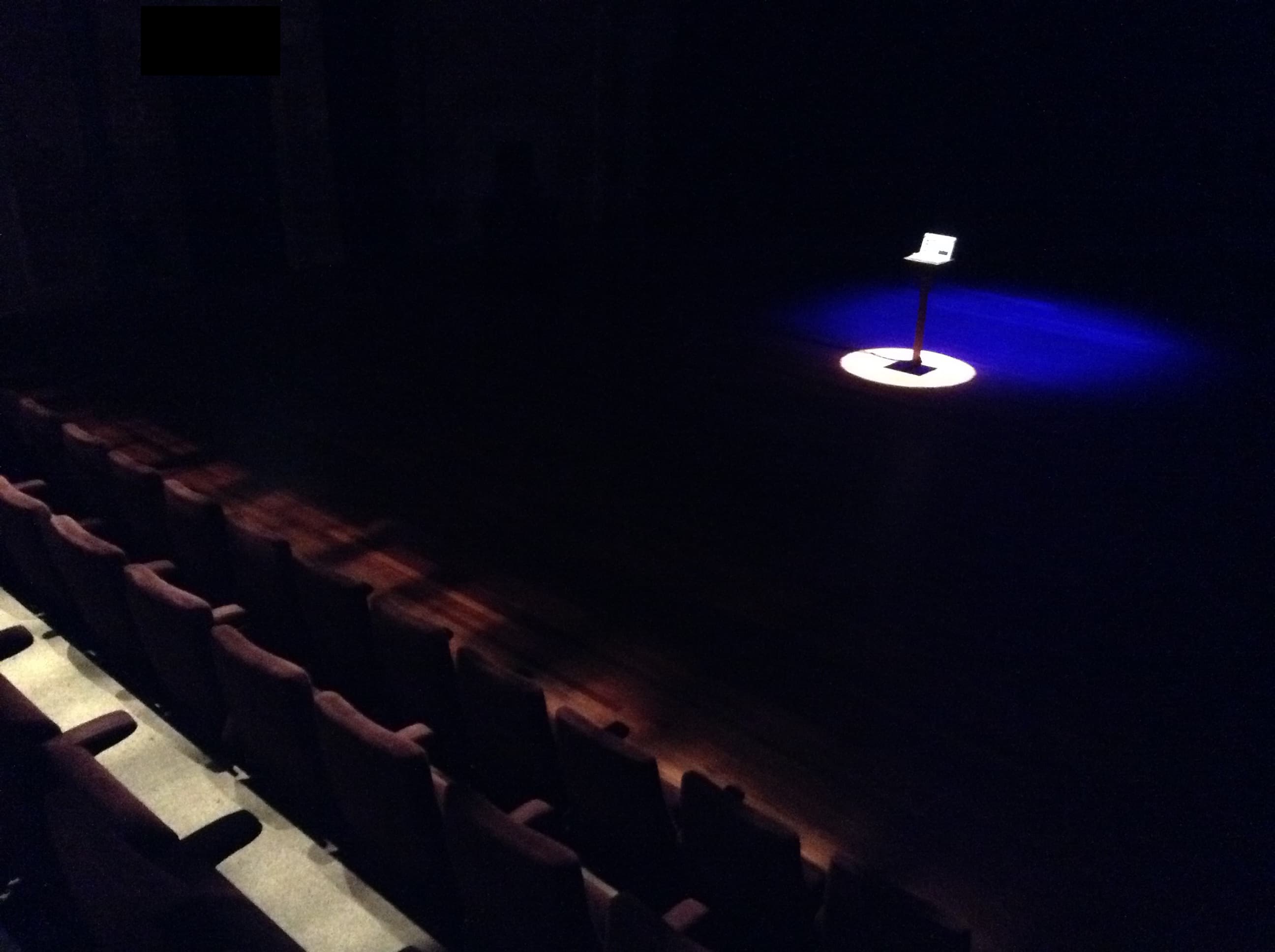
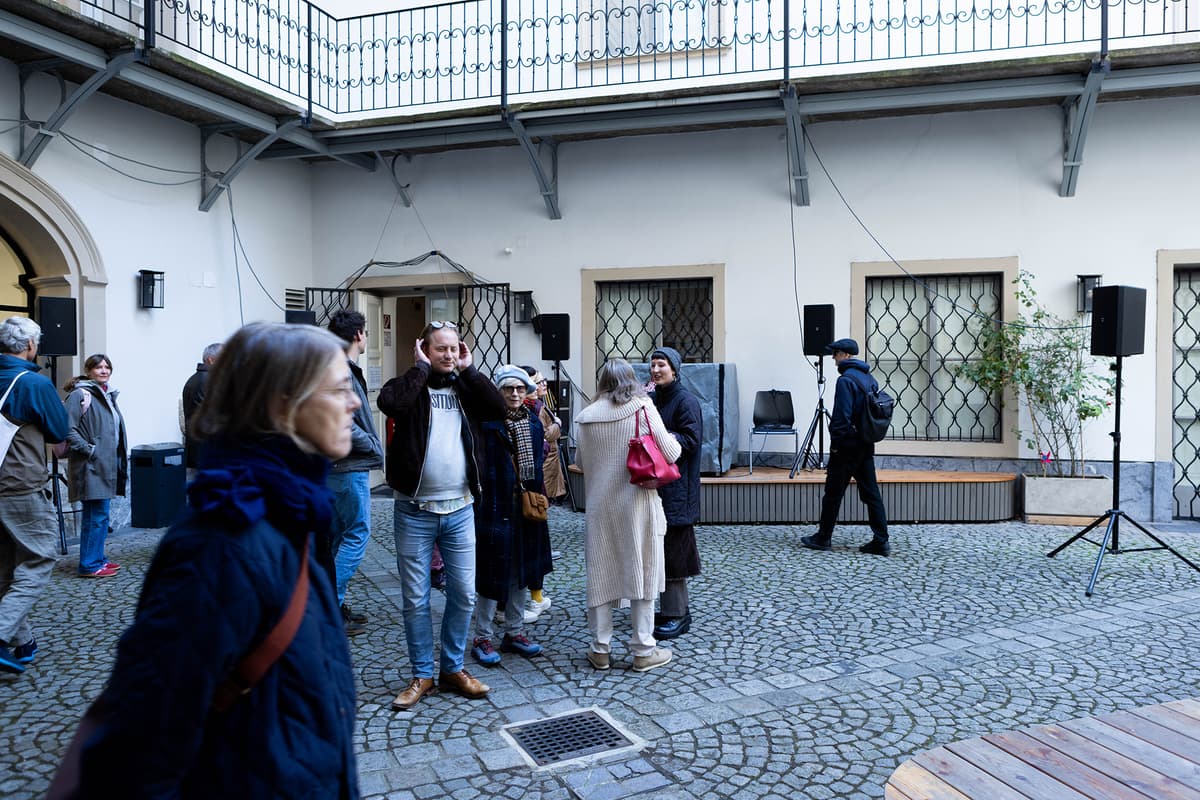
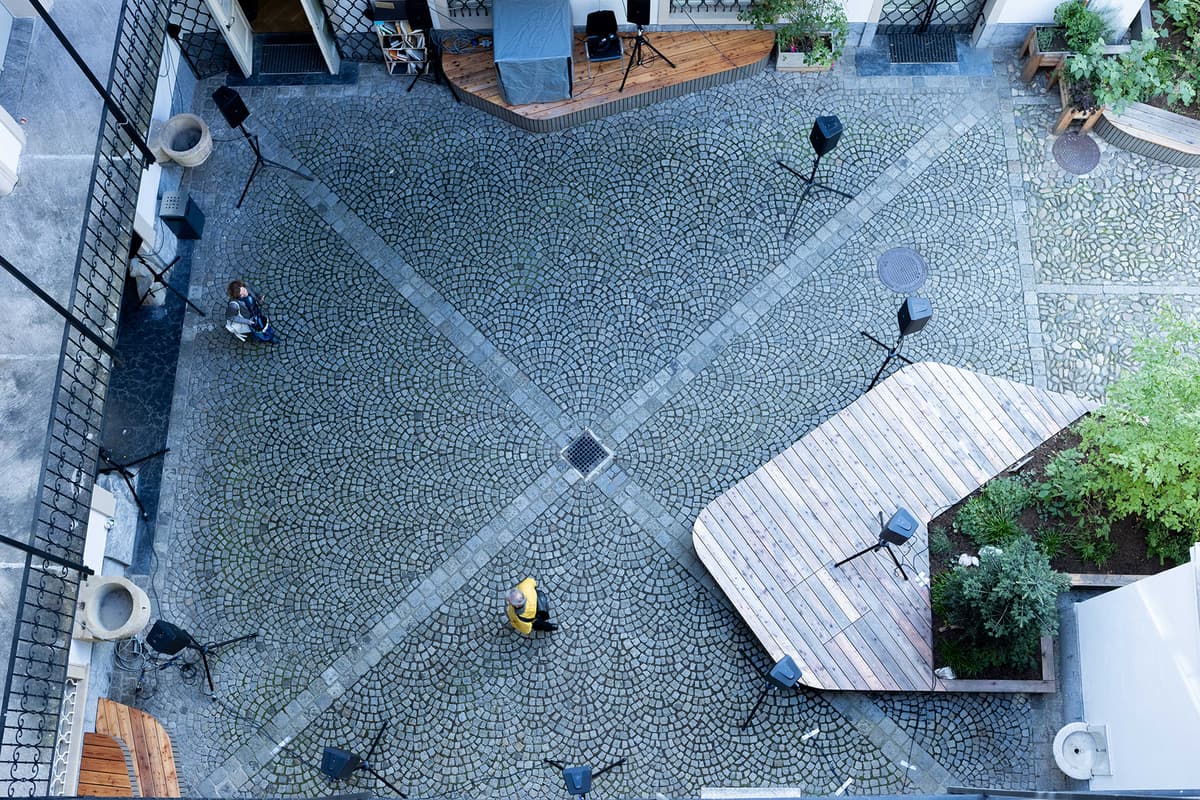
Twelve loudspeakers form a circle, each carrying a narrow band of noise. Walk clockwise to the next loudspeaker and you hear the next chromatic tone up. Keep circling and you find yourself in a paradox worthy of Escher: an endless continuum of ascending tones that is, in fact, completely static. And step into the centre of the circle, and you no longer hear individual tones at all, but their formless sum – white noise. weiss/weisslich 27d, a walk-in work by Peter Ablinger (1959–2025), one of the most idiosyncratic sound thinkers in contemporary music, presented at ORF musikprotokoll 2025. The Graz installation was realised by Winfried Ritsch – to whom Ablinger also dedicated the work.
© ORF musikprotokoll, M. Gross
Installation: weiss/weisslich 27d, Peter Ablinger
© ORF musikprotokoll, M. Gross
Installation top view: weiss/weisslich 27d, Peter Ablinger
It was this work that brought a problem into focus for me – one that had been on my mind for quite some time. I work as a producer and co-curator for ORF musikprotokoll, which has been presenting contemporary and experimental music since 1968 – the oldest festival of its kind in Austria. It is organised by the ORF, the Austrian Broadcasting Corporation, as part of the multidisciplinary arts festival steirischer herbst in Graz. One of its distinctive features: all concerts are recorded and subsequently broadcast on Ö1, the ORF's cultural radio channel. So the question of how to record – and thereby document – a performance has always played an important role here.
For concerts, this is well solved in recording terms: the audience remains in a largely static seated or standing position, and various microphone concepts allow the sonic events to be captured from that perspective in excellent quality. What matters then is the other end of the playback chain – what broadcast or streaming technology can deliver: classic stereo, 5.1 or multichannel formats that can be reproduced in the living room, provided you own that many loudspeakers. Or binaural streams that render surround sound for headphones. Given the trend of listening to music on headphones that has persisted for years now, binaural playback optimised for headphones is a particularly attractive option.
Walk-through sound installations like Ablinger's are a different matter entirely. Here there is no defined listening position and no fixed duration – visitors move freely through the space, linger, return, walk on. And in the case of weiss/weisslich 27d it goes even further: your own movement is the work. Whether you hear endlessly ascending tones or, at the centre of the circle, nothing but white noise is decided not by the composition but by the place and path you choose. This freedom is what defines the art form.
For radio, this is usually solved in one of two ways: either a representative position in the space is defined and the recording is made from there. Or a programme presenter moves through the installation with a stereo microphone, commenting on what she is doing and hearing, occasionally interviewing the composer – combining sound, context and explanation in a single broadcast.
Both approaches work, but they remain a workaround. They try to capture the character of the installation – and in doing so lose exactly what distinguishes it: the independence of position and duration. A recording from a fixed position documents, at best, one state – but never what makes a work like Ablinger's what it is. The freedoms of the physical installation are no longer present in the documentation.
This contradiction raised the question: is there an alternative solution? But first, let's take a brief look back.
A Precursor: tingles & clicks
The search for new formats was not new to me at that point. For several years I have been interested in online music environments that offer a genuine experience of their own – environments that do not try to reproduce a physical event, but take the medium itself seriously as a performance venue.
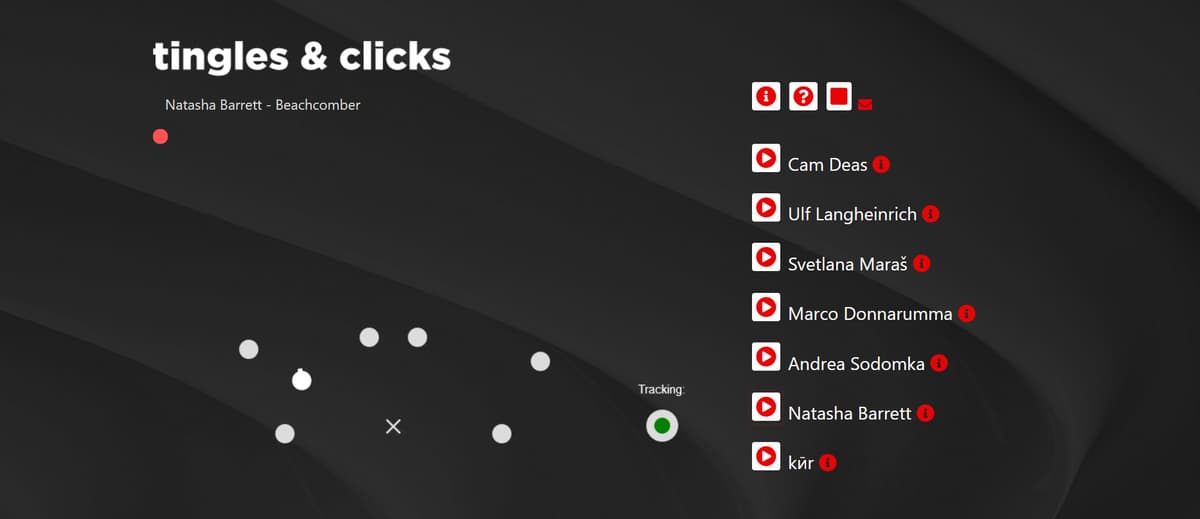
This became concrete during the pandemic: in 2020, I developed the hybrid music project tingles & clicks for ORF musikprotokoll, together with the team of the IEM in Graz. Easy accessibility was important to us: all you needed was a PC or laptop, a webcam, internet access and headphones – exactly the equipment familiar from the home office. Enter the project address into the browser, and you were right in the middle of it.
© ORF musikprotokoll
Browser screenshot: tingles & clicks (2020)
The principle: the webcam tracks the listener's head position on the x- and y-axis – left–right and front–back. The area covered by the webcam is at the same time the virtual sound space. It is divided into three sectors, each assigned an ambient sound. Distributed above them float up to six invisible sound objects, which can only be found by listening. What, how and where to hear is decided by the audience themselves – by listening and navigating: tilting, turning, leaning forwards and backwards becomes movement through the sound space.
A deliberate design decision was the purely two-dimensional surface. It matched the range of motion of the tracked head – movement in front of the screen could be translated into the sound environment directly and plausibly, without claiming a spatial depth the interface could not have delivered.
But exactly here a question remained open: what if you extended this approach into the third dimension? What if you could not just orient yourself within a sound environment, but actually move through it – free in position and duration, just as in a walk-through installation?
From the Plane into Space
For Worlds, the task was now a different one from tingles & clicks. No longer a self-contained, two-dimensional sound environment, but something that could actually recreate a walk-through installation: an environment in which the physical setting of a sound installation can be rebuilt virtually.
And it was not to stop at a visual impression. The resulting world had to function acoustically much like the physical world – with clear rules that you, as a visitor, can rely on as you move through it.
The perceived loudness of a sound source decreases with distance, just as in a real space. And equally important: the world responds correctly to the turning of your own head. A sound source stays in its place – it does not simply rotate along with you, as you know it from conventional headphone listening to recorded music, where the entire sound image turns with every movement of the head. Only when sound sources remain anchored in space while you move freely and look around does the essence of a physical installation emerge: a space you can explore, rather than a recording you merely listen to.
That was the real requirement for Worlds – and the point at which an editor in the browser alone was no longer enough. It needed binaural, spatial audio that follows these physical rules.
A Tool, Not a One-Off Solution
From the very beginning, Worlds was not conceived as a one-off art project, but as a tool. The goal was easy access to building such worlds – an interface with tools that curators, composers or people without a professional audio background can work with independently, without having to write code.
That meant a clear decision against the more obvious path: building custom software or a bespoke code setup anew for every single installation. Instead, a reusable platform was to emerge – an editor in which you place sound sources in space, define zones with ambient sound and set up interactive objects, entirely without programming knowledge. The actual complexity – spatial audio, binaural rendering, physically plausible behaviour of sound in space – remains hidden beneath the surface.
This way, whoever designs a sound world can concentrate on the artistic work: on where a sound sits, how a space sounds, what happens when you approach a particular spot – instead of having to grapple with the technical implementation of spatial audio.
I started very small: with simple experiments in Three.js, an open JavaScript library for rendering 3D graphics directly in the browser. I know the basics of Three.js, and of Next.js too – the web framework I later used to build the platform around the tool, handling things like user management and data storage, and integrating it into the Sounding Future ecosystem. But I am not a programmer. That I took on the development myself was not a matter of principle but born of necessity: no funding partners could be found for the tool's development – hiring experienced programmers was simply out of reach. This is where AI language models came in: they assisted with writing the code and accelerated the work enormously. Without this support, Worlds would simply not have been feasible.
What followed were eight months of intensive development, with countless iterations: building, testing, discarding, starting over. Three times I restarted the project from scratch after several weeks each, because the code had become too tangled. That, too, was part of the learning: along the way I learned a great deal about how to work productively with AI as a coding tool – and how not to.
What AI cannot deliver is the decisive part: knowing what a tool for artistic practice actually needs to do – which parameters composers really need, how spatial listening should feel, where an interface gets in the way. Those decisions came from practice. From the start, the plan was to have no plan: every step, every idea was measured against whether it genuinely benefited the tool – in substance as much as in usability and interface design. In hindsight, this held an unexpected advantage: many details and UI/UX interdependencies I could never have thought through in advance and handed to a development team as a brief – simply because I did not know they were work items in their own right. They only became visible in the doing, step by step. Worlds was to be a tool that grows out of practice, for practice. It is part of Sounding Future, and it is within this environment that it continues to grow.
What You Build With: Space, Sources, Zones, Objects
Regardless of what Worlds was ultimately meant to achieve, it first needed an audio engine capable of reliable, resource-efficient spatial rendering in the browser. There are open-source approaches in this field, JSAmbisonics being the best known: a library from an academic context that provides solid building blocks for Ambisonics processing in the browser – encoding, rotation, binaural decoding. But building blocks are exactly what they are: distance behaviour, source directivity, a reverb engine with per-source sends, externalisation, and the resource management needed to keep dozens of simultaneous sources running smoothly – all of that I would have had to construct and maintain myself.
For Sounding Future I wanted all of this as one mature, actively maintained engine. The choice fell on Atmoky, a Graz-based company specialising in real-time immersive audio. Its founders come from the Institute of Electronic Music and Acoustics (IEM) in Graz – the same institute whose team I had worked with on tingles & clicks – where they developed the IEM Plug-in Suite, a set of free, open-source tools for spatial audio that is widely used in the field. Today, Atmoky builds audio engines for games, VR and interactive environments: its flagship spatial rendering engine trueSpatial is already running in shipped games, alongside a real-time acoustic engine and immersive audio systems for museums and themed attractions. For Worlds, Atmoky's web audio engine provides exactly what was needed: dependable binaural rendering, directly in the browser.
Atmoky provides the fundamental building blocks – first and foremost the Space, the global acoustic frame of a world. This is where reverberation is controlled, for instance – how strongly and how long a room resounds, whether it feels tight and dry or wide and reverberant. Each individual Source and each Zone can feed into this reverb independently, so that some sounds "float" in the space more than others. In addition, the Externalizer controls how strongly a sound is perceived as located outside the head – a key parameter for convincing binaural listening on headphones. It is also something of a distinguishing feature: a 2023 study comparing six spatial audio tools for the browser (Tomasetti, Boem & Turchet, I3DA 2023) noted the atmoky SDK as the only one of the six to offer such an externalizer.
Building on this, I developed my own concepts for Worlds that use Atmoky's audio engine as their foundation but bring their own logic, designed specifically for Worlds: Sources, Zones and World Objects.
© Sounding Future
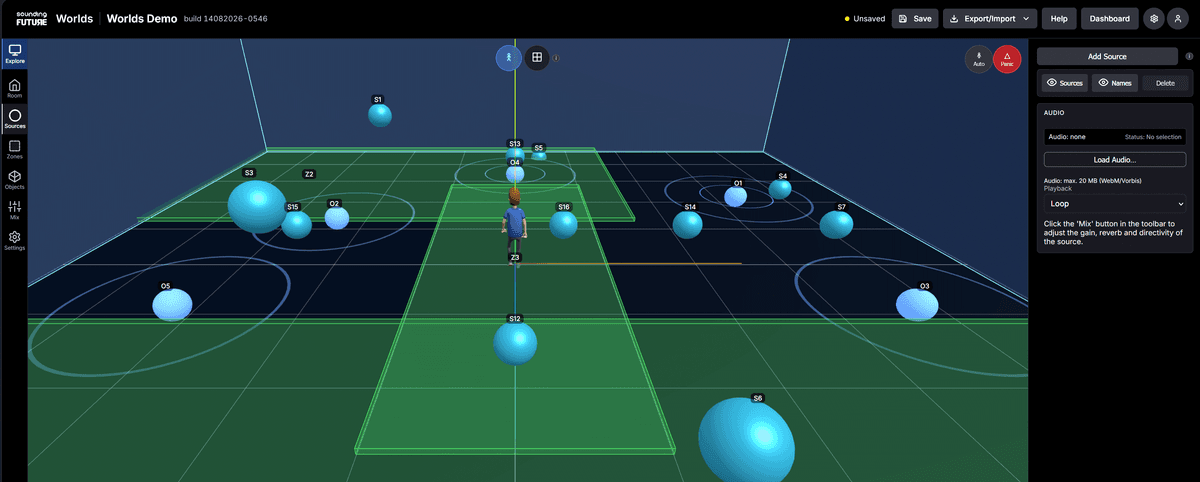
Edit view with zones, objects, sources
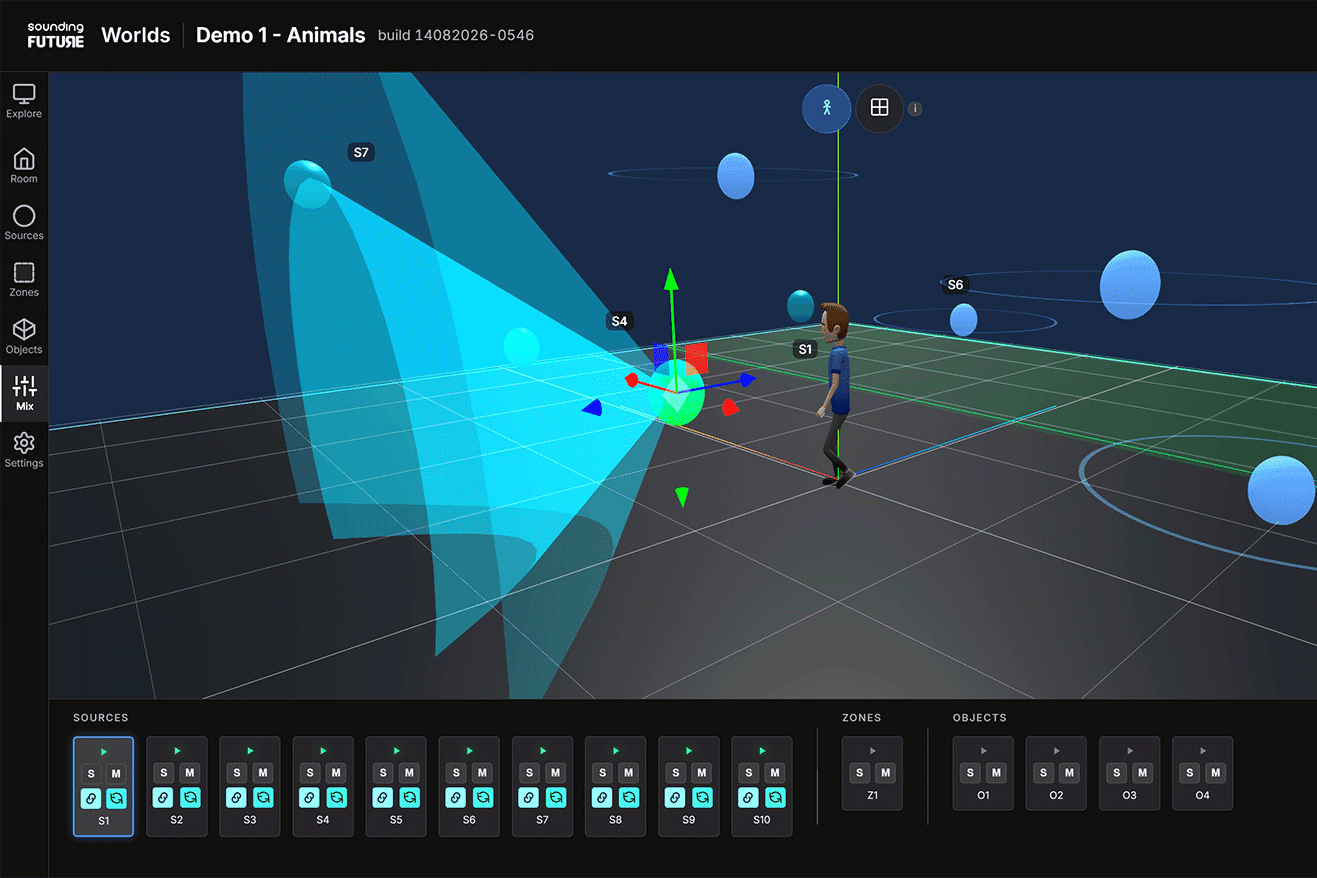
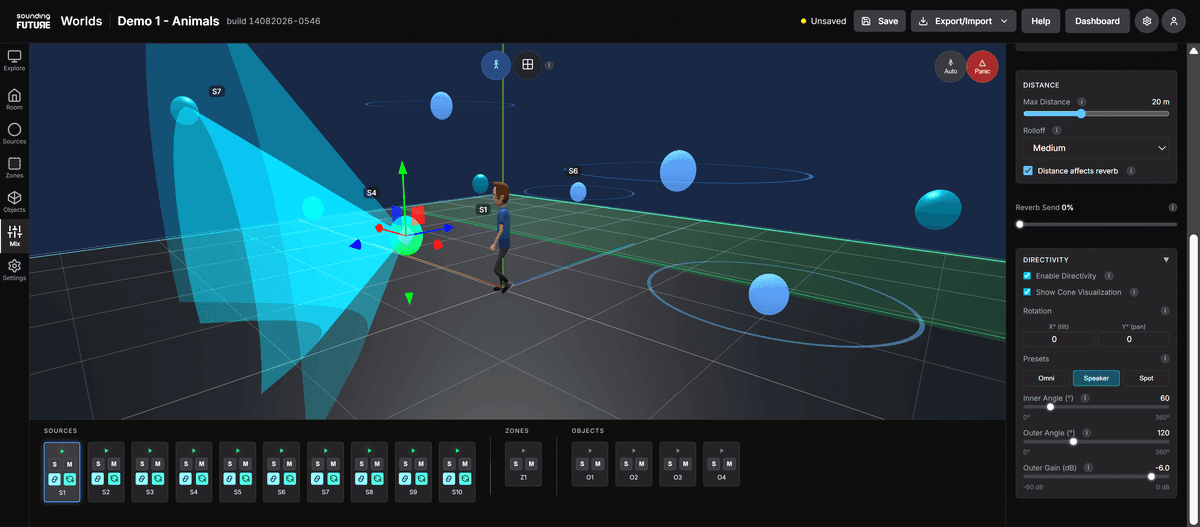
Sources are individual, point-like sound sources in space – a bird in a tree, a voice at a particular spot, a sound object you can approach or move away from. Their loudness and direction change in a physically plausible way, depending on where you are relative to them and where you are looking. Each Source can also be given a directivity pattern: it can radiate evenly in all directions – a full 360 degrees – or project its sound in a focused cone of, say, 90 or 30 degrees, like a loudspeaker pointing one way. Walk around such a source, and it sounds present from the front and noticeably muted from behind.
Zones, by contrast, are not point sources but area-based sound beds that fill a defined region of the space with ambient sound – wind in a courtyard, say, or traffic noise at a street corner. Enter a zone and its sound fades in; leave it and it fades out again. Zones can overlap, with clear priority rules determining which sound prevails.
World Objects, finally, are interactive triggers in space – placeable visibly or invisibly, with a defined radius of effect. Approaching such an object or entering its radius can trigger an action: a sound starts or stops, a text appears, a visual change occurs. You can also choose whether an action is triggered once, as soon as you enter or leave the radius, or whether it changes continuously with distance – a volume, for instance, that rises or falls smoothly the closer you get. World Objects are thus the tool for turning a sound world into a narrative: moments that only come into being when visitors actually turn towards a particular place.
From these four layers emerges the sonic and dramaturgical structure of a Worlds world.
The Editor: Building a World in the Browser
Worlds runs entirely in the browser. No download, nothing to install – you open the link and you are in the editor. Anyone who wants to build a sound world should be able to simply start, without setting up software first.
Rooms: From a Box to a 360° Photo
The first step in building a world is the room itself. Several options are available here: simple geometric shapes such as a box or a dome, which quickly create a neutral test environment, all the way to your own uploaded 3D models or a 360° photo as a photorealistic backdrop. This range has a practical reason: sometimes it is about quickly trying out an idea without worrying about visual details. Sometimes a real place – say, a courtyard where an installation will later actually stand – is to be recreated virtually as precisely as possible, so that you can already experience on screen how a composition will feel on site.
The editor is not limited to recreating real, physically existing spaces, though. You can just as well build worlds that would be impossible, or possible only at great expense, in physical space – visually as well as acoustically. This applies to very large rooms that could hardly be built in reality, or a multitude of sound sources that would scarcely be feasible in a physical installation for reasons of space or cost. Worlds thus becomes not only a tool for preparing real installations, but also a compositional space in its own right.
Placing Sounds – Visible or Invisible
Into this room the sound building blocks are then placed: Sources, Zones and World Objects, the elements described above. This happens not via numeric values or coordinate lists, but directly in three-dimensional space – you grab an object, drag it to its position, and see immediately where it sits. Each building block brings its own set of parameters that can be adjusted on the spot: how far a sound source reaches, how quickly its loudness falls off with distance, how one zone transitions into another.
The visual appearance of every Source and every World Object can also be freely chosen: they can remain completely invisible – pure points of sound in space, found only by listening – or be represented as a simple geometric shape, such as a sphere or a cube. If you want more, you can upload your own 3D model: a loudspeaker, an abstract sculpture, or whatever fits the composition. This decision is purely a matter of design – it does not change the sound behaviour, but it can be decisive when a world is meant to tell a story visually, not just acoustically.
Stepping Inside: Three Perspectives
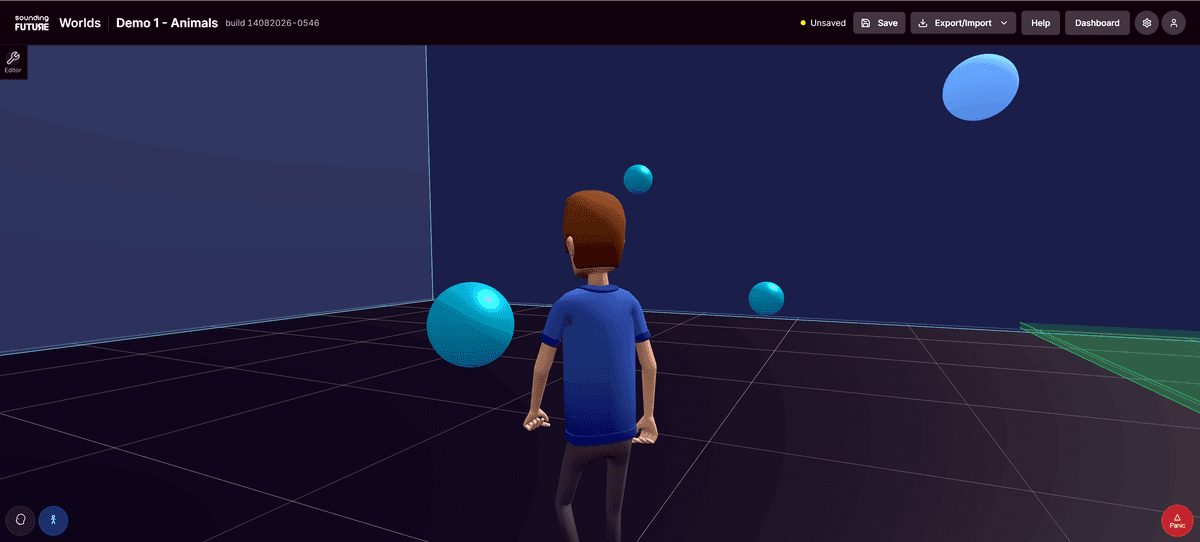
What further distinguishes the editor from a classic audio tool is the ability to move within the world as it takes shape – not just to view it from outside, but to step inside and listen. Three views are available for this: the bird's-eye view from above, helpful for precise placement; a third-person view for an overview while building; and the first-person view, in which you literally walk through your own composition, just as the visitors to an installation will later. This ability to switch inside at any time and hear what you have just built is crucial – you are not mixing on a timeline, you are shaping a space you can walk through immediately.
© Sounding Future
Worlds First-Person-View mode
Your own appearance in the space can be customised as well: for the third-person view, you can upload your own avatar model, so that you – or another figure – can actually be seen walking through the emerging world, rather than following a neutral default shape.
Accordingly, the editor distinguishes between two modes: in edit mode, everything can be moved, adjusted, added. In explore mode, the tools disappear, and what remains is exactly what visitors will later experience – a sound world you move through freely.
Mixer, Sync and Project Management
For fine-tuning there is a mixer, laid out like a mixing desk in classic music production software (a DAW): every Source, every Zone and every sounding World Object appears as its own channel, with mute and solo switches, volume level and reverb send. This allows you to listen to individual sound sources in isolation while working on a complex world with many simultaneous elements – a workflow familiar from music production, transferred directly to the spatial context.
© Sounding Future
Mixer view, zones, objects and one source with activated directivity
Added to this is the sync function: several sources can be marked as a group that plays back in sync with one another. This becomes necessary, for instance, when a composition was originally created for a multichannel format – say, an eight-channel piece – and Worlds is used as a listening space for those channels: the individual channels then sit as separate Sources in the space, but must run exactly in sync, just as they were originally conceived as one coherent work.
Beyond the editor itself, Worlds is embedded in a platform that makes working on multiple projects practical. Your worlds can be saved, reopened and reworked at any time. They can be cloned – to try out a variant without altering the original, for instance, or to use an existing world as the starting point for a new one. Logging in takes you to your own workspace with an overview of your projects – where you will also find several demo worlds to learn from or use as templates, to get to know the tool's possibilities before building a world from scratch.
Never Finished: An Outlook
As of summer 2026, Worlds is in use as a beta version, continuously tested and refined. Its development is not complete – and it never will be. On the list, for instance, is the integration of Gaussian splatting, a recent technique that turns ordinary photos or videos into photorealistic, walkable 3D reproductions of real places – a real courtyard could then be brought into Worlds not just as a 360° photo, but as a space you can actually wander through. And head tracking: translating the listener's physical head movements – via webcam, for example – directly into the listening direction, so that you can literally turn your head to listen around, instead of navigating with mouse or keyboard.
What arrives, and when, depends not least on the interest of the Sounding Future community – and on partners and institutions who want to work with Worlds. For the next stage, I would also like to see a development team: to make what already exists more efficient in the browser environment, and to take on new features such as Gaussian splatting or webcam tracking together – realistically, this will happen with partners who are willing to carry this development forward with us. Because Sounding Future Worlds aims to be both: a tool and a stage for virtual sound worlds. A stage on which existing works from physical space can be documented – or on which something new is invented and tried out, something that exists nowhere else yet.
From the Browser into the Courtyard
What began with the question of how the freedom of a walk-through sound installation could be captured at all has thus become a tool that builds this freedom in from the start: a space you move through, listen to, linger in – online in the browser as much as, in the next step, physically on site.
© Sounding Future, augmented photo with AI-generated humans
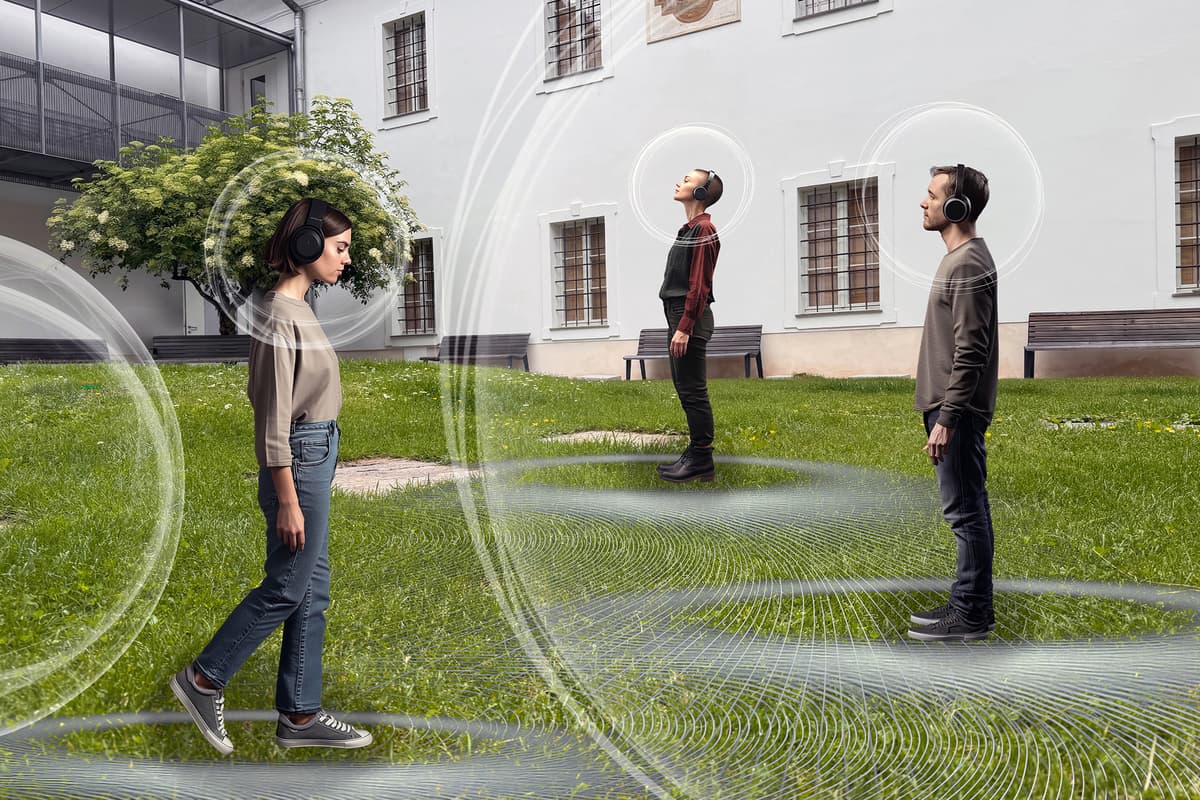
Worlds / Graz, installation project photo
Worlds takes this next step in autumn 2026: in the courtyard of the Volkskundemuseum am Paulustor in Graz, a walk-through sound installation is being created. Several visitors move through the courtyard at the same time, each equipped with headphones and located in the space via tracking – hearing live how the sound changes with every step and every turn of the head.
Three composers – Natasha Barrett, Gerriet K. Sharma and Otto Iivari – have each built their own worlds with Worlds, which now travel the opposite way: from the virtual world into real space. The software that began as an answer to a documentation problem thus itself becomes the basis of a new, genuinely walkable sound work.
The Worlds / Graz installation can be experienced from 8 to 11 October 2026 as part of ORF musikprotokoll 2026 in the courtyard of the Volkskundemuseum am Paulustor in Graz.
How this translation into the physical actually works – from the tracking in the courtyard to the three worlds by Barrett, Sharma and Iivari – will be the subject of a second article, to be published here on Sounding Future.
We're currently trying to find out who's interested in Worlds — institutions and individual artists alike — so we've set up a waitlist and will keep everyone posted as it develops.
Happy to have you on it: https://soundingfuture.com/build
My thanks go to Jakob Gille, Heimo Ranzenbacher, and to Natasha Barrett, Gerriet K. Sharma and Otto Iivari for their valuable feedback while testing Worlds at various stages of its development. Special thanks go to Atmoky for generously supporting Worlds by providing their web audio engine.
The installation is co-produced with ORF musikprotokoll and the Volkskundemuseum Graz, and is supported by the Ernst von Siemens Music Foundation, the cultural department of the Province of Styria (Land Steiermark Kultur) and the cultural department of the City of Graz (Stadt Graz Kultur).