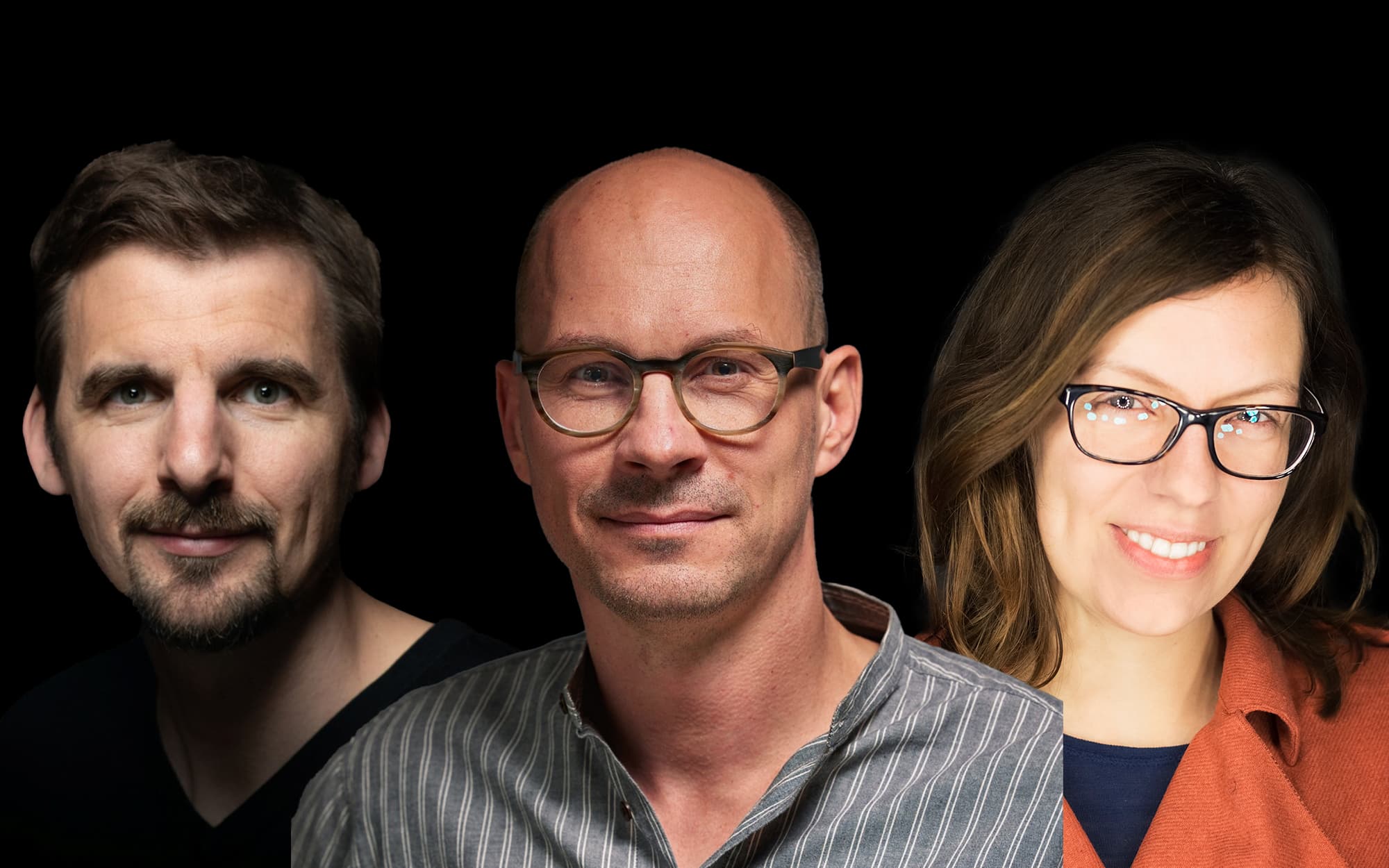
© ORF musikprotokoll, M. Gross
Walking Through Sound: Worlds in a Graz Courtyard
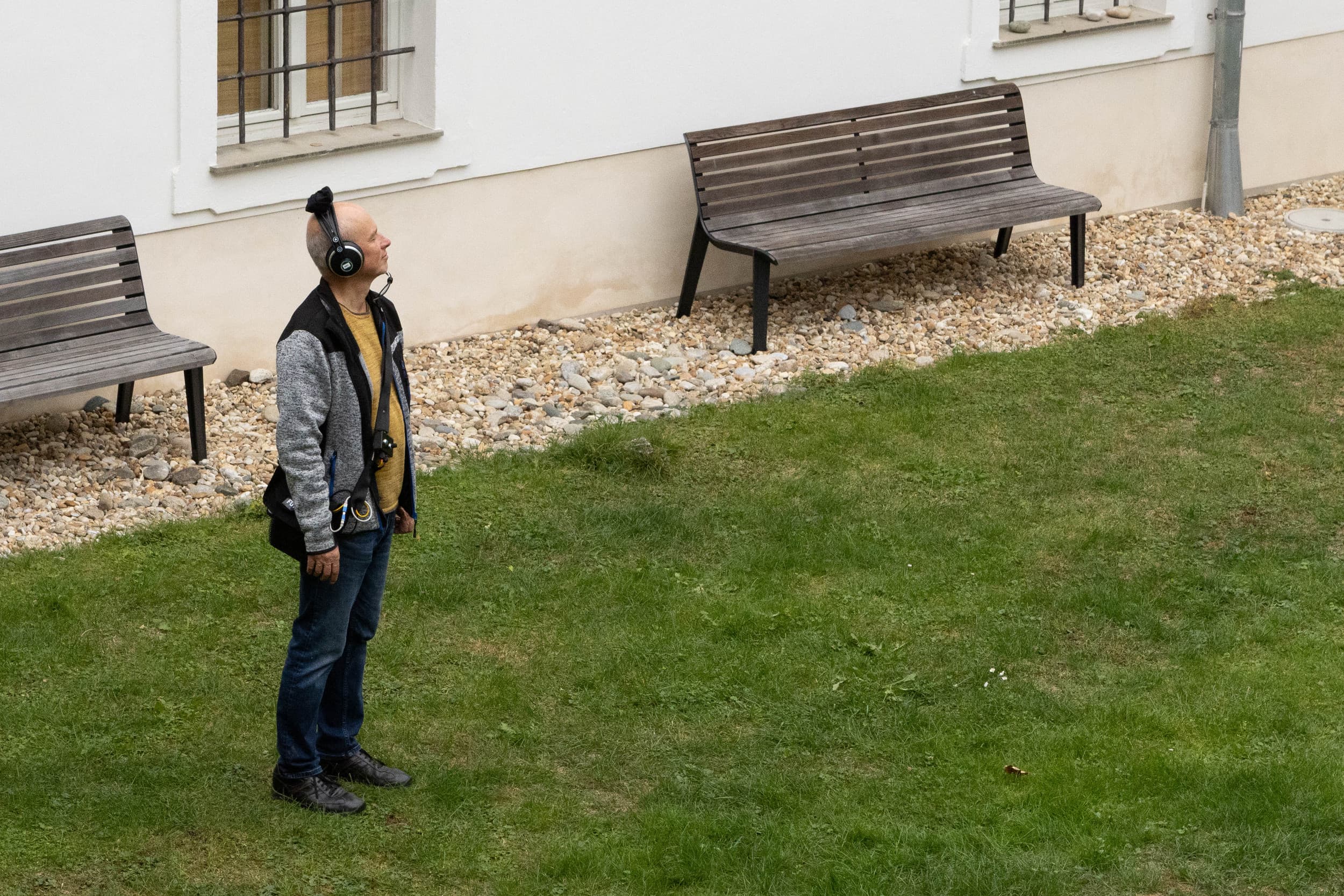
From 8 to 11 October 2026, visitors put on headphones, took a small bag with a mini computer that held local versions of the three worlds, and walked a field of 10 × 15 metres between the pillars of the courtyard. There were no loudspeakers. The sound was computed for each visitor individually, from their position and the direction of their head: the three worlds, built months earlier in the browser, with the same coordinates as the courtyard.
This article describes three things: the works and how differently the three composers used the tool, the technical setup that carried the worlds into the courtyard, and what the installation did to the relation between seeing and hearing.
Transposition, Re-enactment, Digital Twin
One starting point of Worlds was the documentation of installations. Visitors to an installation choose their own listening positions and stay as long as they like. Worlds decouples this behaviour, and the sound that depends on it, from the physical space, and so makes it reproducible. In Graz the order was reversed: the virtual world came first. The composers built their worlds online, in a box of 10 × 15 metres, knowing from the start that in October they would be laid over a real courtyard, one metre to one metre.
Worlds gives them three building blocks. Sources are fixed sound sources in space, either directional or radiating in all directions; they get louder as you approach. Zones are areas of sound that fade in when you enter them and fade out when you leave. Objects respond to approach and play sound fragments when you come within their radius.
Online you move through a world as an avatar, in third-person or first-person view. Everything you see shows where something sounds and how. A directional source is a loudspeaker with a grille on its front, an omnidirectional source a column with a grille all round, an object a flat round body that lights up as you approach, a zone a discreet marking on the ground. The grilles brighten while they play. These are defaults: artists can replace every visual element with their own models, colours and rooms. In the courtyard you are the avatar yourself. You see gravel, grass, the museum walls and the other visitors; everything else you have to hear. The installation is therefore a transposition of the same coordinates and sounds into another medium, a re-enactment of the online walk with your own body, and partly a digital twin – one that was built before the original.
The Field
In the courtyard we chose a rectangle of 10 × 15 metres and gave it exactly two physical landmarks: the tree in one corner and a small mound near the centre, which we called the bulge. Everything else was left as it was. We did not want a path, a map or stations. We wanted a field that could be explored aimlessly, and we left it to the composers whether the tree or the mound should mean anything in their world at all.

© Sounding Future
Courtyard layout. The walkable field: 6 UWB anchors, master tag, tree and bulge.
The composers received this layout as a room in the Worlds editor, tree and bulge included. The editor and the courtyard use the same coordinates: the centre of the field is point zero, one metre is one metre, and the negative z-axis points towards the bridge. What the composers placed online sounded in the courtyard at the same spot.
Three Worlds
From these three building blocks, three very different works emerged.
Natasha Barrett – The Missing Dark Matter
Natasha Barrett starts from cosmology. Dark matter is an invisible form of matter that is inferred from its gravitational effects; it is thought to hold galaxies together. A few years ago astronomers identified galaxies that appear to contain very little of it. For Barrett this says as much about us as about the cosmos:
“When our models fail to match experience, we tend to invent explanations and then search for evidence to support them.”
In The Missing Dark Matter, dark matter speaks with a mystical voice. Its presence or absence shapes the character of the sound space and the order or disorder of its materials. Many of the sounds are sonifications of simplified, scientifically informed galaxy models: each star is mapped to a sound source and spatialised according to its position relative to the system’s barycentre, sometimes with dark matter holding the structure together, elsewhere without it.
Visitors move among portals that inject new sonic matter into the courtyard, and decide for themselves whether they prefer to stay in a zone where the gravitational scaffold of dark matter holds the structure in check, or in one without.
Gerriet Krishna Sharma – Limenfeld
Gerriet Krishna Sharma comes to the courtyard from spatial theory. In his compositional practice he distinguishes three levels: composing in a space, composing with a space and composing space itself. Limenfeld, he writes, works above all on the third level, and opens a fourth question: what does it mean to compose space when that space is at once virtual and physical?
He uses Michel de Certeau’s distinction between lieu, the geometrically given place, and espace, the place that comes into being only through movement and practice. The courtyard is at first a lieu. Only through the listening walk of the visitors, each along their own trajectory through an invisible field of sound, does it become an espace.
What interested him in the project was the reduction:
“No visible loudspeakers, no visual interface, no map. Only headphones, position, body orientation and listening. Orientation arises solely through acoustic practice, or it does not.”
For Sharma, Worlds allows what he calls Sonic Worldmaking: acoustic architectures beyond physical constraints. Sounds that occupy the same position without colliding, zones defined only by sound, intensities that change as the body approaches. He reads the setup as a walkable realisation of the “zones of intensities” Edgar Varèse formulated as a utopia in 1936, with head tracking as a compositional parameter that writes body orientation directly into acoustic perception.
Graz is not a random place for him. It is where he completed his doctorate and developed the conceptual foundations of his practice. With Limenfeld he returns in a medium that did not exist then, but that grew out of the same questions.
Otto Iivari – Block Universe
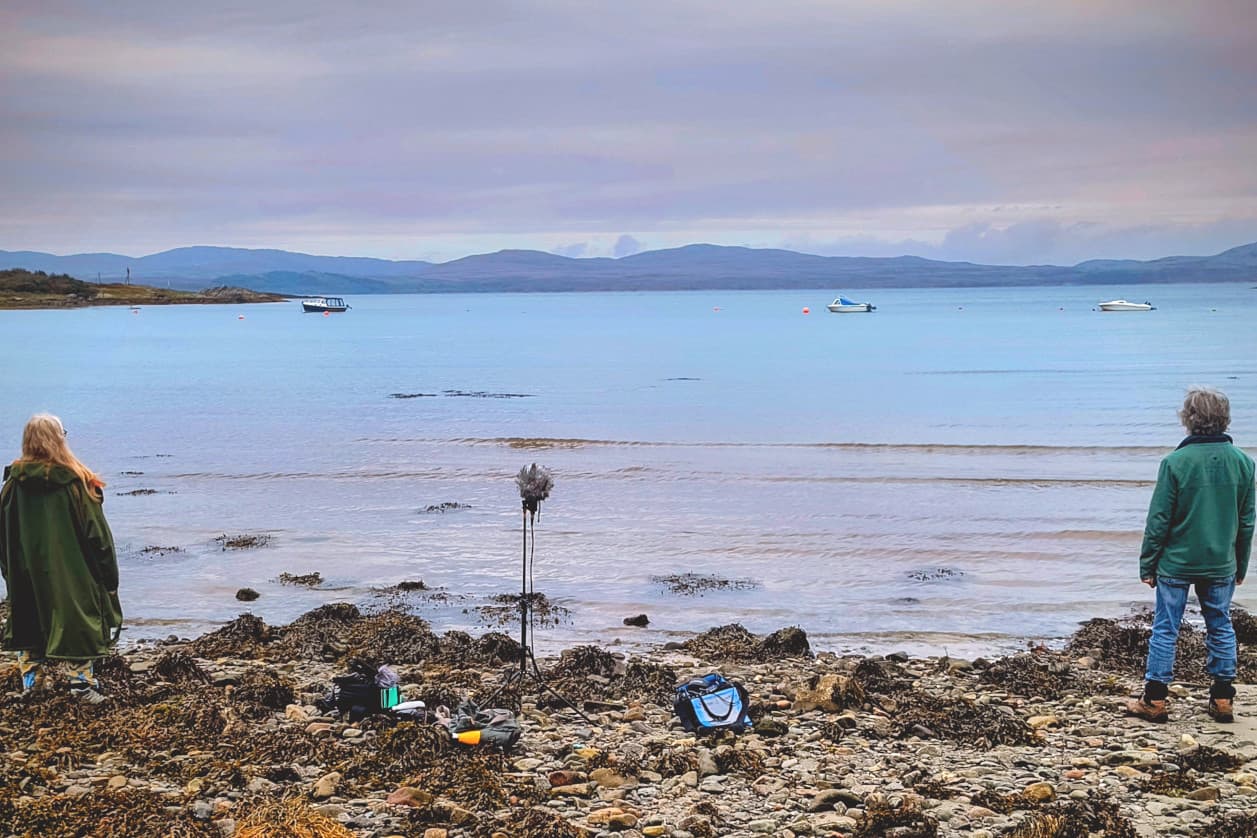
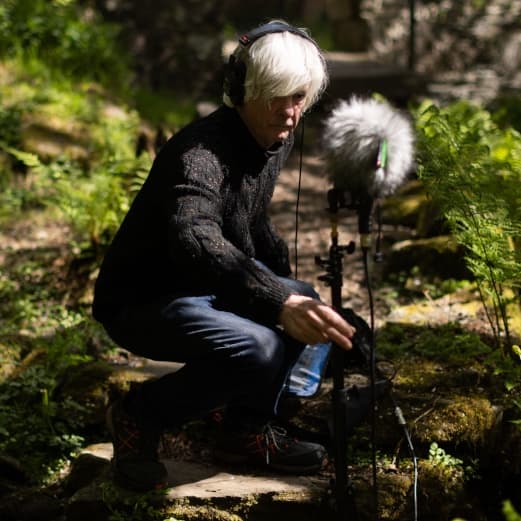
Otto Iivari’s starting point is the block universe, the model of time in which past, present and future exist simultaneously. The model appealed to him when he thought about a piece in which the listener can move inside the composition and peel away moments of sound embedded in the space. But he did not want to make a piece about the model. He wanted something more personal, and filled the courtyard with places he has recorded: Vattaja in Lohtaja, one of the longest natural sand beaches in the Nordic countries; a meadow by Rimmi road near his childhood home in Kälviä, where the wind rustles in the aspens and moves the grass in waves; and sonic moments from his travels, hidden throughout the piece.
These recordings are woven together with sounds from traditional electroacoustic synthesis, made in his father’s garage, “home to an endless collection of objects waiting to be combined for sound-making”. One of the most frequently used sounds comes from a chordophone he built for the piece from a wooden board, steel wire and a tin can as resonator, struck with a mallet tipped with Styrofoam: soft but sharp, almost bell-like.
Block Universe, Iivari writes, moves away from the vast topic of space and time and invites the listener to step inside an acousmatic composition and experience time in the form of sound and space.
Three Ways of Using the Same Vocabulary
Walking the three worlds many times, online and in the courtyard, one thing stands out: how differently the three composers handled the same three elements.

© Sounding Future
Three scores for one courtyard. Zones (soft areas), sources (points with audible range), directional sources (fans), objects (rings mark the trigger radius, double rings respond to proximity). Entrance at the bottom.
Barrett placed 9 sources, 8 zones and 18 objects, Sharma 12, 8 and 14, Iivari 16, 5 and 6.
Barrett’s world is the densest. Her objects are the portals from her text, some so close together that a few steps trigger one after the other, over wide zones that change the sound in layers from the entrance towards the bridge. Sharma’s world is built like a floor plan: zones frame the field, and his objects sit in an almost grid-like formation, thresholds – Limen – that you cross one by one. Iivari’s world is a landscape: sources scattered to the edges carry the recordings, large parts of the field have no zones or objects at all, and the few objects are gathered around the tree.
None of this was prescribed. The tool does not suggest a style, and the three results show it.
Composing with a Tool That Was Still Being Built
One thing the installation sheet did not say: Worlds was not finished when the composers started working in it, and it was still changing when they stopped.
The development of the app ran in close cooperation with Natasha Barrett, Gerriet Krishna Sharma and Otto Iivari: the creative tools, the debugging and the interface guests use to visit a world. The composers built their worlds and at the same time gave feedback: what they were missing, what did not work the way they expected. That feedback went into the next version, and the next version arrived while they were still working in the previous one.
For the development this was enormously useful. Three composers with very different practices, working in parallel on a real deadline, find things we would not have found on our own. For the composers it was probably sometimes annoying. Working in a tool that keeps changing is not what you expect when you accept a commission. They stayed with it, and we are grateful for that.
What came out of it is less a finished product than a development that is still going on. Worlds / Graz was its first public realisation. At the end of October 2026 the three worlds go online for everyone.
Carrying a World in a Bag
The basic idea of the installation is simple: every visitor carries their own small sound world with them. The sound does not come from loudspeakers in the courtyard. It is computed for each person individually and played over headphones, matching where they stand and where they look. Three questions have to be answered for every visitor, continuously: Where am I? Where am I looking? What do I hear?
Where am I? – Positioning by radio
Six pillars with radio antennas, the anchors, stood around the field. Each visitor carried a small transmitter, the tag, mounted on top of the headphones so that it had a clear line of sight to all anchors. The anchors continuously measure how long the radio signal takes to reach the tag and compute its position from that, similar to GPS, only on a small scale and to an accuracy of about 10 to 30 centimetres. The technology is called UWB, ultra-wideband, a very short broadband radio pulse. It is widely adopted in industrial logistics to track assets in warehouses but also in keyless-entry scenarios, where it is used to open doors when a tracker is close enough.
The anchors are small, but had to be protected from October weather. While all our tests took place during one of the hottest summers of recent decades, a typical autumn day in Graz can be very rainy. In order to keep the anchors dry we put them into six pillars at a height of 2.2 metres, neatly placed above the heads of the visitors.
The master tag was connected to a central computer at the edge of the courtyard and gathered the position data of all tags. One drawback encountered during the development was that the more tags are active, the less often each position is updated as tags share the same radio channel. During the field tests on 31 August, four tags resulted in an update rate of around 350 ms per tag. For the final setup we compromised on three active tags which sped the update rate up to around 250 ms. The player interpolates between updates depending on that rate.
While I was developing the app, the tracking – and how it talks to the app – was Peter Venus’s part of the project. Venus is a sound engineer and sound and media artist who has worked for many years on installations, productions and concerts in contemporary music, with a focus on immersive media. He works on both sides, the artistic and the technical, which made the collaboration easy. He wrote Pure Data patches for the central computer and the wearable players. These patches managed a Wi-Fi-based data exchange between the master and the players. On the players this patch also managed the communication between the data layer and the Worlds app running in the browser. For the most part OSC (a flexible protocol that music software and devices use to exchange data) was used as a data protocol. Besides the transmission and exchange of position and head-rotation data an interface was implemented that allowed errors and system health to be checked in real time.
Where am I looking? – A sensor on the headphones
Just below the tag, on the headband, sits a small motion sensor, an IMU, used as a head tracker. It measures which way the head is turned. This happens directly at the head, with no detour over the network; the sensor is cabled straight to the computer in the bag. That is why the sound follows head movements immediately, even when the position lags a little.

© Sounding Future
Headphones with tracking: the UWB tag on top for a clear line of sight to the anchors, the IMU just below it for head rotation. Both are cabled to the Raspberry Pi in the bag.
What do I hear? – A computer per person
In the bag each visitor carried a Raspberry Pi 5, a computer the size of a credit card. On it runs the same Worlds software as online in the browser, only without a screen. It receives position and head orientation and computes the sound: sources get louder as you approach, zones fade in as you enter them, objects respond. The result is rendered binaurally, so that the sound in the headphones (closed AKG K271) seems to come from a place in the courtyard. The 3D audio rendering engine is by atmoky. The three worlds were not re-implemented for the installation; they were exported from the online tool and loaded onto the Pi, and what sounds in the browser sounds the same there.

© Sounding Future
How a visitor is tracked and hears the world
The three worlds are loaded on the Pi one after the other. A button on the bag switches to the next one: from Barrett to Sharma, from Sharma to Iivari, from Iivari back to Barrett. Visitors can press it whenever they like, so each of them decides how long to stay in a world and in which order to hear them. A dial sets the volume. Everything else – restarting a set, resetting head orientation, switching a world from outside – was done at the central computer. Visitors only had to walk and listen.
The bag itself was a challenge of its own. The Pi is actively cooled, so the fabric had to let air through; the cables to the headphones and the button had to be routed so that nothing pulls or tangles while walking; and the whole thing had to survive four days of use. Elli Scambor made the bags, and turned a prototype into something that could be handed to visitors.
When There Is No Screen
Online, Worlds is as much a visual medium as an acoustic one. You see a room, a 360° photo, loudspeakers and columns whose grilles light up while they play, markings on the ground for the zones. You know what you are walking towards before you hear it. For the courtyard we gave all of that up deliberately. No screen, no map, no markings on the ground. The only instruction was the sign at the entrance: move slowly, visit the small mound and the tree, stay between the pillars.
The two landmarks had a specific job. The instruction to visit the mound and the tree was a reason to start walking at all, to cross the field instead of standing at the edge. Once people were moving, something else took over: they went where their listening took them. How does this world sound here? Three metres further on? Over there, under the tree? How has this composer tied the sound to the space? Some tried to find a listening impression again that they had passed a few minutes earlier, and searched the field for it. The courtyard became what Sharma describes: a lieu that turns into an espace through walking.
The ground helped. The courtyard is gravel, and gravel slows you down. Visitors moved more carefully than they would on a paved surface, and the slower pace suited the music. The worlds unfolded at walking speed, not at mouse speed.
This reduction, no loudspeakers, no interface, no map, was how the project was set up from the start, for all three pieces. Only in the courtyard did it become clear what it means. Online, the eye is ahead of the ear. In the courtyard there is only the ear. That is why we now see the online version and the physical installation as two different projects that share one source.
Visitors
Over four days, open from 10 am to 6 pm, several hundred people visited the installation, three at a time. It was staffed throughout. Jakob Gille, a composer of electroacoustic music who works with spatial audio and Ambisonics and our main tutor in the 3D audio tutorials in Sounding Future’s Learning Lab, had supported the setup and spent much of the week in the courtyard handing out sets, resetting head orientation and talking to visitors. Having someone in the courtyard who composes for space himself made a difference to those conversations.
The conversations went in two directions. One was about what people had just heard: which world they preferred, where a particular sound had been, whether the galaxies or the meadow or the architecture had worked for them. The other was about what else the concept and the technology could be used for. Several visitors brought up music therapy, where a space that responds to movement could be a tool. Others brought up music education, where pupils could build their own walkable worlds. We had not expected that so many of these conversations would be about building rather than listening.
Online Again
Worlds / Graz was the first time worlds built in the tool were transferred into public space. They are now open to everyone in the Worlds interface.
For guests who visit them there we added one thing after the festival: a 360° photo of the courtyard that can be switched on and off. With it off, you see the bare virtual field: a box with loudspeakers, objects and zones. With it on, you see the lawn, the benches and the museum walls, and you walk, as an avatar, the field that others walked with their bodies at the festival.

© Sounding Future
The controls in the Worlds interface. Two buttons matter for the Graz worlds: Real place switches the 360° photo of the courtyard on and off, Sound objects shows or hides the markers for sources, objects and zones.
There is a second switch. The markers for sources, objects and zones can be hidden as well. With the photo on and the markers off, you are as close to the courtyard as the browser gets: the lawn, the benches, the walls, and nothing that tells you where the sound is. If you want to know what the visitors in Graz experienced, this is the setting to try.
The 360° photo is a first step. A photo like this is taken from one point, and you can only look around from that point; if you want another view, you jump to the next photo. We are now working on a representation of the courtyard as a Gaussian splat.
Gaussian splatting is a method of reconstructing a real place in 3D from many ordinary photographs. Instead of a mesh of polygons, the scene is stored as millions of small, soft, coloured blobs – the splats – that together look like the place when seen from any angle. The courtyard was photographed for this during the festival. Once the splat is in Worlds, guests will be able to walk through the courtyard online as they did on site, continuously, not from one fixed point to the next.
As always, Graz is the first project for this. The toolchain and the representation will then be available for every other world: any place that can be photographed can become a walkable room in Worlds.
So much for the explanation. The three Graz worlds are online at worlds.soundingfuture.com, with headphones recommended. Walk in, turn your head, and see how far you get without a map.
And if you would rather build than listen: Worlds will open to artists step by step. You can join the waitlist to be among the first.
Worlds / Graz was a production of Sounding Future in cooperation with ORF musikprotokoll and the Volkskundemuseum am Paulustor, supported by the Ernst von Siemens Musikstiftung, the Province of Styria and the City of Graz.
Composition: Natasha Barrett, Gerriet Krishna Sharma, Otto Iivari. Curator and Worlds software: Fränk Zimmer. Tracking hardware and software: Peter Venus. Setup support: Jakob Gille. Software support: Ansar Karrouach. Bags: Elli Scambor. Editing: Heimo Ranzenbacher. 3D audio rendering engine: atmoky. Many thanks to Heimo Ranzenbacher for many stimulating conversations and his feedback throughout this project.