
Rather than using sound exclusively as information, amplification, or feedback correction, I began exploring whether the spatial and temporal properties of sound could actively influence auditory attention, speech timing, perceptual organization, and the overall functional state of the listener during therapy sessions.
This exploration culminated in the development of a real-time stereophonic 3D sound and speech processing approach applied within clinical speech therapy environments. The system does not aim to create cinematic immersion or audio effects in the conventional production sense; instead, spatial audio parameters are explored as dynamic variables capable of shaping the precise auditory conditions under which speech perception and production occur.
This perspective evolved into what I describe as the “Virtual Acoustic Field” (VAF).
The Virtual Acoustic Field (VAF) Definition:
“A framework for the systematic shaping of the auditory environment through the control of spatial, temporal, and intensity-related properties of sound, with the aim of influencing perception, attention, and the organization of communication and neurodevelopmental function.”
Importantly, this work does not originate from the perspective of an audio engineer attempting to enter clinical practice. It originates from the opposite direction: a speech and language therapist exploring how spatial audio thinking may alter the conditions within which communication takes place.
The novelty does not lie in the psychoacoustic mechanisms themselves, which are already well established, but in their real-time use as adaptive clinical environmental variables during live communication-focused interaction. The result is not a fixed protocol or a collection of presets, but an ongoing exploration of how auditory environments themselves may become dynamic clinical variables.

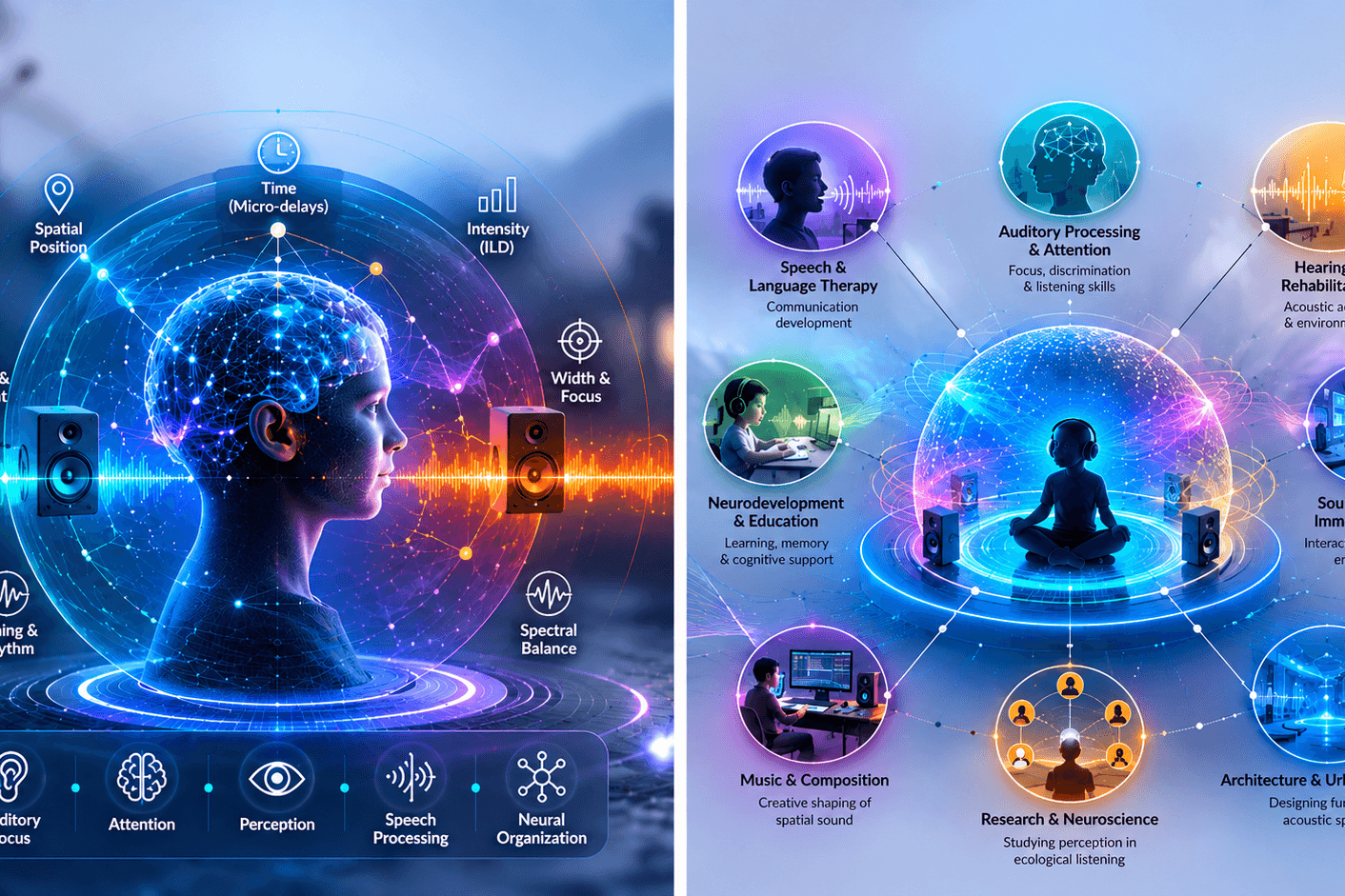
© Nikolaos Mitsiou (AI-assisted visualizations based on the author’s conceptual framework)
VAF Conceptual Framework Illustration
From Audio Effects to Acoustic Conditioning
In conventional audio production, spatial processing tools are typically used for aesthetic, immersive, or mixing purposes. In therapeutic environments, however, the same acoustic phenomena undergo a shift in interpretation.
The question is no longer: “How does this effect sound?”
but rather: “How might this spatial condition influence auditory organization, attention, timing, and speech behavior?”
This shift in perspective transformed the role of spatial processing in my clinical work. For example, moderate stereo width expansion may alter how a listener distributes auditory attention across the acoustic field, while small interaural timing differences can influence spatial orientation and perceptual localization. Similarly, micro-delays within the Haas-effect range may affect temporal coherence without being consciously perceived as an echo.
Importantly, these manipulations are intentionally subtle, as excessive processing can easily overload auditory organization and reduce speech intelligibility. In practice, this clinical caution requires:
Moderate rather than extreme stereo expansion
Micro-temporal offsets rather than obvious repetitions
Controlled spatial variation rather than constant motion
Minimal reverberation to avoid perceptual masking
This approach differs fundamentally from traditional delayed auditory feedback (DAF) systems, where the delayed signal itself becomes the dominant, often disruptive, perceptual event. Instead, it attempts to shape the auditory conditions surrounding speech production in a more distributed, adaptive, and supportive manner.
Real-Time Spatial Workflow in Clinical Practice
The practical implementation of this approach relies on real-time control of the auditory environment during speech therapy sessions. At the center of the workflow is a digital mixing environment based on the Behringer XR12, controlled in real time through the Mixing Station application.
Speech, auditory stimuli, environmental sound, or the patient’s own voice may be routed through spatial processing structures that remain dynamically adjustable throughout the session. Rather than applying fixed effects, the therapist continuously evaluates how changes in the acoustic field appear to interact with:
Auditory attention
Perceptual stability
Speech timing
Vocal monitoring
Listening effort
Overall engagement with the communicative task
Several categories of spatial modulation are explored during sessions, including Stereo Width Modulation, Micro-Temporal Spatial Processing, Controlled Spatial Asymmetry, Spatial Stability vs. Spatial Variability, and Reverberation Control. This transforms the therapist’s role: they no longer operate only as a provider of linguistic or behavioral exercises, but also function as a designer of auditory conditions capable of shaping how communication is experienced within the session itself.

© Nikolaos Mitsiou (AI-assisted visualizations based on the author’s conceptual framework)
Real-Time Spatial Workflow / XR12 Studio Environment
Signal Chain and Spatial Processing Structure
A typical signal path may include:
Voice / Speech Input → Equalization → Spatial Processing → Micro-Temporal Modulation → Stereo Field Adjustment → Output Routing → Headphones or Speaker Environment
Although the chain itself appears technically familiar to audio professionals, the functional interpretation of each stage differs within the clinical context. Equalization is not used primarily for tonal aesthetics; instead, it functions as a way of influencing perceptual accessibility and auditory focus.
Micro-delays and localized internal routing are not intended to create recognizable echoes, but rather serve as subtle temporal-spatial cues capable of influencing localization, perceptual grouping, auditory anticipation, and the temporal organization of speech perception. By utilizing the internal processing matrices and fine temporal adjustments of the digital mixer, the hardware is repurposed from a standard audio tool into a psychoacoustic stimulator.
Perhaps the most defining characteristic of the system is its real-time adaptability; spatial parameters are never fixed before the session begins, but are constantly tailored to the patient's immediate responses.
Beyond Traditional Delayed Auditory Feedback
Traditional DAF primarily modifies auditory feedback after speech has already been produced, making the delayed signal the dominant and often interfering perceptual event.
The approach presented here explores a different acoustic philosophy entirely. Instead of creating overt feedback interference, the emphasis shifts toward shaping aspects of the spatial and temporal organization of the auditory environment surrounding speech production itself — acting more as a feedforward acoustic conditioner.
Within this framework:
Micro-temporal offsets remain strictly below overt echo perception thresholds
Spatial cues remain integrated organically within the auditory scene
Processing attempts to preserve and enhance perceptual coherence rather than disrupt it
The result is not intended as a replacement for DAF, but as an expanded spatial-temporal perspective on auditory conditioning within communication-focused environments.
Clinical Observations and Emerging Questions
One of the most consistent impressions has been that changes in the auditory environment may alter not only how sound is perceived, but also how communicative interaction is organized within the session itself. In some situations, subtle spatial modulation appeared to influence sustained auditory attention, speech initiation, listening engagement, vocal monitoring, rhythm stabilization, or tolerance to prolonged listening tasks.
For instance, in one clinical situation involving speech timing instability, moderate stereo width modulation combined with subtle micro-temporal offsets appeared to improve sustained engagement with speech tasks while reducing perceptual fatigue associated with stronger feedback-based approaches.
An especially important realization throughout this exploration has been that subtlety always matters more than intensity. Large spatial effects or excessive processing quickly become distracting or cognitively exhausting. In contrast, small adjustments near perceptual thresholds appear significantly more compatible with sustained interaction and speech-focused tasks.
Consequently, many questions remain open for future inquiry:
Which forms of spatial organization are most compatible with speech stability?
How does attentional load interact with spatial auditory modulation?
Can adaptive acoustic environments reduce listening fatigue?
How does spatial predictability influence speech timing?
Future Directions
Future communication-focused environments may eventually move toward adaptive and responsive acoustic systems capable of dynamically adjusting according to the listener’s perceptual and behavioral state. Rather than relying on fixed presets, future environments may incorporate:
Adaptive spatial modulation
AI-assisted parameter adjustment
Responsive auditory field organization
Real-time attentional monitoring
Individualized perceptual calibration
Within such environments, the acoustic field itself may become continuously interactive rather than statically configured.
Closing Reflection
This work does not attempt to present spatial audio as a replacement for established therapeutic methods, nor as a technological shortcut for communication-related difficulties. Instead, it proposes a different way of thinking about the auditory environment itself.
Perhaps the future question is not only how we approach communication disorders, but how we design the auditory conditions within which communication takes place. From this perspective, sound is no longer merely information, background, or an effect. It becomes part of the functional architecture of perception, attention, timing, and communication.
The auditory field is therefore not simply something we hear; it may also be something we shape.