
What Alan Blumlein actually understood
On 14 December 1931, Alan Dower Blumlein filed British Patent 394,325 for what he called 'binaural sound'. The popular version of the story is that he invented stereo. And he did: today, we would recognise much of his thinking as the foundations of stereo.
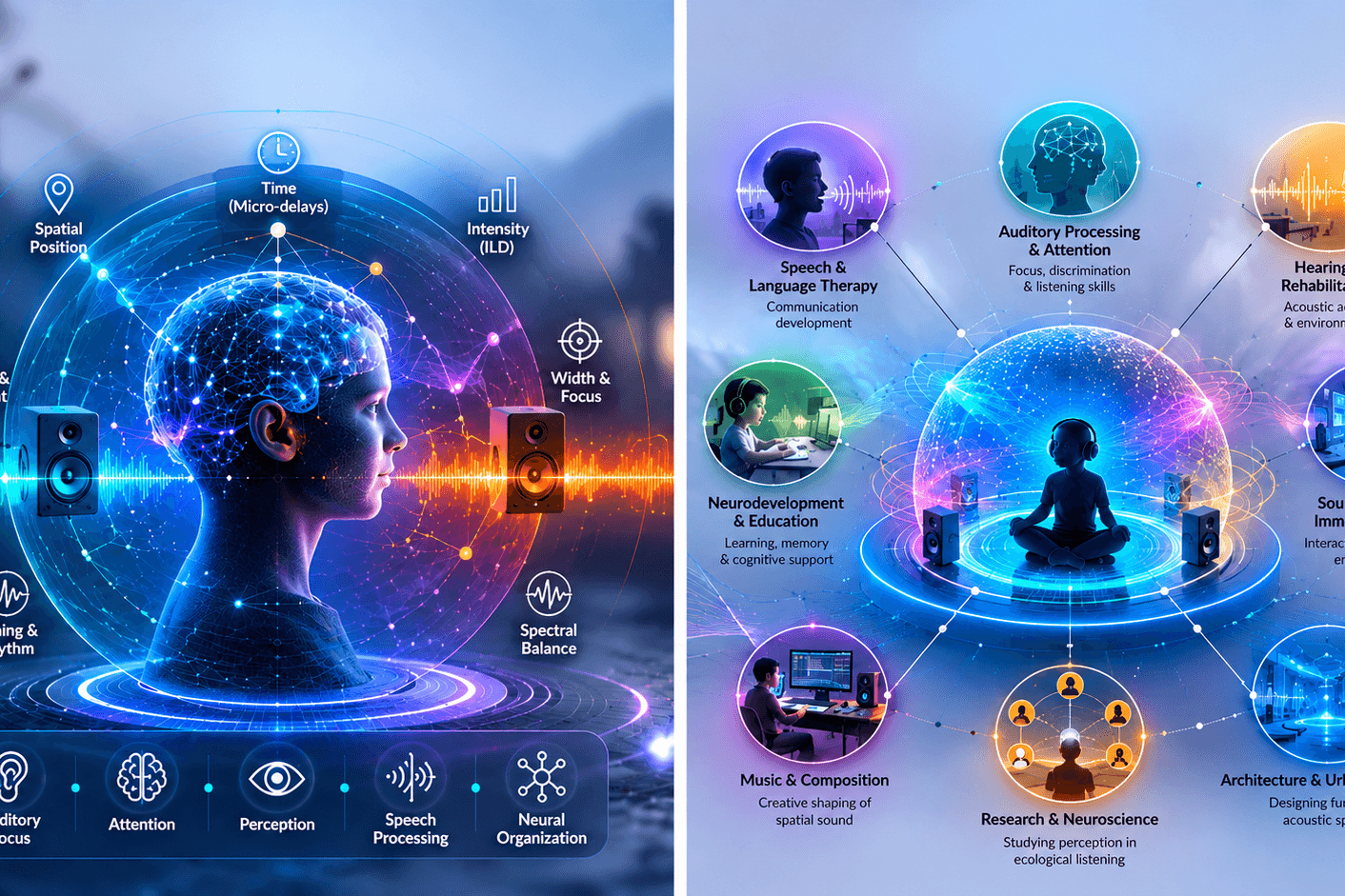
But Blumlein's ambition was broader than the word 'stereo' would come to imply. His real insight was perceptual, not mechanical. Rather than beginning with microphones or loudspeakers, he began with the listener. The patent examines how we determine the direction of sound by comparing what reaches our two ears and goes on to ask how a loudspeaker system might recreate those same perceptual cues.
This is a remarkable objective for 1931. Blumlein wasn't simply trying to transmit two channels of audio; he was trying to recreate the everyday experience of directional hearing.
The patent spends remarkably little time discussing 'stereo' in the modern sense, and a great deal of time discussing localisation, phase, intensity and perception. It is an engineer's attempt to understand, first, how the brain constructs a sound field, and then, how to reproduce it.
In modern language, Blumlein was identifying the perceptual cues our brains use to judge direction, and describing the information a reproduction system must preserve to sound convincing. He wasn't trying to reproduce every physical aspect of a sound field; he was trying to reproduce enough of the perceptual cues to convince the listener.
One elegant consequence of this work was the Mid/Side representation of sound. By expressing the sound field as a Mid signal (the sum of microphone sources) and a Side signal (the difference between them), the directional information could be encoded, manipulated and later reconstructed with remarkable flexibility. Today Mid/Side remains one of the most elegant tools in recording and mixing, and the coincident microphone technique that bears Blumlein's name is still widely used.
Where Blumlein saw that stereo was not the complete answer
Stereo took the most practical commercial expression of Blumlein's work and ran with it. The 45/45 record groove, headphones, two channels to two speakers: it became the standard, and rightly so. None of this is a complaint about stereo. Stereo is not broken. It solved its own problem beautifully, and it is still solving it today.
But throughout Patent 394,325, Blumlein returns to a broader question than simply transmitting two audio channels. His concern repeatedly revolves around the idea of reproducing a convincing directional experience for the listener.
Two loudspeakers are not two headphones. Over headphones, each ear hears only its own channel and the illusion is clean. Put the same signal through two speakers in a room and each ear now hears both of them; the cues partly contradict one another, and the stereo image only really coheres in precisely one place in the room – what we call the 'sweet spot'. Blumlein recognised this explicitly and devoted much of the patent to understanding how those directional cues might be preserved once sound is reproduced through loudspeakers.
Then the work stopped. Blumlein was tragically killed in 1942, at the age of thirty-eight, in the crash of a Halifax bomber while testing airborne radar. Commercial stereo did not arrive until the late 1950s, once his patents had lapsed. As stereo became established, the industry naturally concentrated on refining and commercialising two-channel reproduction. The broader psychoacoustic questions explored throughout the patent became less relevant. Not because they were wrong, but because the practical problem of the day had been solved. The ‘stereo experience’ was easily achieved – and it worked.
For the next seventy years, there was little commercial reason to advance the science any further.
Nearly a century later, the problem finally returns
What changed is not the theory. What changed is the job the world is asking us to do.
Fast forward to 2026. Spatial audio recordings are everywhere. Object-based and immersive formats ask us to do something that stereo never required – reproduce a fully three-dimensional sound field, a sound that lives around the listener rather than between two points.
The true difficulty of immersive audio is not the format. It is the playback technology.
Done in a way that echoes the studio that mixed it, reproducing immersive content implies a lot of loudspeakers, careful placement, acoustic treatment, and – once again – a sweet spot (which is now even more critical to achieving the desired effect). The established tool for this is a discrete array of loudspeakers – typically 7.1.4 or similar, and a precisely calibrated room and listening position.
Wave Field Synthesis, beam forming and crosstalk-cancellation technologies all exist and have gained followers. They are all, in different ways, attempting to solve the same modern problem: how do we reproduce a convincing sound field in a manner that is both accessible and practical?
One highly elegant example is Audioscenic, founded by Marcos Simón. Rather than trying to create a spatial sound field throughout an entire room, it tracks a listener and dynamically adapts its rendering to maintain a consistent binaural experience at the user’s ears. It is an excellent example of the industry exploring practical deployment rather than simply increasing technical capability, and is particularly well suited to applications such as computer monitors, laptops or soundbars.
The point I want to make is this: all of these technologies begin with the same objective. If we accept that the goal of audio reproduction is to recreate the listening experience rather than the physical sound field itself, the perceptual questions that Blumlein explored suddenly become critically relevant again.
The theory has barely changed at all. The engineering challenge has.
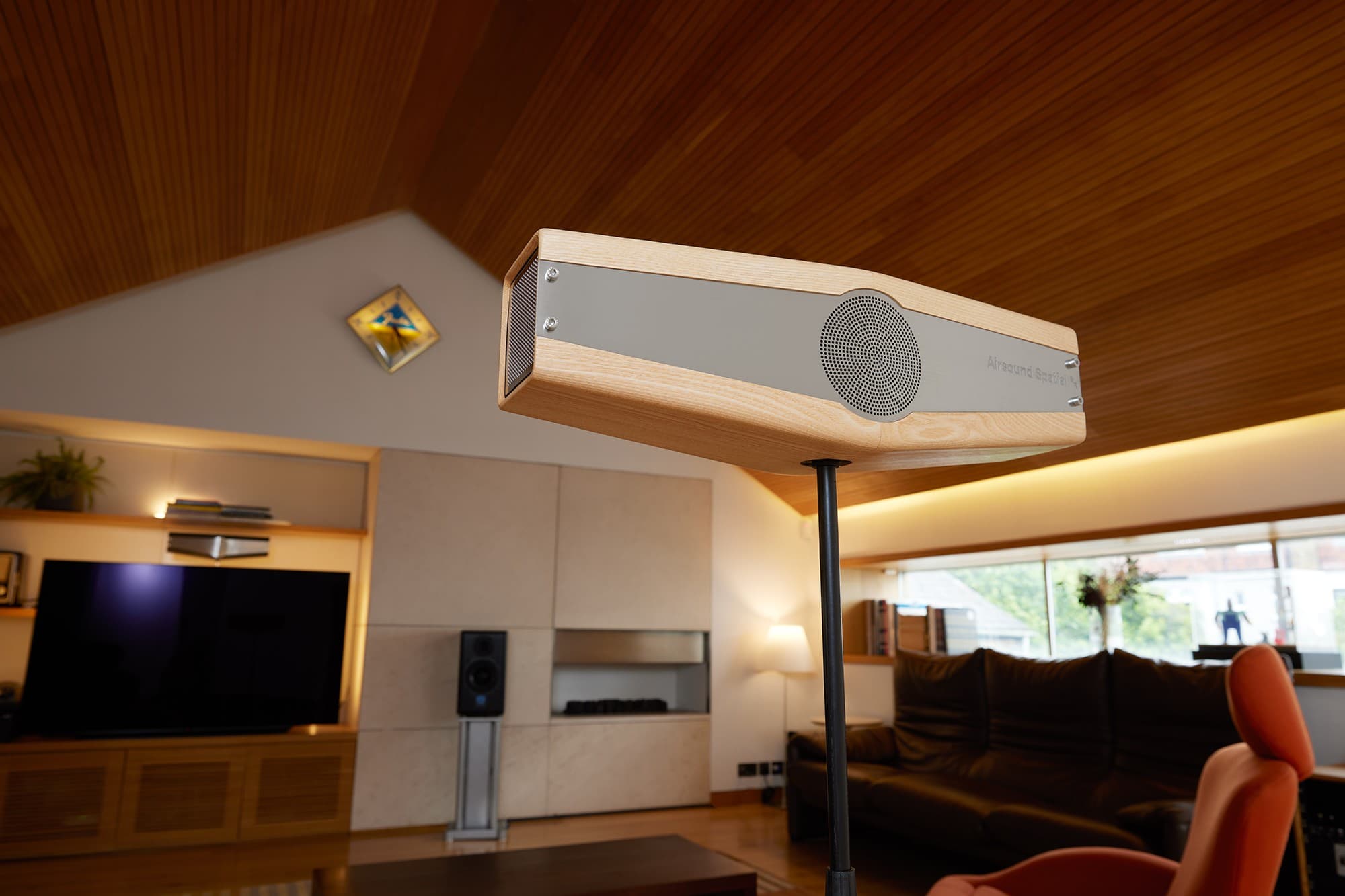
Airsound and Airsound Spatial
The thing that became Airsound started, fittingly, as an experiment with Blumlein’s own technique. In 2005 I was assisting with a Mid/Side recording of a choir alongside my father, Ted Fletcher, a recording engineer who had worked alongside Joe Meek and spent a working life building mixing consoles, radio stations, and investigating the behaviour of recorded sound.
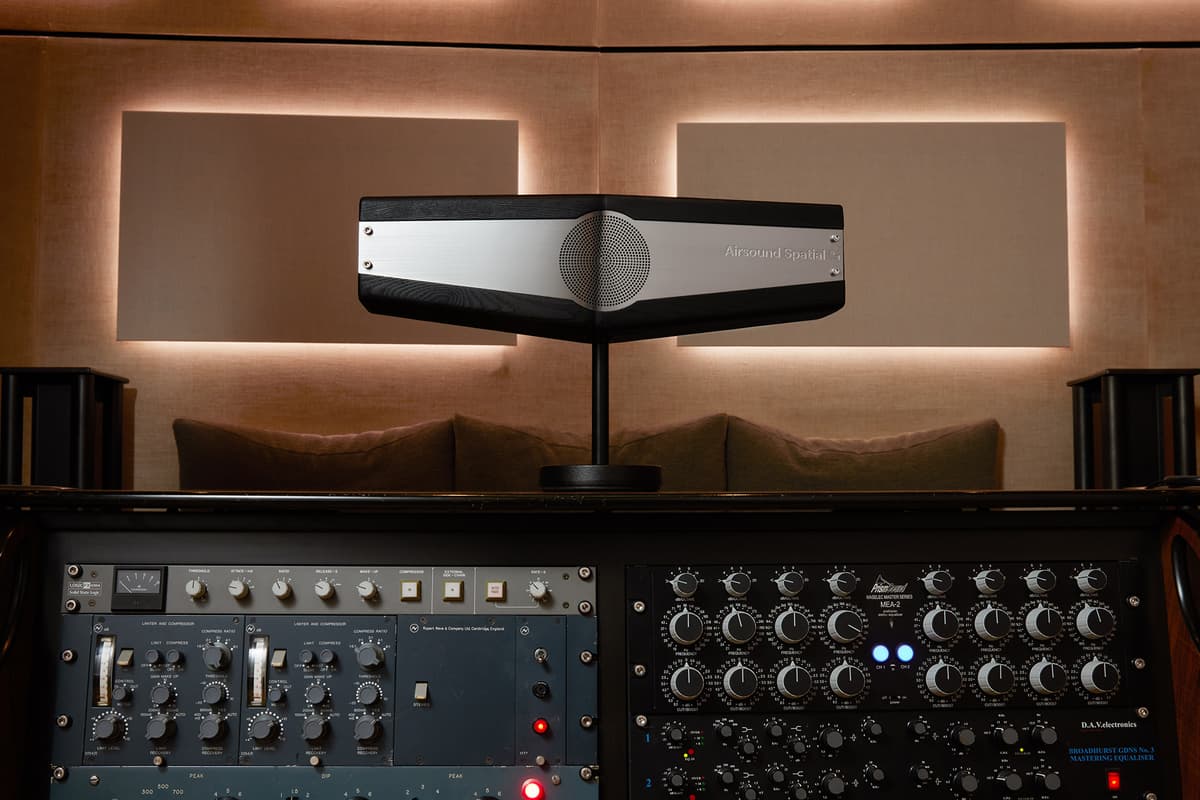
I tried something that I had visualised as we were returning home in the car from the recording (Ted was explaining to me the concept of Mid/Side and what the signals represented). My thought was to play the raw Mid/Side signals as they were captured: the Mid through a forward-facing speaker, the Side through side-firing speakers, with one reverse-wired to mimic the back of the microphone that captured the signal.
© Airsound Spatial
Black Speaker
Listening to it was startling. The sound field was cohesive. You could move around it and the sound was largely unchanged. It felt completely different to the stereo experience where you felt a pull to the sweet spot (due to the soundstage collapsing unless you were in precisely the correct position). The Mid/Side presentation of the spatial sound was largely unaffected by listening position.
That demonstration became the starting point for years of experiments between my father and me, exploring whether the same perceptual principles could be applied to everyday stereo reproduction. Airsound stereo was born.
What followed from the mid-2010s was a line of soundbars and Bluetooth speakers: devices using this approach to convey stereo from a single box to a wide listening area.
Although well received and fairly successful, the commercial reality was that stereo was not a problem to be solved. Airsound stereo remained a novelty on the fringes of audio technology.
Airsound Spatial: the same idea, scaled up
When immersive audio arrived, the question was simple and my brother, Guy Fletcher, asked me directly: could the same Airsound technology carry a full Atmos mix as opposed to just a stereo one?
Being a musician, producer and mixing engineer, Guy had a very useful test case: he had just finished creating the Atmos remix of Dire Straits' Brothers in Arms and had the depressing feeling (shared amongst Atmos engineers) that the incredible immersive sound he heard in the studio would remain locked in there. He asked me if Airsound could be made to translate more than stereo.
After going through all the rational reasons why it should be impossible, an idea formed. It was based on those years of working with Mid/Side systems and it was an idea I had mentally dismissed multiple times before. But this time I felt I had to explore and prototype it.
The idea was no longer Mid/Side. It was a spatial-first sound field built on similar perceptual principles to Airsound stereo. My initial assumption was that the sonic illusion would surely collapse – but it had to be explored and tested.
© Guy Fletcher
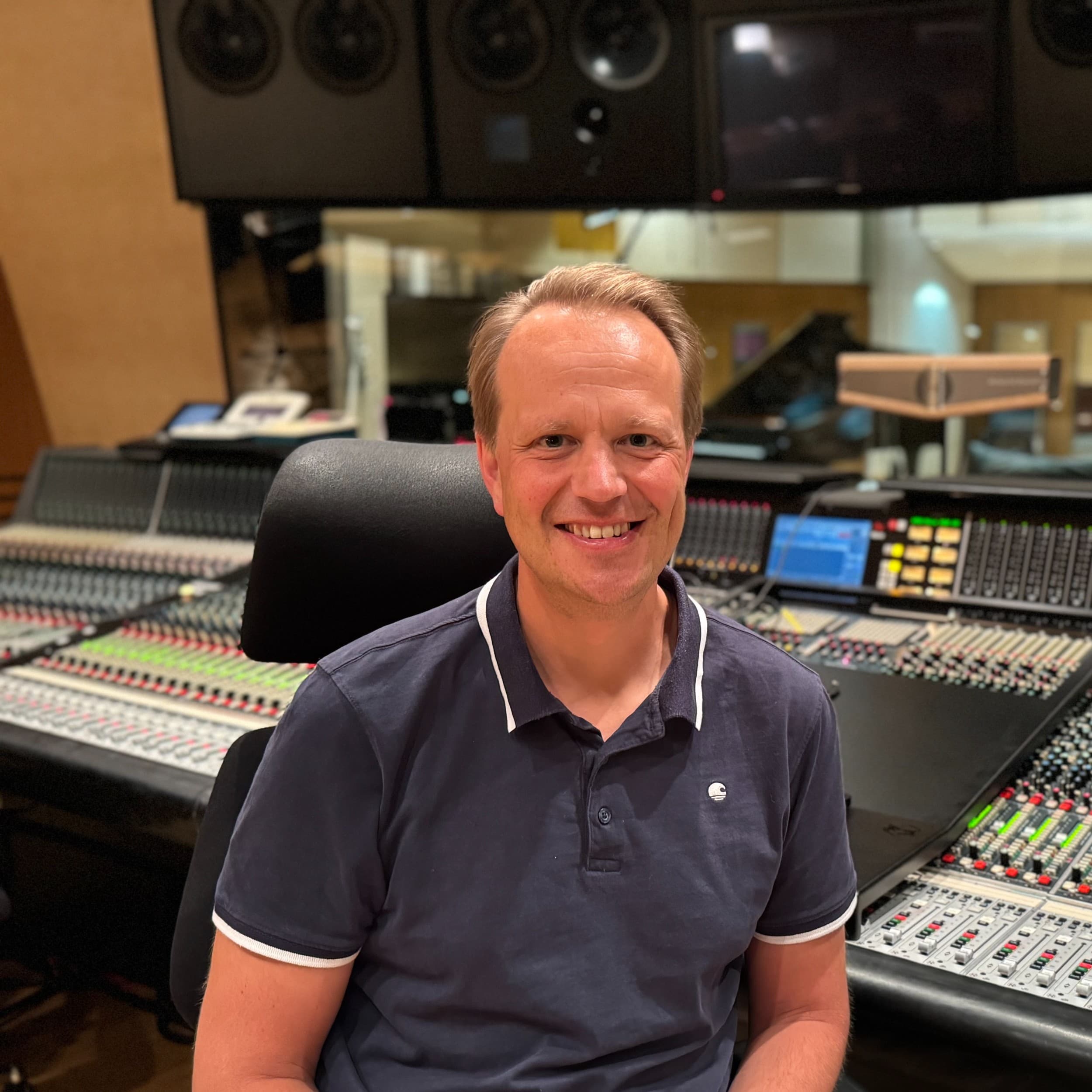
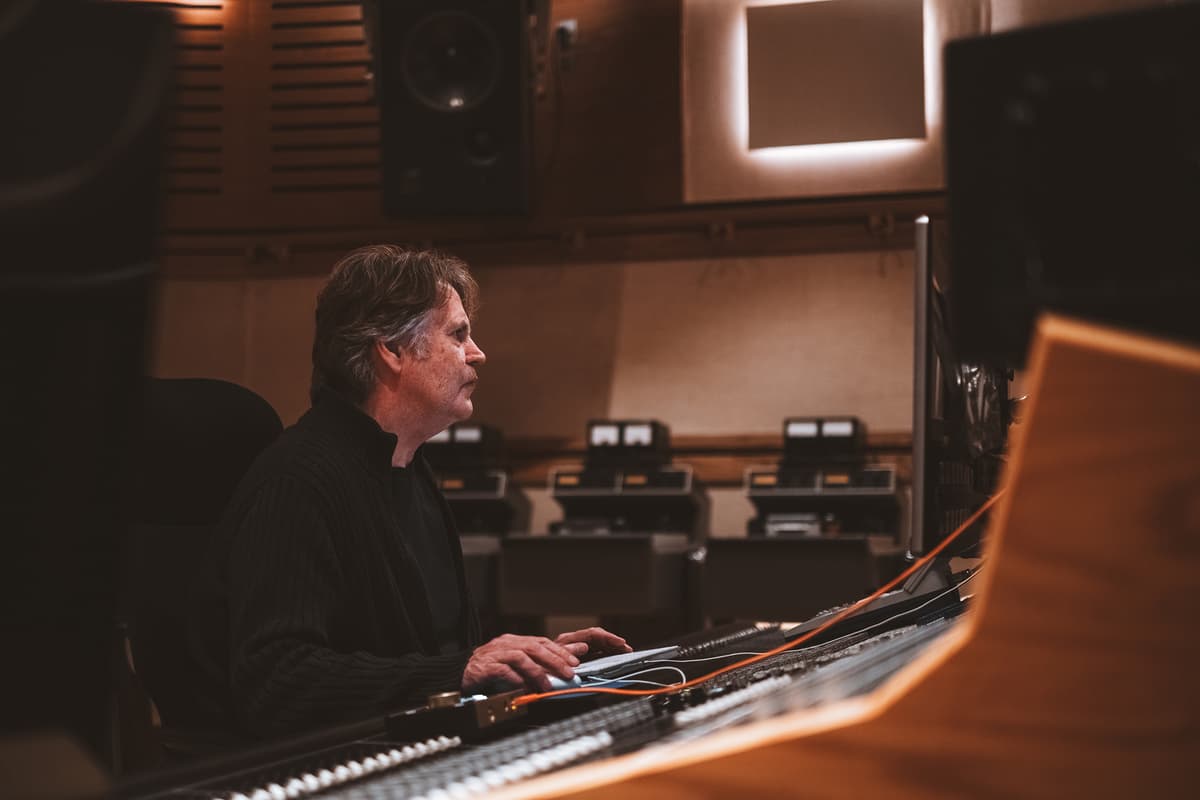
British Grove Studios April, 2024
I created a prototype three-speaker system and played it to my father and brother in my father’s lounge. Guy had been working at British Grove Studios and handed me an unreleased mix of the Guitar Heroes ‘Local Hero’ project – the most complex Atmos mix I have ever encountered. I played it, and Guy was immediately convinced. The spatial presentation held.
Having just left the studio where he had mixed the track in a 12-speaker ATC environment, Guy was hearing all the cues in all the right places and could hear the track communicating the music exactly as he had intended – and all from three small speakers in a lounge.
Taking it further
That moment didn't immediately begin a product. It began a line of enquiry. The question was no longer whether Mid/Side could improve stereo, but whether the same perceptual principles could be developed into a practical technology capable of delivering a perceptually consistent spatial sound field from relatively few speakers. That question has guided my work ever since.
To me, Mid/Side was no longer just a way of representing stereo. It had become a way of thinking about how a sound field could be constructed and steered perceptually. The challenge was turning that observation into a practical technology.
There are many subtleties to what makes this approach convincing. The journey has been a quest to figure these out and turn the solution into something new and usable in multiple environments. It feels remarkably consistent with the way Blumlein originally framed the problem.
The implications of this perceptual approach are profound. The input format (stereo, 7.1.4, or more) no longer defines the speaker system. Equally, the number and placement of speakers become far less critical.
Today, with time, research and development, Airsound Spatial software has become a technology that can address any number of speakers, in any configuration, and instantly arrive at an inspiringly realistic spatial presentation, using dipoles to steer sound selectively and perceptually fill gaps where there are no speakers.
Looking back, our approach – creating a software solution to be licensed for manufacture across multiple verticals and industries – is important. It means we can stay true to our goal: to make spatial audio more accessible.
That’s our aim. To help create emotionally meaningful, compellingly immersive experiences of spatial audio for more people, made by more diverse creators, and played back in more rooms and venues (of more different shapes and sizes) than ever before.
The popularity of 'spatial' demands accessibility
Of course, this is not a substitute for a properly calibrated discrete array when that is what the work demands. In careful listening, hard-panned, pin-point placements come through marginally less precisely than they would on a full reference array. But what this technology delivers, in rooms and in situations where a full array is simply impossible, creates a vital twist in the cost-benefit analysis of spatial audio.
Perhaps more encouraging than anything else has been the reaction from people who spend their lives listening critically. Airsound Spatial has quickly gathered the experiences and testimonies of a growing number of renowned engineers and artists working at the demanding end of immersive sound – among them Steven Wilson, Alan Meyerson and Phil Manzanera.
We read Blumlein differently now
The point of all this is not simply that an old idea turned out to be useful. It is the reminder that 'early' and 'wrong' are very different verdicts, and that we are often poor at distinguishing between them.
What fascinates me most about Blumlein's work is not that he anticipated a particular technology. It is that he started with perception. He asked what the listener needed to experience and then designed an engineering solution to achieve it.
Nearly a century later, I believe we are asking the same question again, but for a very different reason.
Spatial audio no longer needs proving. The formats exist. The content exists. The creative talent exists. What it now needs is practical, accessible playback that allows those experiences to exist outside the rarefied environment of carefully designed listening rooms.
Perhaps that is why Blumlein's patent suddenly feels so remarkably modern. The perceptual principles have barely changed. The challenge of applying them has transformed completely.
Whether Airsound Spatial ultimately proves to be part of that future is for others to judge. But I am increasingly convinced that the next significant advances in audio will not come from asking how to create better spatial content. They will come from asking how to allow more people to experience the remarkable content we already have.
When I first read Blumlein's 1931 patent, I read it as the birth of stereo. Today I find myself reading it rather differently. I see an engineer starting with human perception and working back to an engineering solution.
The technology has changed beyond recognition, but this approach to engineering feels as relevant today as it did in 1931.